
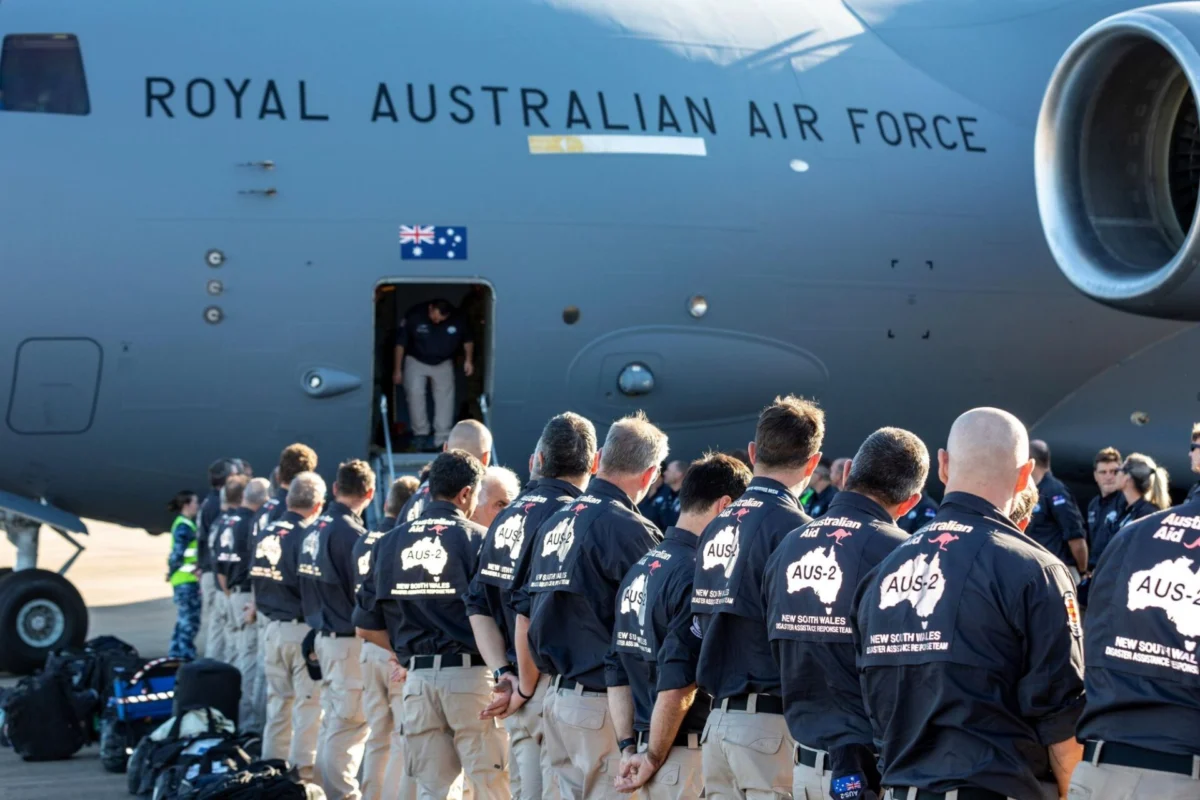
Australia’s fleet of eight Boeing C-17A Globemaster III aircraft is the backbone of the country’s strategic airlift capability.
These airlifters carry troops, supplies, combat vehicles, heavy equipment, and helicopters wherever they are needed around the world.
However, with only eight airframes in service, every aircraft pulled from operations for maintenance or upgrades has a direct impact on what the Australian Defence Force can do.
Keeping that fleet available while modernizing it at the same time is a constant balancing act for the Royal Australian Air Force (RAAF). It requires close coordination with Boeing, the United States Air Force, and a network of international partner nations
The upgrade problem
Australia acquired its first C-17A in 2006. As the fleet has aged, maintenance requirements have grown more complex, and demand for new capabilities has increased. According to the RAAF, the challenge is that many upgrades can only be installed by Boeing at its facility in Texas, which means aircraft have to be flown to the US and temporarily taken out of service.
To reduce that downtime, the RAAF has worked with Boeing and the USAF to bundle as much upgrade work as possible into the fleet’s scheduled six-yearly major overhauls in the US. Routine maintenance is carried out in Australia every six months, but the heavier work requires a trip overseas.
According to the RAAF, one approach that has paid off is installing hardware for capabilities that are still under development during those scheduled visits. That way, when the software is eventually ready, the update can be completed in Australia without sending the aircraft back to the US.
Squadron Leader Emily Hartley, who served as the RAAF’s logistics and sustainment manager for the C-17A at the USAF’s Program Office at Robins Air Force Base in Georgia from 2022 to 2025, helped drive that approach.
“A big win for us was taking the opportunity to install hardware for capabilities that were still in development,” she said.
Hartley was recently awarded a Conspicuous Service Cross in the King’s Birthday military honors list for her work during the posting.
Engines and corrosion
Engine preservation is another key piece of the puzzle. Working with Boeing, RAAF engineers have pushed initiatives to address corrosion risks in spare engines before they become a problem. The goal is to make sure replacement engines are safe, deliver maximum flying hours, and don’t create unnecessary work for maintenance crews back in Australia.
A spare parts pool shared by nine nations
The RAAF said that Australia doesn’t maintain its C-17A fleet in isolation. The aircraft operates within a global Virtual Fleet spares pool shared by nine international operators: Canada, the UK, NATO, Qatar, the UAE, India, Kuwait, and the US. This allows participating countries to draw on common parts and resources when needed.
Following Australia’s 2024 Defence Strategic Review, the RAAF worked with US Air Mobility Command and other partners to stress-test how that shared system would hold up in a crisis or conflict scenario. The effort led to more formalized policies for international logistics support in contingency situations and new multinational planning exercises designed to strengthen cooperation among C-17A operators.
“The goal was to make sure Australia was not only participating in that system, but that we were properly prepared for how it would operate under pressure,” Hartley said.
The C-17A underpins a wide range of ADF missions and is regularly used alongside allied forces. With just eight aircraft, maximizing availability is not just a logistics exercise, it directly affects Australia’s ability to respond when it matters.