
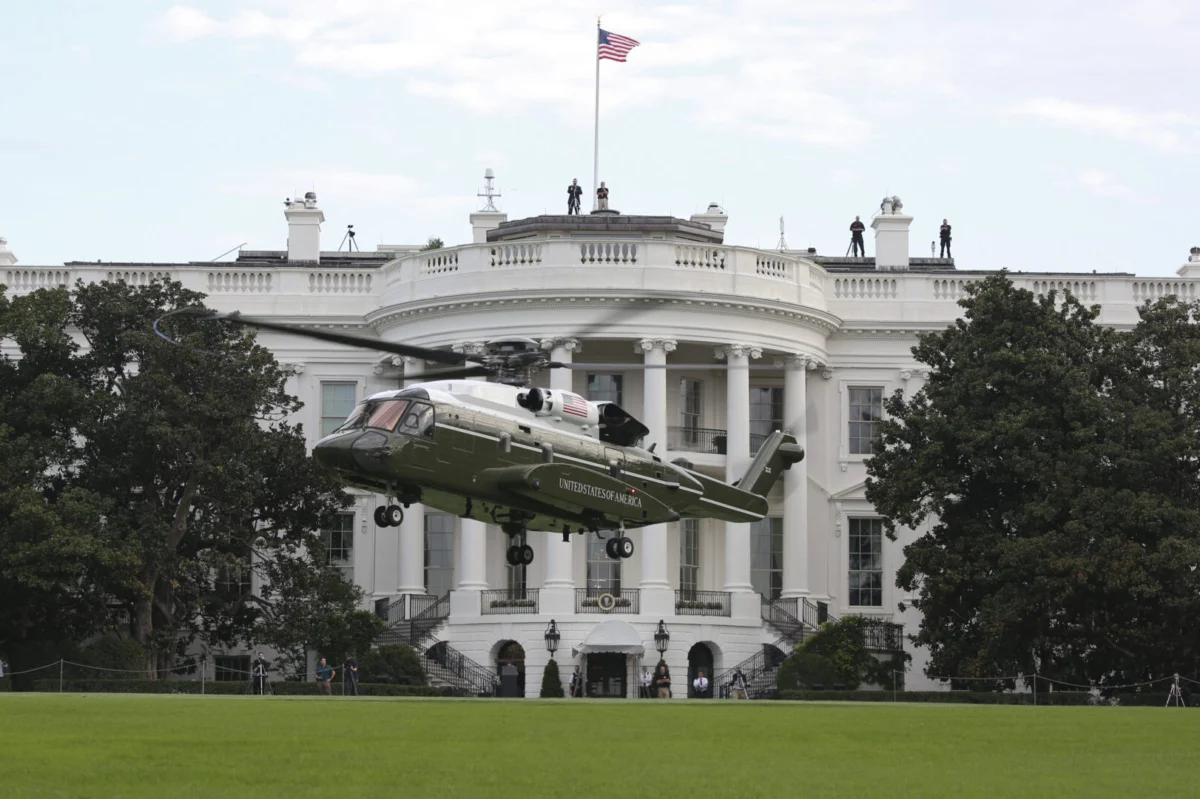
US President Donald Trump led reporters onto the White House South Lawn on August 19, 2026, to show off a partly built granite helicopter landing pad, signing his name on one of the slabs during the tour.
The pad exists because the Sikorsky VH-92A Patriot, the helicopter the US Navy bought to take over the Marine One mission, has never met a key performance requirement to land without damaging the surface beneath it.

The US Government Accountability Office (GAO) first reported the shortfall in April 2018 and has tracked it since. In an April 2020 assessment, the GAO said the Navy found during a September 2018 training event that the VH-92A’s exhaust had damaged a landing zone.
Program officials told the GAO that the event did not represent a typical operational scenario because the lawn was exposed to exhaust for longer than it would be under normal operating conditions.
The GAO listed three candidate fixes then under study: changes to operational procedures, changes to the helicopter, and lawn surface treatments. Sikorsky flight-tested a prototype auxiliary power unit exhaust deflector in March 2020.
New Marine One entered service… but not on the South Lawn
The VH-92A is a derivative of the commercial S-92A, flown by Marine Helicopter Squadron One (HMX-1) alongside the VH-3D Sea King and VH-60N White Hawk it was bought to replace. The Navy procured 23 airframes, 21 operational aircraft, and two engineering development models. The US Marine Corps declared initial operational capability in December 2021.
The Pentagon’s Director, Operational Test and Evaluation (DOT&E) assessed the type as operationally effective and suitable in a January 2023 report, and the White House Military Office has been retiring the legacy fleet under a phased, event-driven transition plan. South Lawn arrivals and departures have remained with the older helicopters.
The fleet has drawn separate scrutiny in Washington. The Federal Aviation Administration (FAA) is examining an August 4, 2026, loss of separation involving Marine One and an Embraer E175 near Ronald Reagan Washington National Airport (DCA).
Who is paying for the $6M helipad?
Trump said in July 2026 that Sikorsky would cover the full cost of the pad, which he put at $5 million to $6 million. On August 19, 2026, he described Sikorsky as paying much of the bill, with additional donations from others including himself. A Lockheed Martin spokesperson said in a statement to ABC News that the company’s contribution was made to the National Park Service.
Trump said the finished pad would be able to accommodate any helicopter in the world and confirmed he had ordered earlier work to be torn out so the structure could be raised to level it, adding about a week and a half to the schedule.