
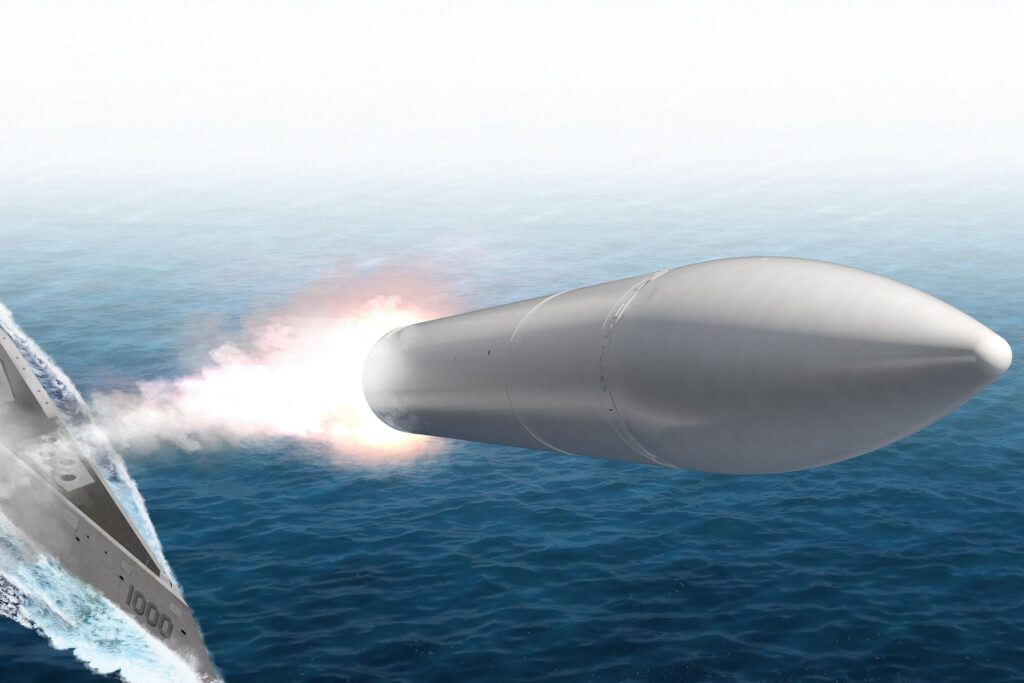
The UK Ministry of Defence has awarded a £20 million ($27 million) contract to Lockheed Martin UK to build a hypersonic target vehicle, giving British missile defense programs something realistic to shoot at for the first time in more than a decade.
The contract, announced on July 22, 2026 during the Farnborough International Airshow, covers Project Bowline. Lockheed Martin UK will design, manufacture, qualify and test a vehicle intended to represent high-speed threats traveling at speeds above Mach 5, with a live flight demonstration planned for 2027 at the MOD Hebrides Range, the range complex off Scotland’s western coast used for UK guided weapons trials.
The UK MOD has disclosed no propulsion system, launch method, altitude, range, or maneuver envelope. That leaves open whether the vehicle will represent a boost-glide weapon, an air-breathing hypersonic cruise missile, or a simpler high-speed test body.
What the ministry has said is what the target is for. The program will culminate in a first flight demonstration enabling the future assessment and qualification of next-generation missile defense systems, including sensors and interceptors. Detecting, tracking and engaging a maneuvering vehicle at those speeds is the harder half of the counter-hypersonic problem, and it cannot be validated against simulation alone.
The contract was placed through the UK MOD’s Science and Technology Oriented Research and Development in Missile Defence (STORM) framework, managed by the UK Missile Defence Centre. It will support around 63 jobs in Bedfordshire and inject £2 million ($2.7 million) into the supply chain, with more than a third going to UK small and medium-sized enterprises.
An AUKUS contribution
Project Bowline sits under the AUKUS Pillar 2 Hypersonic Flight Test and Experimentation (HyFliTE) Project Arrangement, with the US and Australia contributing flight test expertise and technical peer review. The HyFliTE arrangement was signed in November 2024 and envisages a series of trilateral test campaigns before the end of the decade.
National Armaments Director Rupert Pearce said the program would help the UK stay ahead of rapidly evolving hypersonic threats, framing it as both an arsenal and an industrial investment. London is also pursuing a sovereign hypersonic cruise missile for entry into service by 2030 and committed £1.4 billion to the Stratus program with France and Italy on July 8, 2026.
Across the Channel, two rival European Defence Fund efforts are competing to design an endo-atmospheric hypersonic interceptor: HYDIS², led by MBDA, which entered its concept phase in May 2024, and EU HYDEF, coordinated by Spain’s SMS with Diehl Defence as technical lead.
HYDIS² settled on a solid-propellant concept validated by its steering committee on July 10, 2026, and will spend its remaining year maturing technologies toward experimental proof of concept. The EDF plans to fund only one of the two under its 2026 work program, with €100 million ($117 million) at stake.