
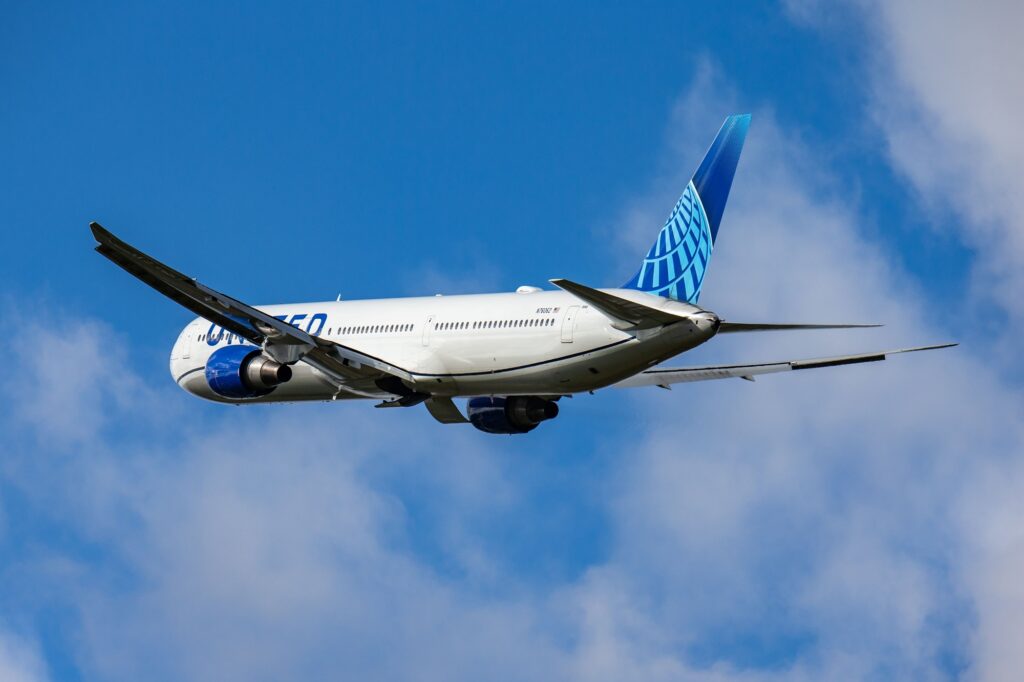
A United Airlines flight from Newark to Spain returned to Newark Liberty International Airport (EWR) on May 30, 2026, after the name of a Bluetooth device on board triggered a security concern.
United Flight 236 departed Newark at about 18:00 local time for Palma de Mallorca, Spain, and landed back at Newark at 21:37, according to the Port Authority of New York and New Jersey. The Boeing 767 had 190 passengers and 12 crew members onboard.
Air traffic control audio indicated that the issue involved the name of a discoverable Bluetooth device on the aircraft. In the recording, a controller said a passenger had a Bluetooth device with a “certain four-letter word” as its device name, requiring security personnel to inspect the aircraft, including the cargo area.
Flight tracking data showed the aircraft turning around while over the Atlantic several hundred miles from EWR and using the 7700 emergency squawk code.
Passengers posting online said the crew repeatedly instructed passengers to turn off Bluetooth devices during the flight. One passenger said the crew told the cabin that two Bluetooth devices remained active after multiple announcements.
The crew turned the aircraft back after communicating with United’s operations center in Chicago.
After the flight returned to Newark, passengers evacuated the aircraft via airstairs while Port Authority police searched it. Passengers then went through TSA and Customs and Border Protection screening before boarding a replacement aircraft with a new crew.
The replacement flight departed early on May 31 and later arrived in Palma de Mallorca.
The incident follows several recent cases in which wireless device names have triggered security responses on commercial flights.
In January 2026, a Turkish Airlines Airbus A321 operating from Istanbul to Barcelona landed at Barcelona-El Prat Airport after a passenger allegedly used a mobile hotspot name containing a bomb threat. Spanish authorities inspected the aircraft and found no threat. Turkish Airlines said legal action would follow once the passenger responsible was identified.
On May 10, 2026, a KLM flight from Málaga to Amsterdam was delayed for several hours after a Wi-Fi hotspot name indicated there was a bomb onboard. KLM said it treated the threat seriously and coordinated with local authorities.