
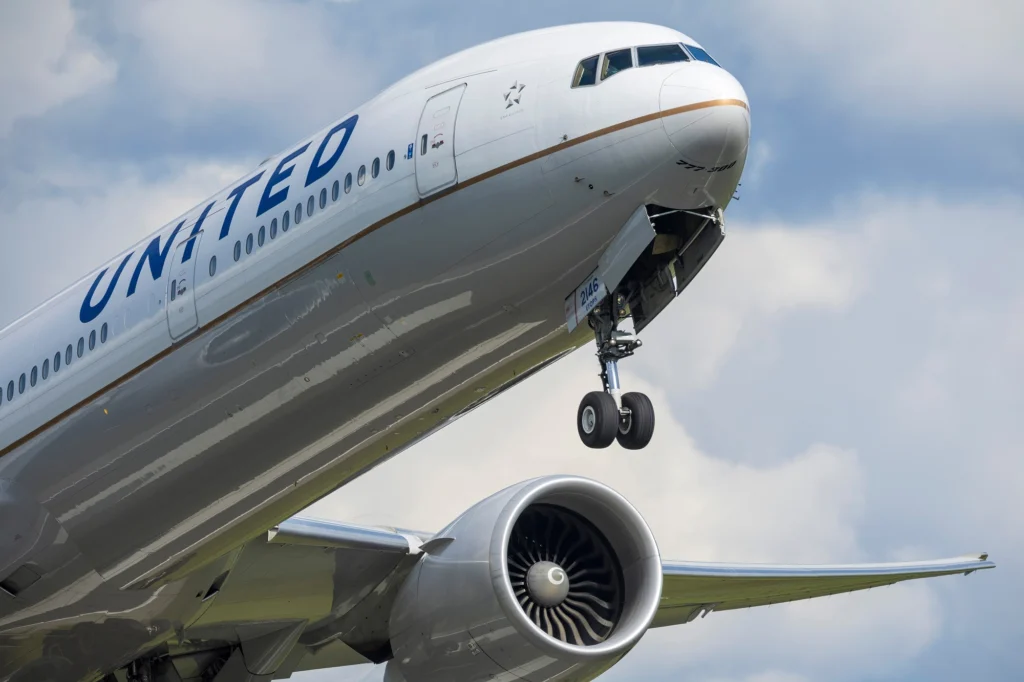
United Airlines operated its first Starlink-equipped transatlantic widebody flight on June 22, 2026, when Flight 14 departed Newark Liberty International Airport (EWR) bound for London-Heathrow Airport (LHR).
The flight is being operated by a Boeing 777.
Passengers on the flight are able to use Starlink-enabled Wi-Fi, which connects through SpaceX’s low-Earth-orbit satellite network.
United said Starlink Wi-Fi is free for MileagePlus members.
The Newark-London flight marks a new stage in United’s Starlink rollout, which began with regional aircraft before moving into the airline’s mainline and widebody fleets.
United said it has about 400 aircraft equipped with Starlink so far.
The airline plans to install Starlink on up to 60 widebody aircraft by the end of 2026. United expects its entire widebody fleet to be equipped by next summer.
“United is changing what it means to stay connected on an overseas flight,” David Kinzelman, United’s Chief Customer Officer, said. “Starlink offers the same fast, reliable internet access and connectivity we’re all used to at home, delivered in the air at 35,000 feet, flying anywhere around the world.”
Kinzelman said the technology could change the inflight experience for both customers and employees.
United announced its Starlink partnership in 2024 and has moved faster than originally expected to bring the service to aircraft across its fleet.
The airline received FAA approval in 2025 to use Starlink on Embraer 175 regional jets and later on Boeing 737-800 aircraft.
United said last year that it planned to prioritize Starlink installations on Boeing 777 routes from hubs including Newark, Washington Dulles, Houston and San Francisco to long-haul destinations such as London, Paris, Frankfurt, Zurich and Tokyo.
The move comes as airlines continue to treat inflight connectivity as part of the core passenger experience rather than an optional extra.
Starlink’s low-Earth-orbit network is designed to reduce latency compared with older satellite internet systems. For passengers, the goal is to make inflight Wi-Fi feel more like a connection at home or in the office, including for streaming, messaging and work.