
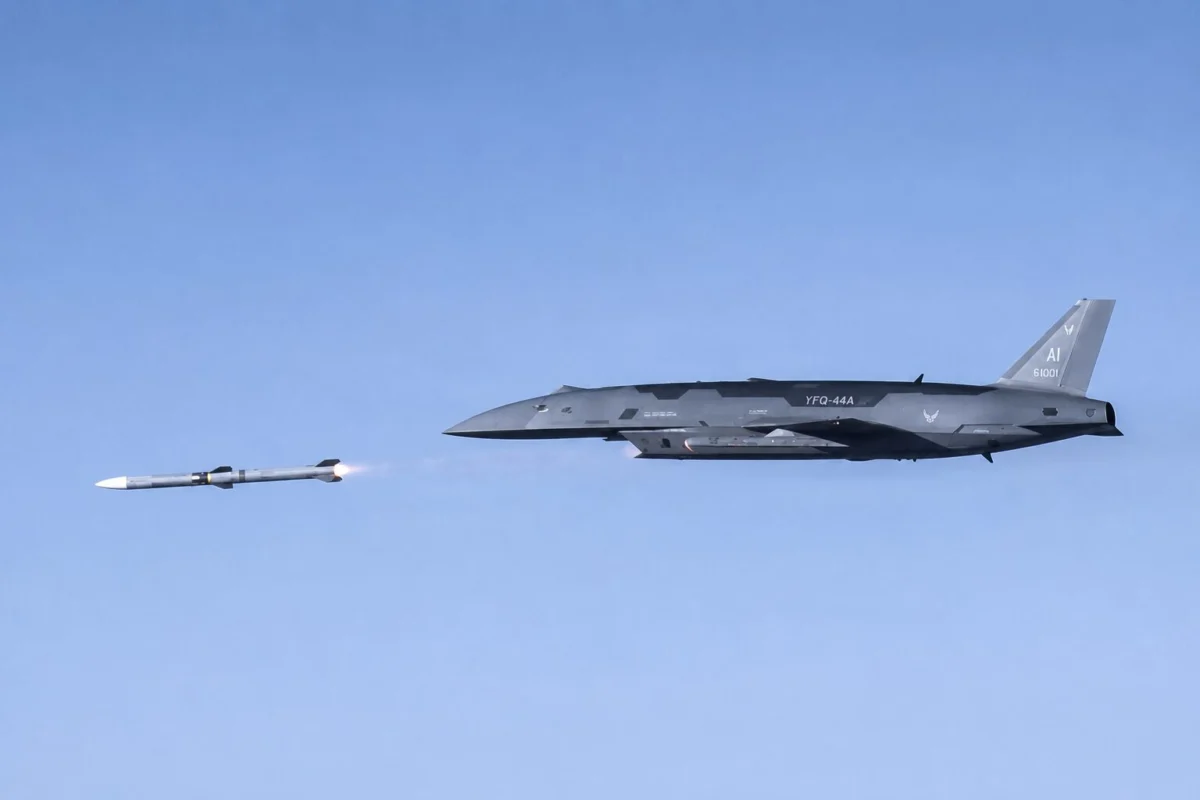
The US Air Force has fired a live air-to-air missile from a jet-powered combat drone for the first time, marking a major step in the development of uncrewed aircraft designed to fight alongside crewed warplanes.
Anduril’s YFQ-44A fired an AIM-120 Advanced Medium-Range Air-to-Air Missile at a target in restricted airspace over California’s Mojave Desert, the Air Force said on July 15, 2026.
The Air Force said the YFQ-44A carried out the targeting and launch sequence on its own, while a human operator retained control over the decision to fire.
“CCA will not autonomously employ weapons,” the Air Force said. “The decision to release any weapon system remains exclusively with a human operator, who maintains command and control of the platform at all times.”
The test was conducted with the 412th Test Wing’s Air Dominance Combined Test Force, which includes military personnel, government employees and contractors.
Testing began earlier in 2026 with inert captive-carry flights designed to collect handling data while the YFQ-44A carried the weapon. Later evaluations focused on the data link between the aircraft and missile and whether commands from the operator were executed correctly in a simulated environment.
“Moving from inert carriage earlier this year to this weapon release demonstrates program maturity, allowing us to validate our digital integration models with actual data,” Gen. Dale White, the Department of War’s Direct Reporting Portfolio Manager for Critical Major Weapon Systems, said.
The Air Force did not say whether the AIM-120 physically struck or destroyed an aerial target. It described the target as digital and the event as live-fire testing, meaning the missile itself was launched but the engagement relied on a simulated target track.
Air Force Chief of Staff Gen. Ken Wilsbach called the test “an important next step” in the Collaborative Combat Aircraft program.
“We’re one step closer to delivering capabilities to the warfighter,” Wilsbach said.
YFQ-44A developed as autonomous fighter escort
The YFQ-44A, originally known as Fury, is one of two aircraft selected for the first phase of the Air Force’s Collaborative Combat Aircraft (CCA) program.
The service is also testing General Atomics Aeronautical Systems’ YFQ-42A.
Both are intended to operate with crewed combat aircraft and carry out missions including reconnaissance, electronic warfare and air-to-air combat. The Air Force says the relatively affordable aircraft could fly ahead of crewed fighters into heavily defended airspace, reducing the risk to pilots.
Anduril’s aircraft carries weapons externally under its wings. The General Atomics design uses an internal weapons bay, a design that can reduce radar signature.
The Air Force has described the aircraft as semi-autonomous rather than fully autonomous. They are expected to handle many flight and mission tasks with limited direct control, but humans will remain in the loop.
The YFQ-44A weapons test follows the Air Force’s decision to move both competing aircraft into a new phase of development and acquisition.
The service has said it wants to field CCA faster and in larger numbers than a traditional crewed fighter program, using shorter development cycles and software that can be updated as threats change.
“This latest milestone continues the rapid pace of developmental testing for safe and effective CCA operations,” the Air Force said.
The Air Force has not disclosed when the YFQ-44A conducted the missile launch or when it expects the aircraft to enter operational service.