
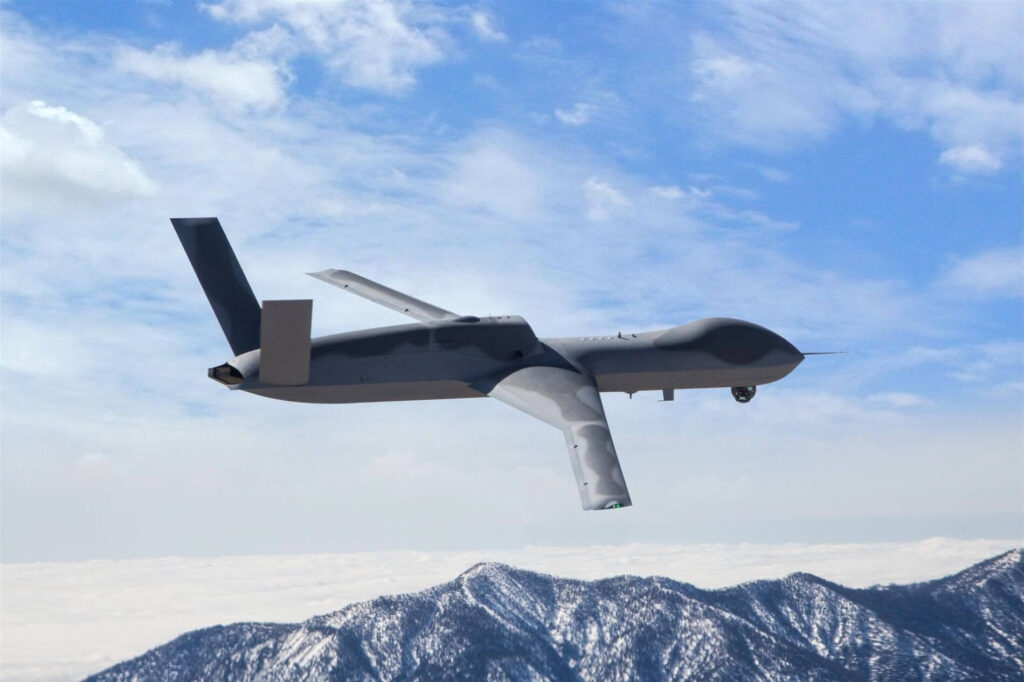
The US Air Force has conducted a live demonstration of manned-unmanned teaming, linking a crewed F-22 Raptor with an uncrewed MQ-20 Avenger in a flight test designed to explore how autonomous aircraft can support frontline fighters in future operations.
The exercise took place on February 23, 2026, at Edwards Air Force Base in California, pairing an F-22 flown by a USAF pilot with an MQ-20 operating as an autonomous system rather than as a remotely piloted aircraft. The test was conducted in collaboration with General Atomics Aeronautical Systems, which supplied the Avenger and the autonomy software used during the mission.
According to the US Air Force and GA-ASI, the F-22 pilot used a tactical data link and autonomy interface to issue mission-level commands to the MQ-20, including waypoint navigation, patrol patterns and simulated engagement tasks. The Avenger responded by executing those tasks autonomously after receiving high-level instructions.
Manned-unmanned teaming concept
The US Air Force emphasizes that it does not intend for fighter pilots simply to transition into drone operators in the cockpit. Instead, manned-unmanned teaming concepts aim to enable crewed aircraft to command uncrewed systems at the tactical level, treating them as cooperative assets rather than remotely flown platforms.
The MQ-20 serves as a surrogate platform for these experiments. Although not slated for operational service as a Collaborative Combat Aircraft (CCA) in its current design, its jet-powered performance, payload capacity, and autonomy interfaces make it useful for exploring how autonomy, sensors, and data links might function in advanced air combat scenarios.
The F-22’s involvement is noteworthy because, as a fifth-generation stealth fighter that predates current autonomy programs, it was not originally designed to control uncrewed teammates. Demonstrations such as this are focused less on immediate deployment and more on understanding how legacy fighters could operate alongside future CCAs.
Legacy fighters and AI experiments
In recent years, the US Air Force has adapted several legacy platforms to experiment with autonomy and AI. Under the VENOM program, multiple F-16 Fighting Falcons are being modified into autonomy testbeds to evaluate flight-control software and combat decision-making ahead of broader trials.
In Europe, Swedish firm Saab has flown a Gripen E fighter with Helsing’s Centaur AI agent capable of executing complex manoeuvres and cueing missions in beyond-visual-range scenarios, while France has repurposed its Mirage 2000D RMV as a testbed for combat AI and human-machine teaming concepts that could inform future systems.