
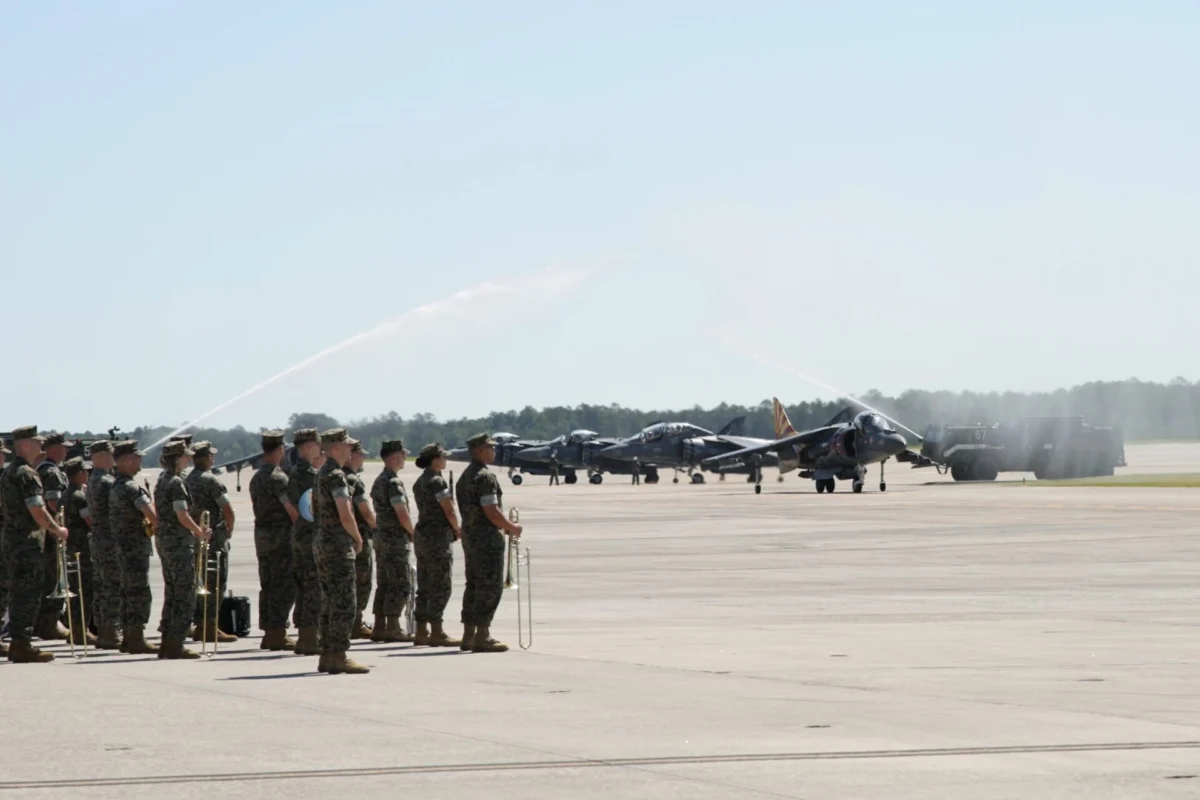
The US Marine Corps flew its final AV-8B Harrier II on June 3, 2026, concluding more than four decades of combat service for the jump jet. Days earlier, Spain confirmed that it would take five of the retired US aircraft to keep its own Harrier fleet flying.
The retirement was marked with a sundown ceremony at Marine Corps Air Station Cherry Point, North Carolina, held from June 1 through June 5, with the final flight on June 3. The last operational unit, Marine Attack Squadron 223 (VMA-223), returned from its final deployment on May 20, 2026, after a cruise with the 22nd Marine Expeditionary Unit aboard the amphibious assault ship USS Iwo Jima in the US Southern Command area.
The move runs a year ahead of schedule, as the previous aviation plan had indicated that the type would operate into 2027. The US Marine Corps is consolidating on the Lockheed Martin F-35B and expects to field 205 F-35B and 56 F-35C jets by the end of 2026, within a program of record of 420 aircraft. The Harrier fleet, which peaked at roughly 280 jets, had fallen to 87 aircraft by 2025.

From the Cold War to the Gulf
The Harrier can be traced back to the British Hawker Siddeley Harrier, the first operational V/STOL aircraft, whose Hawker P.1127 prototype first hovered in untethered flight around 1960. The AV-8B Harrier II, an Anglo-American redesign led by McDonnell Douglas with British Aerospace, made its first flight on November 5, 1981, before entering service in January 1985. An estimated 337 airframes were built before production ended in 2003.
Able to fly from amphibious assault ships and austere sites without a runway, the type undertook more than 3,300 sorties in the 1991 Gulf War, when General Norman Schwarzkopf counted it among the conflict’s most important weapons. It later saw combat over Afghanistan, Iraq and Libya.
The Harrier’s final operational deployment came in the Caribbean, where it flew ahead of the January 2026 capture of Venezuelan President Nicolás Maduro. It sat out the US air campaign against Iran in early 2026 as it wound down toward retirement
Five jets bound for Spain
According to InfoDefensa, which first reported the transfer, the Spanish Navy will receive five complete former US Marine Corps AV-8B Harrier IIs, delivered disassembled for logistical reasons rather than as loose spares, to feed the parts supply that keeps its fleet airworthy. To reach 2032 with the current aircraft, Spain plans to buy spares from both the United States and Italy, the type’s other two operators.
An earlier plan was dropped to ship the jets aboard the flagship Juan Carlos I during its voyage to the United States for the 250th anniversary of American independence. It is not yet clear whether the disassembled aircraft will reach Spain aboard another navy vessel or a commercial cargo ship.
Madrid’s STOVL dilemma
The government of Prime Minister Pedro Sánchez has ruled out an F-35B purchase, having earlier weighed a mixed F-35A and F-35B order before prioritizing the Eurofighter and the Future Combat Air System. That leaves no fifth-generation replacement for the only fixed-wing jets that the navy can fly from a ship, and the service has signaled its intention to hold on to the capability.
Admiral Gonzalo Sanz Alisedo, second in command of the naval staff, told InfoDefensa that keeping embarked fixed-wing aviation is critical and that the Spanish Navy is not prepared to lose it. Secretary of State for Defense Amparo Valcarce told the Senate Defense Committee that spare-parts purchases and a stronger national industrial base would keep the Harriers operational until 2032, with Airbus contracted to overhaul the fleet and cleared to use secondhand components in flight condition.
With the US Marine Corps having retired it and the Italian Navy planning to run about half a dozen jets from the carrier Cavour for another two to three years, Spain is set to become the world’s last Harrier operator by 2028 or 2029. A new carrier, replacing the Juan Carlos I, is not expected before 2040.