
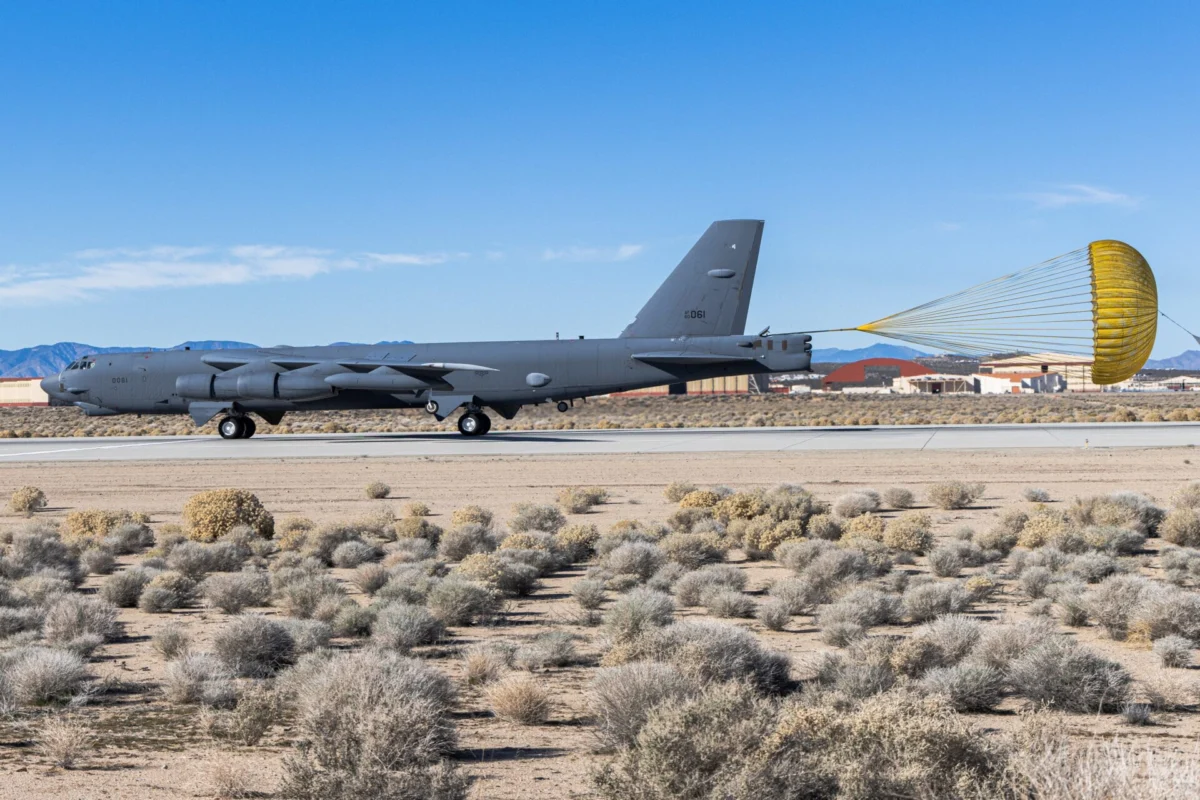
A US Air Force B-52 Stratofortress has completed its ferry flight following the installation of a new active electronically scanned array (AESA) radar, marking another step in the service’s broader effort to modernize the long-serving bomber fleet.
The aircraft flew from Boeing’s San Antonio facility to Edwards Air Force Base, California, on December 8, 2025. The mission was carried out by crews from the 49th Test Evaluation Squadron at Barksdale Air Force Base and the 419th Flight Test Squadron at Edwards.
According to the USAF, the upgraded bomber will now enter a new series of ground and flight evaluations scheduled through 2026.
Radar upgrade moves into test campaign
The Raytheon AN/APQ-188 AESA radar, supplied by Raytheon, replaces the B-52’s legacy AN/APQ-166 mechanically scanned system. The new sensor is intended to provide improved navigation, mapping, and targeting accuracy, as well as all-weather performance, while reducing maintenance demands.
The B-52 Radar Modernization Program (RMP) is one of the most significant system changes undertaken on the B-52 in decades.
With the ferry flight complete, the upgraded aircraft will undergo an expanded test program at Edwards AFB. Evaluations will assess radar performance, integration with existing systems, and operational suitability ahead of broader fleet rollout.
Modernization aims to keep the B-52 in service for nearly a century
The wider upgrade program includes new avionics, updated mission systems, and a complete re-engining effort. As part of the Commercial Engine Replacement Program (CERP), the USAF has selected the Rolls-Royce F130 to replace the Pratt and Whitney JT3D, known in military service as the TF33, which has powered the B-52H since the early 1960s.
These modifications are expected to deliver improved range, fuel burn, reliability and maintainability. The redesignated B-52J is projected to enter service around 2033, extending the bomber’s operational life into the 2050s.
The modernization effort ensures that the B-52, in continuous service since 1955, remains a central element of US long-range strike capability even as new platforms such as the B-21 Raider begin to enter service.