
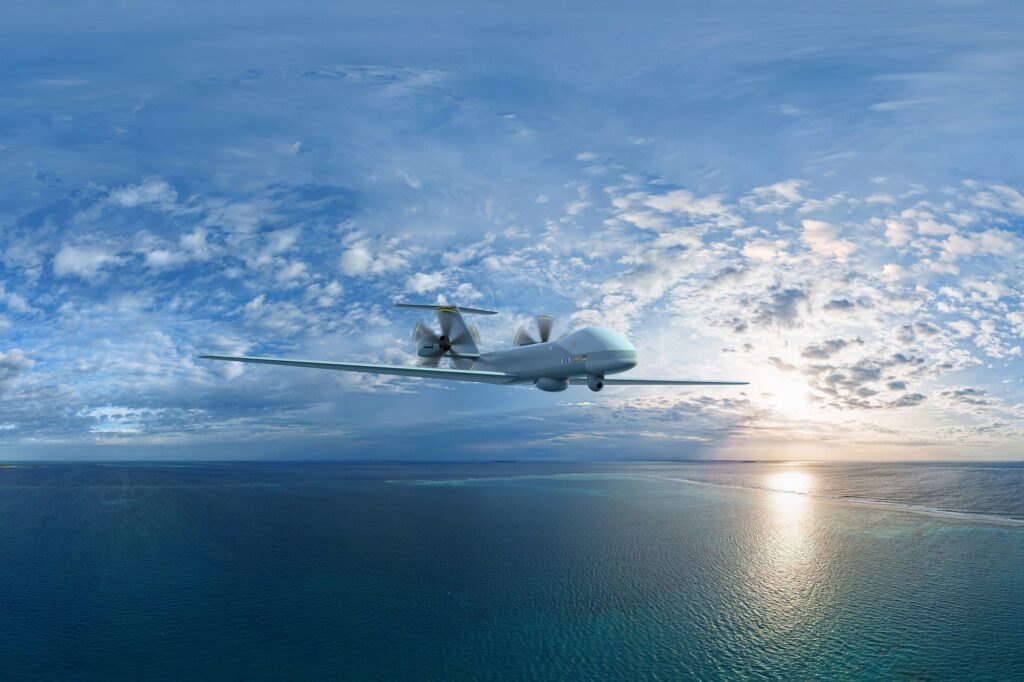
Airbus has signed a memorandum of understanding (MoU) with Kawasaki Heavy Industries to study a Japanese anti-submarine warfare (ASW) version of the U950 Eurodrone, the European remotely piloted aircraft system in which Tokyo has held observer status since 2023.
Under the MoU, Airbus and Kawasaki will work up options for the design, development and commercialization of a maritime variant. That covers defining possible configurations, integrating Japanese sensors and effectors, and identifying workshare for Japanese industry during production and sustainment. Airbus said the aim is to ensure Japan could operate the aircraft sovereignly and without restrictions, should it decide to acquire it.
A new uncrewed layer for Japan’s submarine hunt
The Eurodrone will be able to carry sonobuoys and torpedoes and loiter for long periods, which Airbus argues suits the surveillance of the large maritime zones around Japan. The drone would complement, rather than replace, Tokyo’s crewed assets. The Japan Maritime Self-Defense Force flies the domestically built Kawasaki P-1, which it has deployed to track suspected Chinese submarines near its southern islands.
Japan is no stranger to uncrewed maritime surveillance. Its Coast Guard already operates the General Atomics MQ-9B SeaGuardian, generally seen as the Eurodrone’s closest competitor. Airbus is pitching its system as a higher-payload alternative that can carry anti-submarine weapons, not sensors alone.
An export boost for a program in flux
Airbus describes the Eurodrone as a four-nation program of Germany, France, Italy and Spain, managed by the Organisation for Joint Armament Cooperation (OCCAR), with India also holding observer status.
France left Eurodrone acquisition funding out of its revised military programming law in April 2026, prompting reports of a planned exit, but Airbus said at the ILA Berlin air show in June 2026 that Paris remains a committed partner and the program still has four nations. Broadening that base with an export customer such as Japan would help further underpin the effort.
First flight is now scheduled for 2029, a slip from an earlier 2027 target. Airbus says the aircraft can carry a mission payload of up to 2.3 tonnes and stay airborne for as long as 40 hours. The company added that work on a Japanese variant could later feed into European naval versions of the drone.