
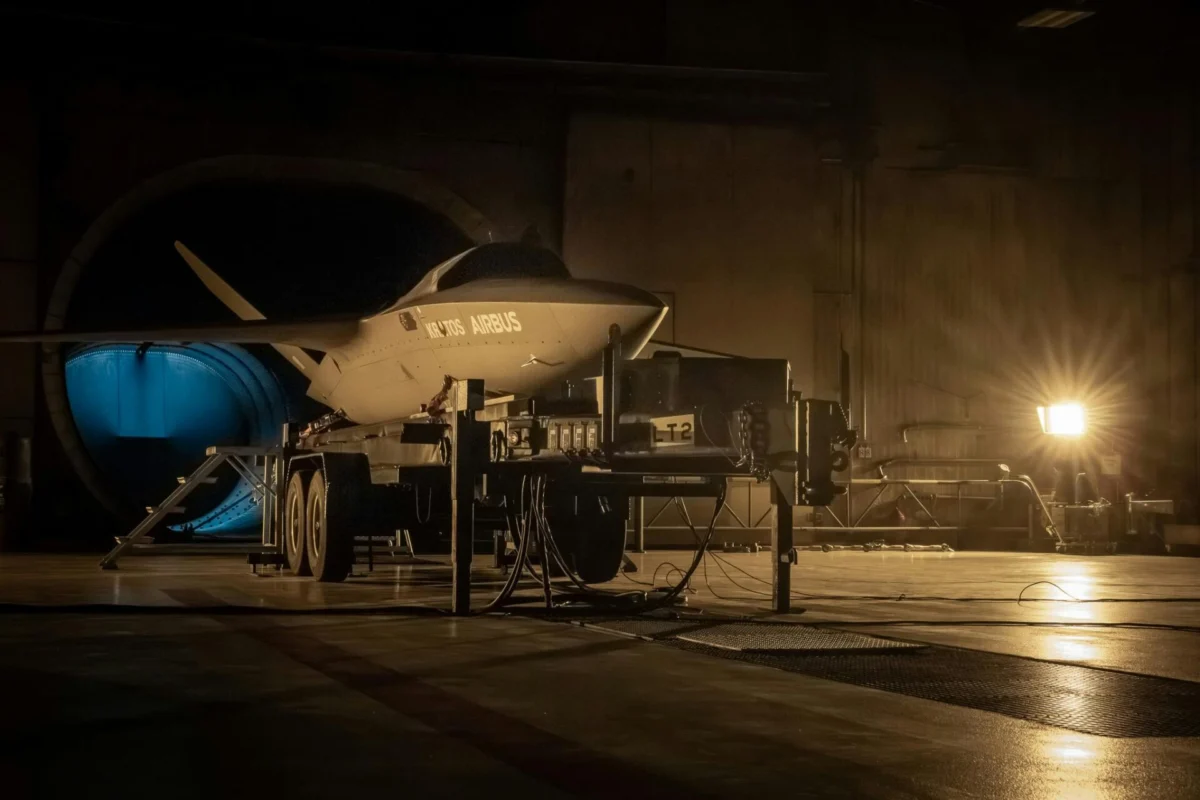
Airbus said it is preparing the first two Kratos-built Valkyrie uncrewed combat aircraft for flight testing in Germany, amid Berlin’s efforts to field a reusable combat drone capability for the Luftwaffe by 2029.
The company announced on March 13, 2026, that the two aircraft are being readied in Manching, near Munich, for their first flights later this year with a European mission system installed onboard.
The aircraft, sourced from US partner Kratos Defense & Security Solutions, will be equipped with Airbus’ Multiplatform Autonomous Reconfigurable and Secure, or MARS, mission system. Airbus is pitching the system as a sovereign European layer built on top of a proven US-designed air vehicle, an approach meant to accelerate delivery while preserving control over key mission functions.
Airbus said MARS includes an AI-enabled software layer called MindShare, designed not only to replace a pilot onboard the uncrewed aircraft, but also to coordinate manned and unmanned platforms during a mission.
May we present? This is the Valkyrie.
— Airbus Defence (@AirbusDefence) March 13, 2026
Airbus is working at full throttle to offer the German Air Force an operational Uncrewed Collaborative Combat Aircraft (UCCA) system by 2029. In Manching, near Munich, the company is currently preparing the first two Valkyries it acquired… pic.twitter.com/eJ4aUpvvk4
Airbus’ bid in Germany’s 2029 drone push
The announcement builds on a partnership first unveiled in July 2025, when Airbus and Kratos said they would offer a Europeanized version of the XQ-58A Valkyrie to Germany as an uncrewed collaborative combat aircraft, or CCA, with an operational target date of 2029. At the time, the offer was presented as a faster alternative to a clean-sheet European development.
The company said the aircraft has a length of 9.1 meters, a wingspan of 8.2 meters, a maximum takeoff weight of about three tons, a ceiling of up to 45,000 feet, and a range of more than 5,000 kilometers. The original XQ-58A first flew in the United States in 2019.
Airbus said the Valkyrie could be used autonomously or controlled by a Eurofighter Typhoon jet, taking on kinetic and non-kinetic missions in scenarios considered too risky for a crewed aircraft. The company is working with Rafael to add connectivity to the Litening 5 targeting pod already selected for the fighter, with avionics changes being done to allow the aircraft to act as a command platform for the drone.
A near-term program with wider implications
Germany’s fast-track combat drone effort is taking shape around several other offers built on US-derived platforms. Alongside Airbus and Kratos, Rheinmetall has partnered with Anduril on European versions of the YFQ-44 Fury, and General Atomics has separately unveiled a European CCA offer based on its YFQ-42A, with industrial work centered on its German affiliate.
The German CCA effort is unfolding well ahead of Europe’s larger Future Combat Air System program, but it is not disconnected from it.
Within the FCAS “system of systems,” the so-called Remote Carrier pillar is led by Airbus for Germany, with MBDA as a main partner for France. Those Remote Carriers are intended to operate alongside the New Generation Fighter and within a wider combat cloud.
The question remains whether these US-derived platforms will eventually be integrated within the FCAS Combat Cloud.
Dassault is pursuing its own UCAS effort in parallel, intended to support the Rafale F5 by 2033. The program was formally launched in October 2024 as part of the future Rafale F5 standard set to enter service in the early 2030s. But the project still appears to be awaiting funding commitments and industrial partners, according to CEO Eric Trappier in a March 5, 2026, interview with Boursorama.