
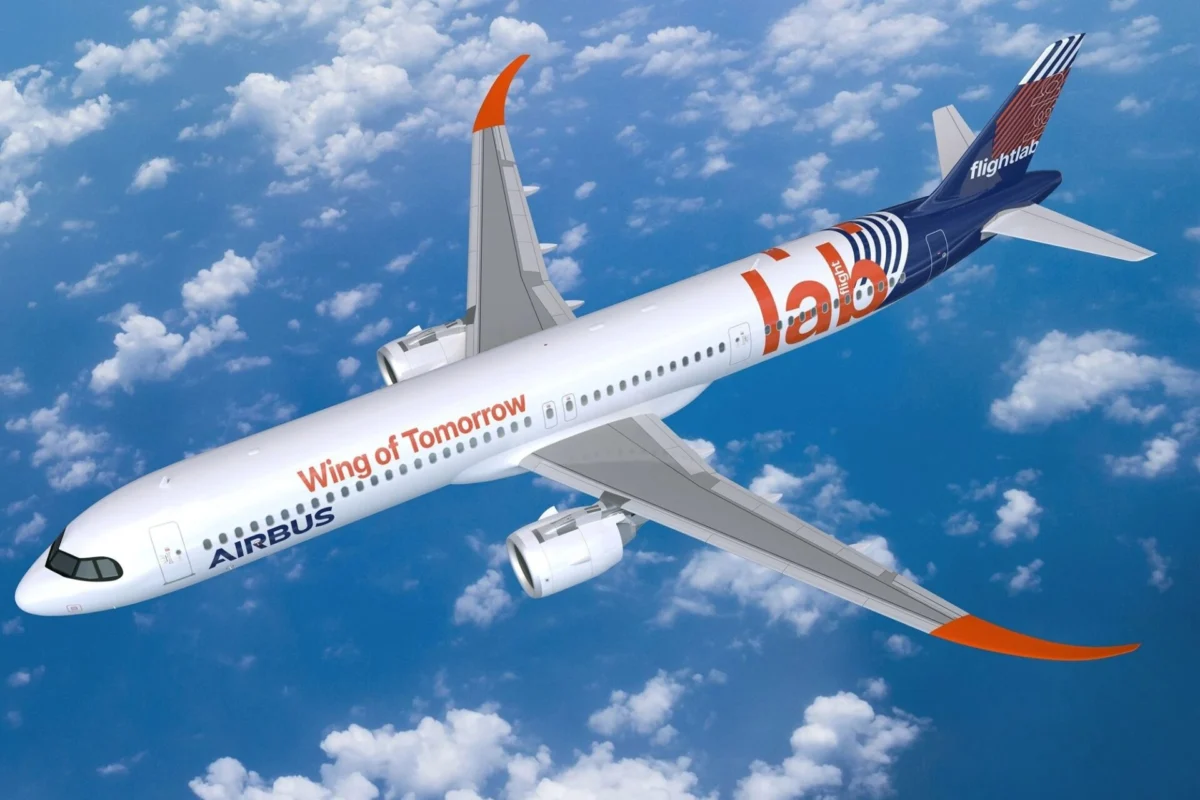
At Farnborough Airshow 2026, Airbus unveiled detailed plans for the next stage of wing evolution as key staff members provided an update on the Wing of Tomorrow Program.
Visibly excited by the news she and colleagues were about to share, Sue Partridge, Head of the Wing of Tomorrow Program, opened proceedings in front of gathered media representatives.
Partridge said that for 50 years, Airbus has been working on innovations looking for efficiency and performance improvements to make its aircraft “better and better”.
“The biggest levers that we have to improve the efficiency of our aircraft are the engines and the wings,” she said.
For 10 years the Wing of Tomorrow team have been working away in the UK looking at how they can make wings “longer, lighter, and more slender”.

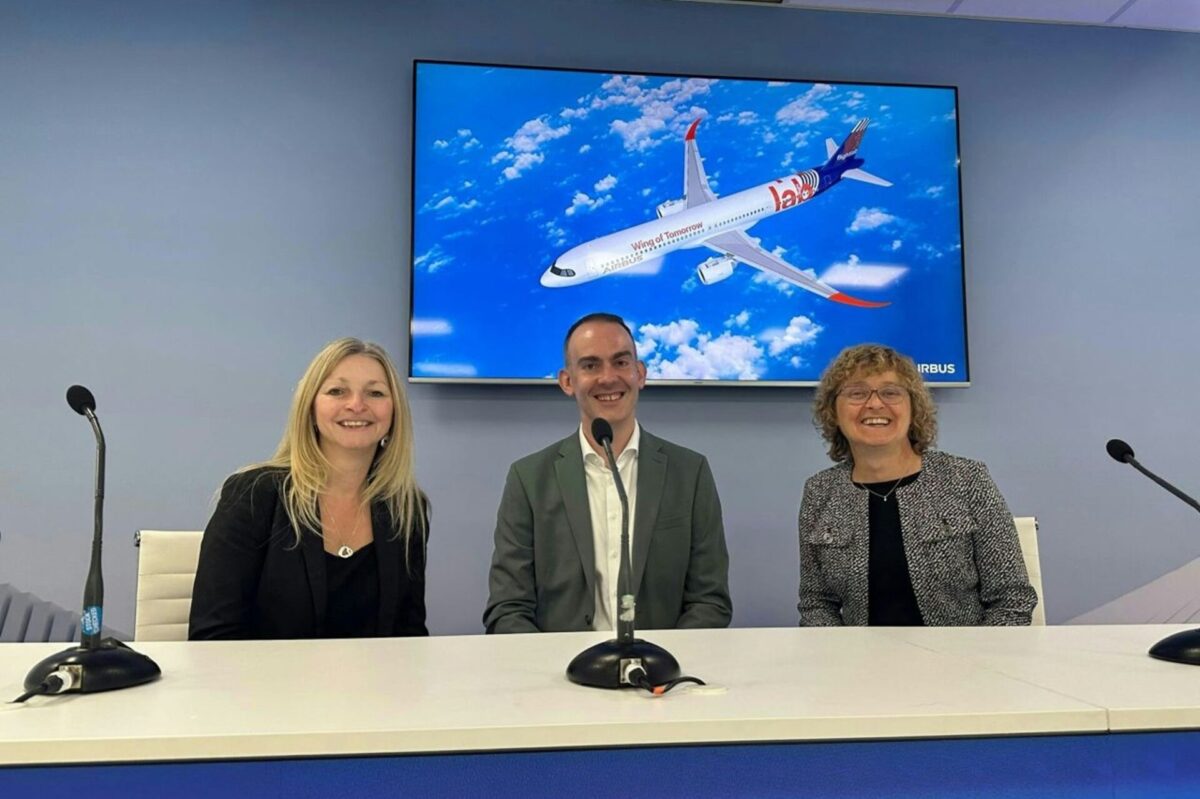
“We’ve been investing many millions in exploring how our wings can improve aircraft efficiency through flight physics rather than through fuels, which is maybe seen as the more traditional way to improve things,” she added.
Partridge confirmed that with the financial support from Airbus and the Aerospace Technology Institute (ATI), colleagues at both Filton and Broughton, had completed the construction of three 17-metre (ground based) wing demonstrators.
The first is a fully equipped wing, involving over 100 different technologies and more than 40 global partners, to “understand what are the best technology choices for our next generation of aircraft”.
The second wing demonstrator is currently at Airbus’ Aerospace Integrated Research and Test Centre (AIRTeC) in Filton, taking part in research.
The final wing, which Partridge described as the “run at rate wing”, has been completed and is at the Advanced Manufacturing Research Center in Broughton.
“That’s where we’re really testing the industrial system, looking at the automation options we’ve been developing, understanding what’s the best build philosophy, and which of those automation technologies could be the right ones for our next-generation aircraft,” she explained.
Partridge, who has been working on the Wing of Tomorrow Program since its inception, also described the completion of the demonstrators as a “great milestone for the team”.
Evolution of folding wing technology
In parallel, Airbus has been rigorously working on its folding wing technology, and much of the presentation at Farnborough Airshow focused on this area with some big announcements.
“In order to be able to fit these long, strong, and light wings into airports around the world, we need to develop the technology to be able to fold the wings on the ground,” Partridge said. “We’ve been focusing again on full-scale demonstration, and we’ve done a lot of work on ground demonstration of those technologies, the systems and the structures that we will need in order to be able to fold the wing.”
Partridge said that the project not only requires Airbus to “de-risk this technology on the ground, but also de-risk this technology in the air”.
Accordingly, Airbus laid out its plans for the next phase of its folding wing ambitions to design, build, and flight test full-scale wing extensions.
We’re launching a new flight-test campaign for our Wing of Tomorrow programme! Over the next 3 years, we’ll flight test full-scale wing extensions on an #A321neo to master aerodynamic efficiency for next-gen single-aisle aircraft.
— Airbus (@Airbus) July 22, 2026
Watch the future of wing design take shape.… pic.twitter.com/xM9C6VOhRH
As Integrated Project Team Leader, Rich McPherson, explained in the second half of 2027 Airbus will flight test full scale wing extensions on an Airbus A321neo in Toulouse, France.
The extensions, each measuring four to five meters, will replicate a folding wing in the fully extended position during a flight.
“We are going to evaluate a number of different geometries, multimeter in length over the course of the campaign, and build these devices in the Wing Technology Development Center in Filton,” McPherson said. “We’re then going to take those extension devices down to the south of France in Toulouse, where we are going to install them on one of our single aisle flight test aircraft.”
Airbus will remove the A321neo’s sharklets and replace them with multiple wing extensions during testing.
McPherson explained: “All the devices will have extensive flight test instrumentation installed on them to enable us to understand the performance benefits of each of these devices, understand the aerodynamics, and evaluate how these longer wings will impact other variables in the aircraft. This will be a cruise demonstrator.”
A flight test crew will be onboard the demonstrator to help understand the handling of the extended wings and gather data to unlock the technology for future use.
Where is Airbus currently in the folding wing program?
Airbus is currently using advanced digital simulation and has “performed intensive wind tunnel testing to really evaluate and optimize the different devices”.
Components for the first extension device have been manufactured with partner companies, and assembly is about to begin in Filton.
“At Airbus, though, nothing leaves the ground without being rigorously tested, and long before these extension devices take flight, we will already know exactly how they will behave when we take them into the skies,” McPherson added.
Currently the ground demonstrators are looking at the hinge mechanism that would be used for the folding wings of future aircraft.
Reflecting on the team’s achievements so far, McPherson said since starting at Airbus in 2009, that this is the moment where the aircraft wing has the “potential to give the same, if not more, of an efficiency gain than the next generation of engine”.
“As an engineer, that’s incredibly inspiring and motivates all of us every single day,” he added. “We’re literally on this program rewriting the rules of flight, and I cannot wait to see these devices up in the air.”