
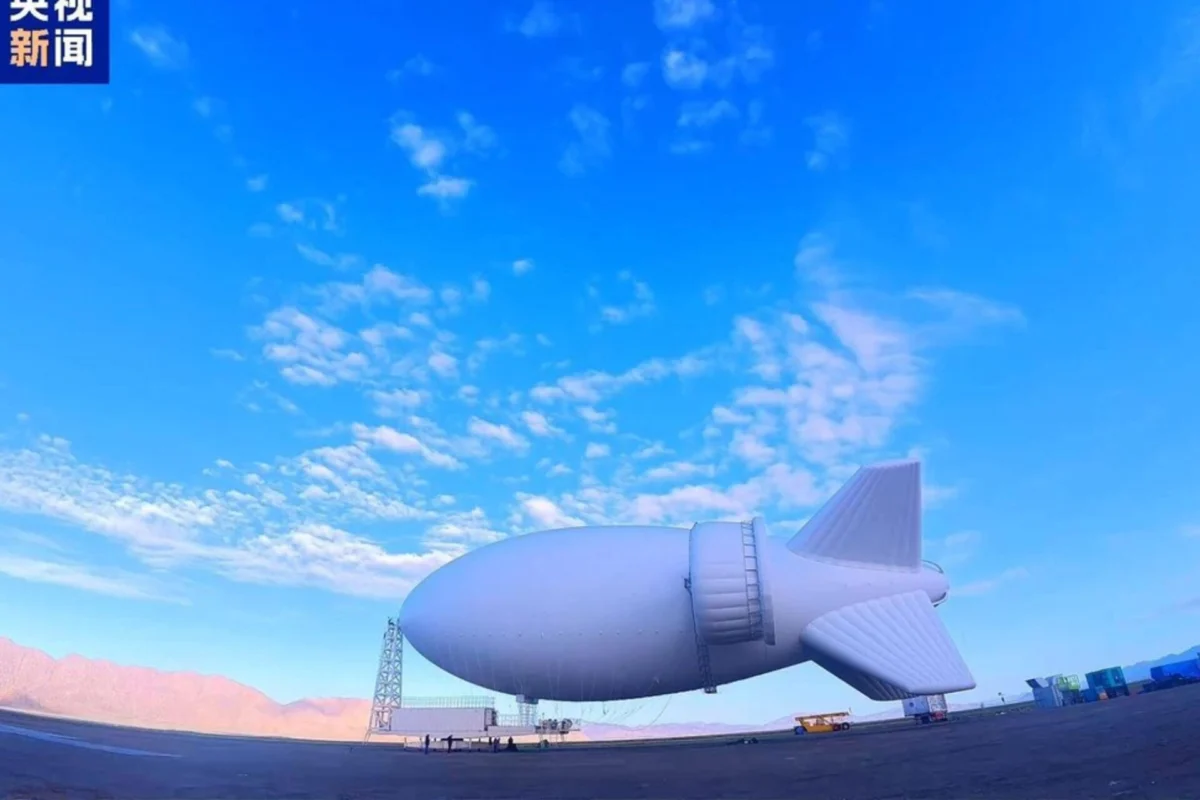
China’s upgraded S4000 Stratosphere Airborne Wind Energy System (SAWES) has completed a full-process flight test, reaching an operational altitude of 13,123 feet, roughly 4,000 meters, in a trial conducted at a base in Northwest China.
CCTV News first reported the test, which China says marks a step closer to deploying high-altitude wind power for commercial electricity generation.
The airship-like platform is designed to capture wind energy at heights far beyond the reach of conventional wind turbines, giving it access to stronger, more consistent wind resources higher in the atmosphere.
China's domestically developed S4000 Stratosphere Airborne Wind Energy System (SAWES) has recently completed a verification test in northwest China, marking a new breakthrough in the country's stratospheric high-altitude wind power technology.
— China Science (@ChinaScience) August 24, 2026
With a maximum operating altitude… pic.twitter.com/QtdhZTp2uJ
Full sequence validated, from ascent to grid-ready power
The trial validated the system’s complete operating sequence, including ascent, station-keeping, electricity generation, and controlled recovery.
According to the report, all key indicators met required standards, a result expected to support further development of the technology for use in complex high-altitude environments.
The S4000 builds on an earlier platform, the S2000, with an upgraded configuration designed to improve overall performance while allowing the system to connect directly to mainstream power grids. It also carries a stated design service life of up to 20 years, which could make long-term deployment viable in locations where traditional wind turbines face physical or spatial limitations.
Unlike conventional turbines, which rely on tall fixed towers to reach higher wind speeds, the S4000 operates more like a floating airship, using a large envelope to stay aloft while carrying its power-generating equipment.
Electricity generated in flight is transmitted to the ground through a tether, which also helps keep the platform positioned during operation.
S2000’s 2026 debut already powered a Sichuan grid
The S4000 test follows an earlier real-world demonstration by its predecessor, the S2000, which Live Science and other outlets reported on in February 2026.
In a January 2026 test flight over Sichuan Province, the S2000 climbed to about 6,560 feet, or 2,000 meters, and generated 385 kilowatt-hours of electricity, enough to power an average US household for roughly 13.3 days, based on figures from the US Energy Information Administration. That electricity was delivered directly to the local grid, marking the first real-world power generation demonstration for the system.
The S2000’s developer, Beijing Linyi Yunchuan Energy Technology, described it at the time as the world’s first megawatt-level airborne wind power system designed for use near urban areas. The aircraft measures 197 feet long and 131 feet both high and wide, and is rated at 3 megawatts of total power capacity, according to Global Times.
Weng Hanke, the company’s chief technology officer, told Tide News, an affiliate of the state-owned Zhejiang Daily Press Group, that the technology could serve two main purposes: providing stable power for off-grid settings such as border outposts, and complementing existing ground-based wind systems as part of a broader, three-dimensional approach to energy generation.