

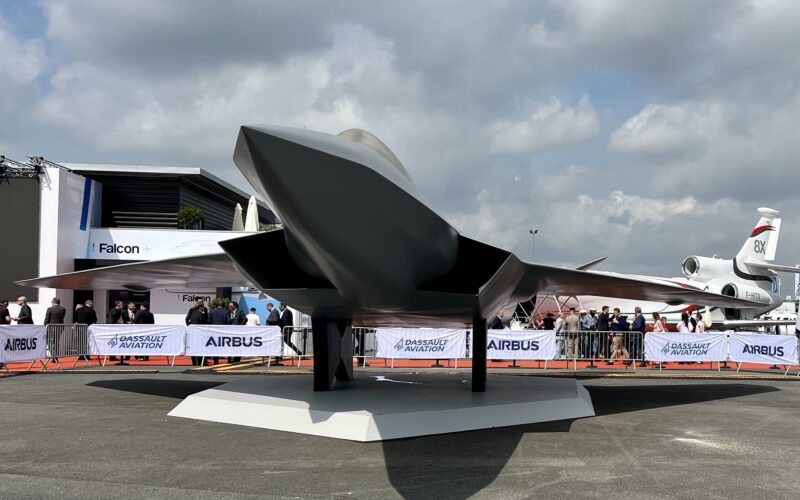
France plans to launch a second demonstration phase for its New Generation Fighter (NGF) in 2027, followed by the start of full-scale fighter development in 2029, according to documents accompanying the country’s draft 2027 defense budget.
The timeline appears in the annual performance plan for the defense mission, under Program 146, ‘Equipment of the forces’.
The initial demonstration phase began in December 2022 with the award of the Next Generation Weapon System (NGWS) contract, as part of the joint program with Germany and Spain. The second phase, scheduled to begin in 2027, will include the flight of an NGF prototype.
The schedule is consistent with comments made by Dassault Aviation CEO Éric Trappier to the French Senate on July 1, 2026, when he suggested that the demonstrator could make its first flight in 2031 or 2032.
FCAS funding commitments more than double
France’s Ministry of the Armed Forces plans to more than double its funding commitments for the Future Combat Air System (FCAS), known in French as SCAF, from €1.2 billion in 2026 to €2.74 billion in 2027.
These commitments enable the defense ministry to sign contracts for work that may be paid for over several years. Actual payment appropriations are set to increase more modestly, by 23%, from €454.5 million to €557.8 million.
The budget also earmarks funding for research into stealth and collaborative combat technologies, among the priorities for future air warfare under Program 144.
Overall, France’s defense budget, excluding pensions, would reach €63.4 billion in 2027, an increase of €6.5 billion over 2026.
France confirms national work on its next-generation fighter
The new schedule comes as France moves ahead with its own fighter development plans, following the collapse of the joint Franco-German NGF project in June 2026.
Speaking before the French National Assembly’s defense committee on October 8, 2026, Armed Forces Minister Catherine Vautrin confirmed that France had already decided to pursue national development work.
“As early as July 2026, it was decided to launch national work on the critical path of what we called the NGF,” Vautrin said, according to Challenges journalist Vincent Lamigeon, who reported her remarks on X.
Vautrin explained that the decision was intended to preserve the original schedule, with the aim of achieving an operational capability in the early 2040s.
She also indicated that France intends to build on work already completed under the multinational program, preserving the value of previous investments.
Those earlier investments include Turenne 2, a French propulsion research program awarded to Safran in 2019. According to a 2020 French Senate report, the €115 million contract covers technologies intended to increase the thrust of the Rafale’s M88 engine and prepare the powerplant for the NGF.
Germany, meanwhile, is weighing its options. While its aerospace industry has formed the Airbus-led Team Gen 6 to pursue a new fighter, British Prime Minister Andy Burnham said on October 8, 2026, that the UK was open to Germany joining the Global Combat Air Programme (GCAP), currently being developed with Italy and Japan. Berlin has yet to make a decision.
France could also gain a new partner in India, whose Ministry of Defense told a parliamentary committee in August 2026 that it had begun work to join the French-led program.
In parallel, France is advancing the Rafale F5, a major upgrade intended to keep its existing fighter fleet operationally relevant well into the 2030s. Targeted for entry into service between 2033 and 2035, the new standard will introduce improved radar and electronic warfare systems, the future ASN4G hypersonic nuclear missile, and the ability to operate alongside a stealth combat drone derived from Dassault’s nEUROn demonstrator. It will also receive Safran’s M88 T-REX engine, designed to deliver 20% more thrust than the current M88.