
Denys Shtilierman, co-owner and chief designer of Ukrainian manufacturer Fire Point, published four photographs on X on July 29, 2026, showing a long-range strike drone at launch and a second, unidentified missile in powered flight. He captioned the set with a single word, “Ранок,” meaning “morning,” and offered no technical detail.
Ранок) pic.twitter.com/yJMRDAALCo
— Denys Shtilierman (@DenShtilierman) July 29, 2026
FP-1 appears with unexplained wing fairings
Two of the four frames show an FP-1 one-way attack drone. In the first, the aircraft sits on a ground launch rail in pre-dawn light. In the second, it is captured leaving the rail under rocket power.
The FP-1 in the photographs appears to carry two symmetrical raised structures, or aerodynamic fairings, on the upper surface of the wing. Possibilities include additional fuel capacity, but also mission equipment such as communications hardware, sensors, or another payload entirely.


They do invite comparison with the configuration Fire Point displayed at Eurosatory 2026 in Paris in June 2026. There, the company presented a redesigned FP-1/FP-2 family built around a new monoplane wing with fuel capacity integrated into the structure.
Fire Point said the change would extend the FP-1’s range from 1,650 kilometers (1,025 miles) to 2,700 kilometers (1,680 miles), and would allow the shorter-ranged FP-2 to carry a 200-kilogram (441-pound) warhead to 370 kilometers (230 miles), or a 105-kilogram (231-pound) warhead to 700 kilometers (435 miles).
An unidentified missile

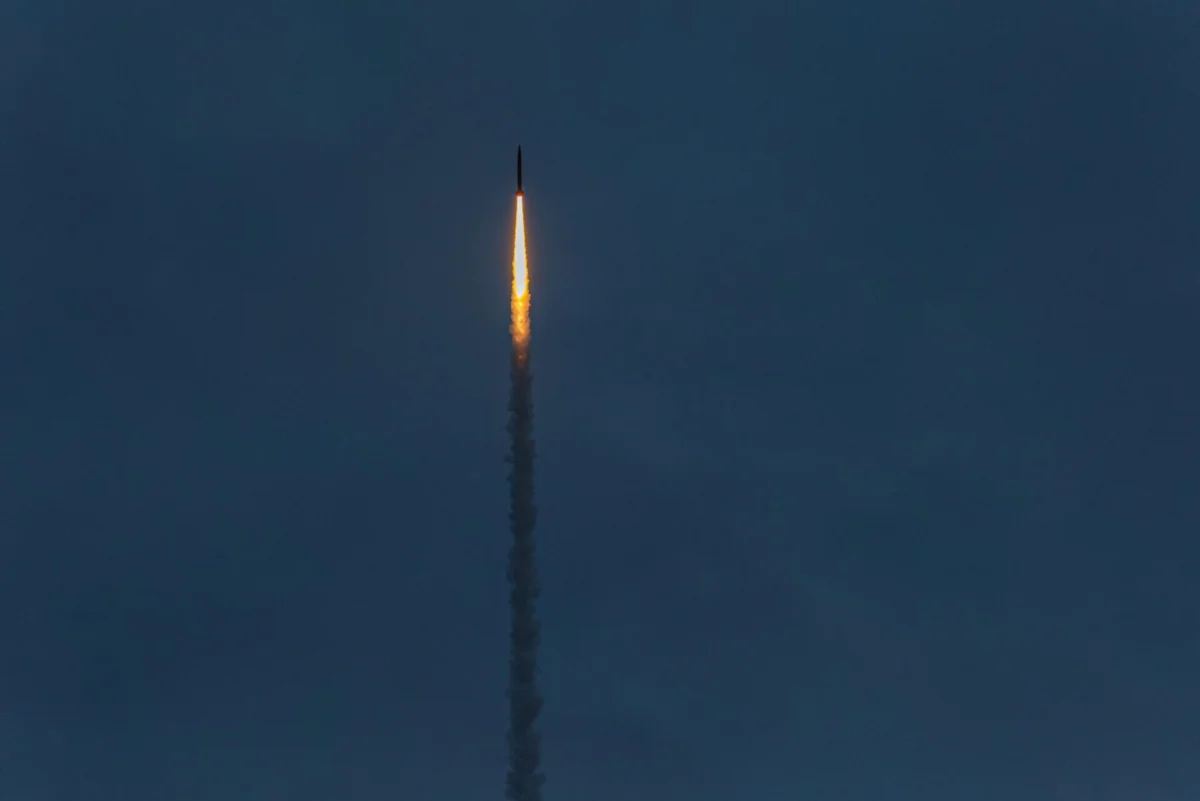
The third photograph is the harder of the two subjects to place. It shows a slender missile climbing almost vertically under rocket power. Fire Point has not identified it, but two candidates from the company’s catalog are the FP-7 and the FP-7.x.
The distinction between them is significant. The FP-7 is a tactical ballistic missile, unveiled at the MSPO exhibition in Poland in September 2025 and shown in flight in February 2026. Fire Point gives it a range of about 200 kilometers (124 miles), a speed near 1,500 meters per second (4,921 feet per second), a 150-kilogram warhead, and an apogee of roughly 65 kilometers (40 miles). Ukrainian reporting has consistently described the design as drawing on the Soviet 48N6 surface-to-air missile used by the S-300 and S-400 families.
The FP-7.x reuses that airframe for the opposite task. It is an interceptor, developed as the effector for Freyja, the anti-ballistic system Fire Point presented on July 13, 2026, as a shield to be owned jointly with European partners. The company describes a 7.25-meter (23.8-foot) missile with a 0.53-meter (1.7-foot) body diameter, composite construction and an imaging infrared seeker, with Germany’s Diehl Defence named as a guidance partner.
Fire Point reported the first fully guided maneuvering flight of the FP-7.x on June 3, 2026. Shtilierman told the Financial Times that the missile reached 25 kilometers (16 miles) in testing, comparable to Patriot engagement altitudes, and said it is intended to counter Russian ballistic missiles and drones at a fraction of the cost of existing Western systems. He put the unit price near $700,000 against about $3.8 million for a Patriot PAC-3 round, and said production of three missiles per day could begin in August 2026, with more complete rounds available in 2027 through the Diehl partnership. The first attempt at intercepting a ballistic target is planned for around July 2027.
Fire Point’s catalog also includes the substantially larger FP-9 ballistic missile, with a claimed range of 855 kilometers (531 miles), a speed of 2,200 meters per second (7,218 feet per second) and an 800-kilogram (1,764-pound) warhead. Measuring approximately 9.5 meters (31 feet) long and 1.1 meters (3.6 feet) in diameter, the FP-9 remained at the engine-testing stage in late July 2026.
A portfolio pulling in two directions
The two subjects of the new post track Fire Point’s widening product line. The company built its reputation on one-way attack drones and on the Flamingo, which was first reported in combat against an FSB outpost in Crimea in August 2025. It has since added two ballistic missiles and an interceptor program pitched at European buyers.
Separately, on July 29, 2026, Fire Point said on Telegram that FP-1 drones struck the Rosneft-owned Ryazan oil refinery, which processes more than 17 million tons of crude a year, and a Wildberries logistics hub.
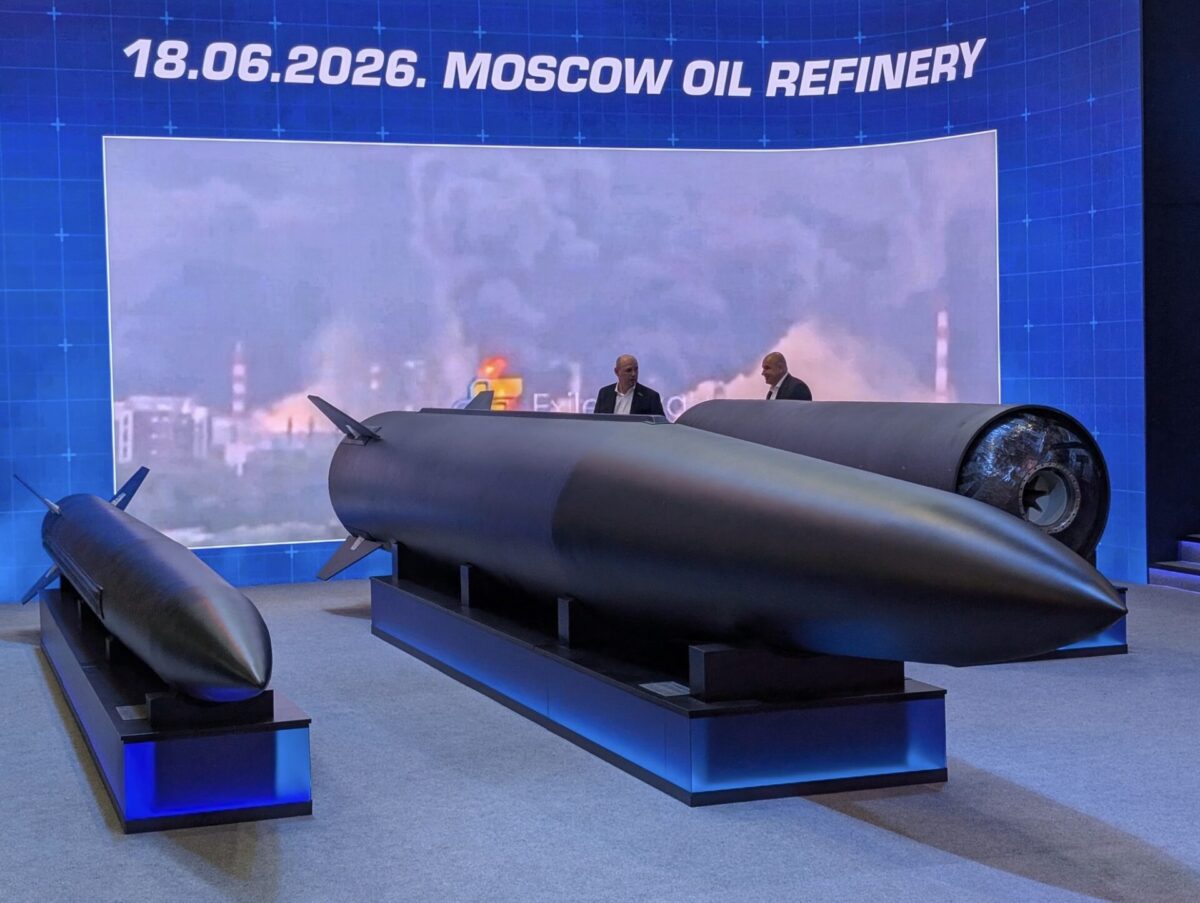
Ukraine’s General Staff confirmed a strike on the refinery, which was also hit during attacks on Russian refining and pipeline infrastructure earlier this summer, and in a June 18, 2026 raid on the Moscow refinery that also involved FP-1s.