
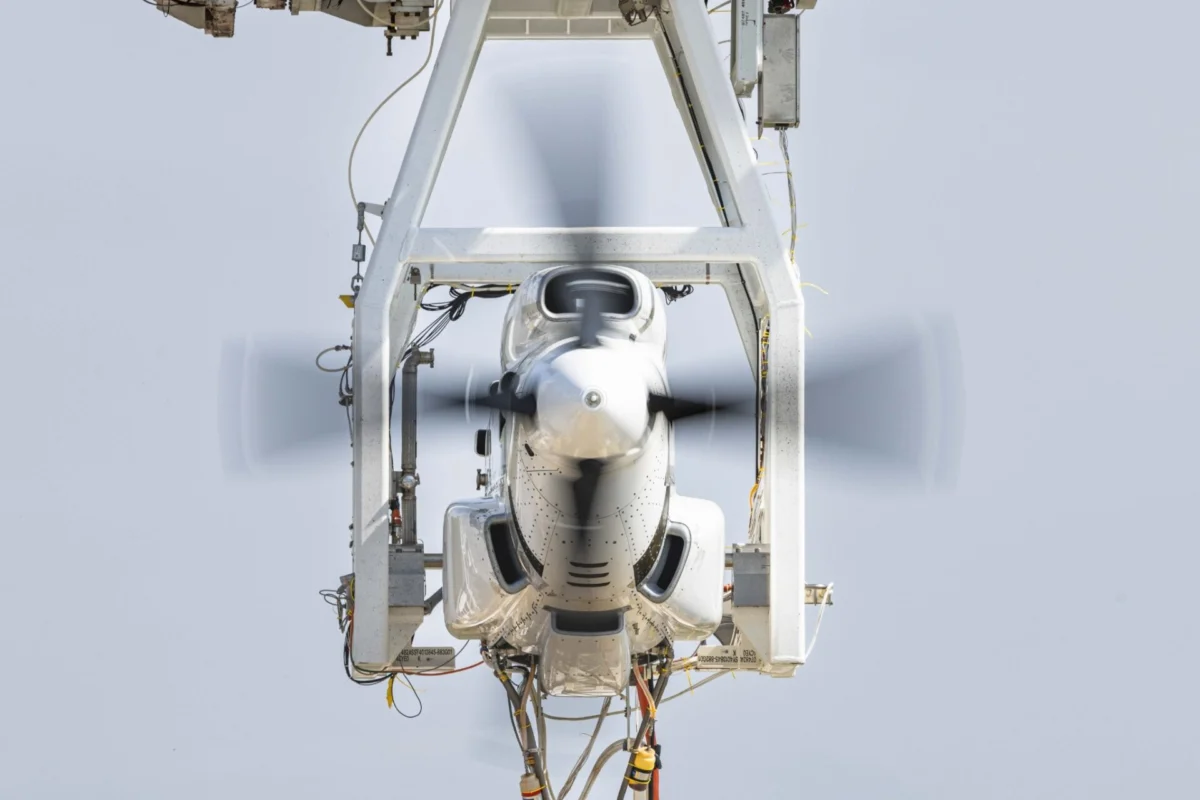
GE Aerospace has completed its first ground test of a fully integrated megawatt-class hybrid-electric powertrain, marking a new step in a NASA-backed demonstrator program aimed at creating new types of engines.
The company claimed that the test validated the full integrated system, including GE Aerospace-developed motor/generators, power converters, inverters and controllers.
The system also included Dowty propellers, Avio Aero gearboxes and a CT7 engine.
BAE Systems provided the batteries used in the test and Boeing subsidiary Aurora Flight Sciences supplied the complete nacelle.
The ground test was completed at GE Aerospace’s Peebles Test Operation in Ohio, where engineers simulated taxi, takeoff, climb and cruise conditions. According to GE, the test successfully demonstrated the electric powertrain’s ability to power the propeller and charge the battery.
The work is part of NASA’s Electrified Powertrain Flight Demonstration, or EPFD, program. GE Aerospace is developing the megawatt-class hybrid-electric powertrain for ground and flight testing under the program.
“Step by step, we’re proving hybrid electric engine technology for next-generation commercial aircraft,” said Arjan Hegeman, Vice President of Future of Flight at GE Aerospace. “The ground test is a major turning point in our understanding of hybrid electric powertrains for aviation and a fundamental building block for the future.”
GE said the test clears the way for future flight testing of the hybrid powerplant. The company previously said the flight test aircraft for the EPFD program would be a modified Saab 340B powered by CT7-9B turboprop engines.
NASA selected GE Aerospace in 2021 for the EPFD program, which is intended to mature electrified aircraft propulsion systems through ground and flight demonstrations at a scale relevant to commercial aircraft.
GE said that the latest test used components designed to meet higher safety and reliability requirements than typical test hardware. The goal was not only to prove individual components, but also to mature a commercial-grade hybrid-electric engine system.
GE Aerospace noted that this was not its first hybrid-electric propulsion test and that it has in fact been working on hybrid-electric systems for more than a decade. The company conducted a ground test of an electric motor-driven propeller in 2016. In 2022, it completed what it described as the world’s first test of a megawatt-class, multi-kilovolt hybrid-electric propulsion system, under simulated altitude conditions at NASA’s Electric Aircraft Testbed.
The new milestone is the first ground test of the fully integrated powertrain being developed for NASA’s EPFD program.
The latest test is also separate from another GE Aerospace hybrid-electric effort announced earlier this year. In January 2026, GE declared that it had completed ground testing of a modified Passport turbofan engine under NASA’s Turbofan Engine Power Extraction Demonstration project.
The program in question focused on power extraction and injection in a turbofan architecture that could apply to future single-aisle aircraft. The EPFD system announced this week is tied to the Saab 340B flight demonstrator and uses a CT7 turboprop-based architecture.
GE claim that the system is compatible with multiple fuel types and could support future advanced engine architectures, including open fan concepts being studied under CFM International’s Revolutionary Innovation for Sustainable Engines, or RISE, program.
NASA’s EPFD program also includes work with magniX, which is modifying a de Havilland Canada Dash 7 with electric propulsion technology for flight demonstration.