

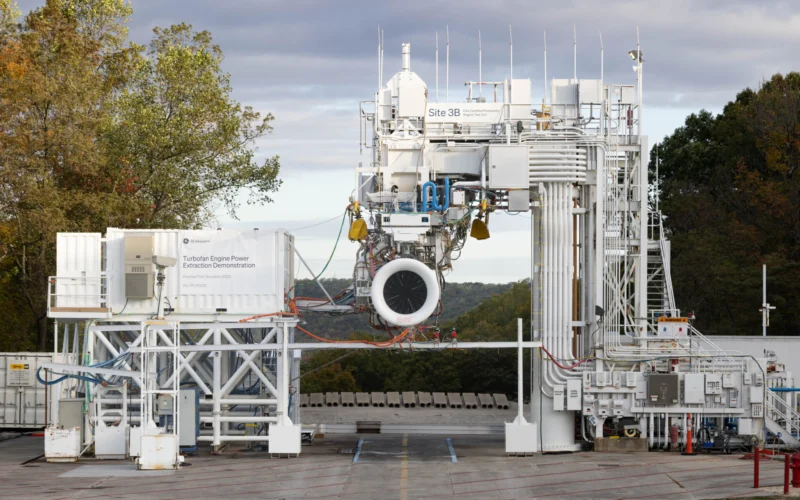
GE Aerospace has completed ground testing of a hybrid electric turbofan engine system, marking a concrete step toward bringing electric propulsion into mainstream commercial aviation.
The tests, conducted at GE’s Peebles Test Operation in Ohio, used a modified Passport engine and were carried out under a NASA-supported research effort known as the Turbofan Engine Power Extraction Demonstration project. The work focused on how electrical systems can be integrated directly into a high-bypass turbofan, rather than testing standalone components in isolation.
According to GE Aerospace, the ground campaign successfully demonstrated the ability to extract power from the engine, transfer it through electrical systems, and inject power back into the propulsion system while maintaining stable operation. Engineers also evaluated how electric motor-generators could be embedded within the gas turbine itself, allowing the engine to operate with or without onboard energy storage.
NASA officials said the test provided rare insight into how a hybrid electric system behaves as a complete engine architecture, not just as a collection of parts.
“Turbines already exist. Compressors already exist,” said Anthony Nerone, project manager at NASA Glenn Research Center. “But there is no hybrid-electric engine flying today. And that’s what we were able to see.”
GE Aerospace said the results met or exceeded technical benchmarks established by NASA, including targets tied to fuel efficiency and power requirements for future single-aisle aircraft.
The company emphasized that the architecture demonstrated during the test does not rely on batteries to function, a key distinction as manufacturers consider weight, complexity, and certification challenges tied to large onboard energy storage systems.
The hybrid electric turbofan work feeds into CFM International’s Revolutionary Innovation for Sustainable Engines, or RISE, technology program, which targets more than a 20% reduction in fuel burn compared with today’s in-service engines through new architectures, materials, and increased electrical integration.
CFM International is a 50-50 joint venture between GE Aerospace and Safran Aircraft Engines, and the results of GE’s ground testing are intended to help mature next-generation narrowbody propulsion concepts for eventual commercial use.
Since its launch in 2021, the RISE program has accumulated hundreds of tests and thousands of endurance cycles, including work on open-fan engines, compact cores, and hybrid electric systems. While none of these technologies represent a certified product yet, CFM has said it expects ground and flight testing to continue through the decade as the concepts mature.
Hybrid electric propulsion has long been viewed as a potential bridge between conventional gas turbines and more radical future concepts, such as hydrogen or fully electric aircraft. Rather than replacing the turbofan, the approach focuses on using electric machines to supplement power during specific phases of flight, improve efficiency, and reduce fuel burn without abandoning proven engine designs.
GE Aerospace said the latest test milestone helps narrow the gap between research and real-world application. While significant certification, durability, and integration hurdles remain, the company framed the demonstration as evidence that hybrid electric propulsion can move beyond theory and into practical engine architectures suitable for narrowbody aircraft.
1 comment
It’s happening in aviation and unfortunately in Formula 1 as well… ; )