
Flights across the Middle East were rerouted on February 28, 2026, after explosions were reported in Tehran, Isfahan, and other Iranian cities.
Trump says the US has begun “significant combat operations” in Iran to eliminate what he describes as imminent threats to Americans, US forces, and allies, and he repeats that Iran will “never” be allowed to get a nuclear weapon. He says the US will destroy Iran’s missile capability and navy, and he warns Iranian security forces to stand down in exchange for immunity or face death.
Netanyahu says Israel and the United States have launched an operation to remove what he calls an existential threat from Iran, and he thanks Trump for “historic leadership.” He frames the goal as preventing Iran from acquiring nuclear weapons, urges Israelis to follow Home Front Command instructions, and calls on Iran’s people to overthrow the regime.
Airspace closures and diversions
Iran’s civil aviation authorities announced a full airspace closure “until further notice,” following the reported blasts. Israel also closed its airspace to civil traffic as it declared a nationwide emergency posture.
Flight-tracking data showed the aircraft already airborne, clearing Iranian airspace, with knock-on effects on neighboring routes.
The immediate disruption is likely to hit Europe–Gulf and Europe–Asia routings that commonly rely on Iranian and Iraqi overflight corridors. In recent weeks, some airlines had already been flying longer routings and adding fuel stops to avoid Iranian airspace.
Missile alerts in Israel, including Jerusalem
In Israel, air raid sirens sounded in Jerusalem as authorities warned the public via mobile alerts of what was described as an “extremely serious” situation, anticipating retaliation. Israeli media and international outlets also reported missile salvos launched from Iran toward Israel, with air defenses working to intercept threats.
Residents in Jerusalem were warned of an incoming threat and that jets could be heard overhead as the country moved into emergency procedures, including shutting down Israeli airspace.
“In response to the aggression of the hostile and criminal enemy against the Islamic Republic of Iran, the first wave of massive missile and drone attacks by the Islamic Republic of Iran has been launched towards the occupied territories,” the Iranian Revolutionary Guard announced.
Buildup preceded the strikes
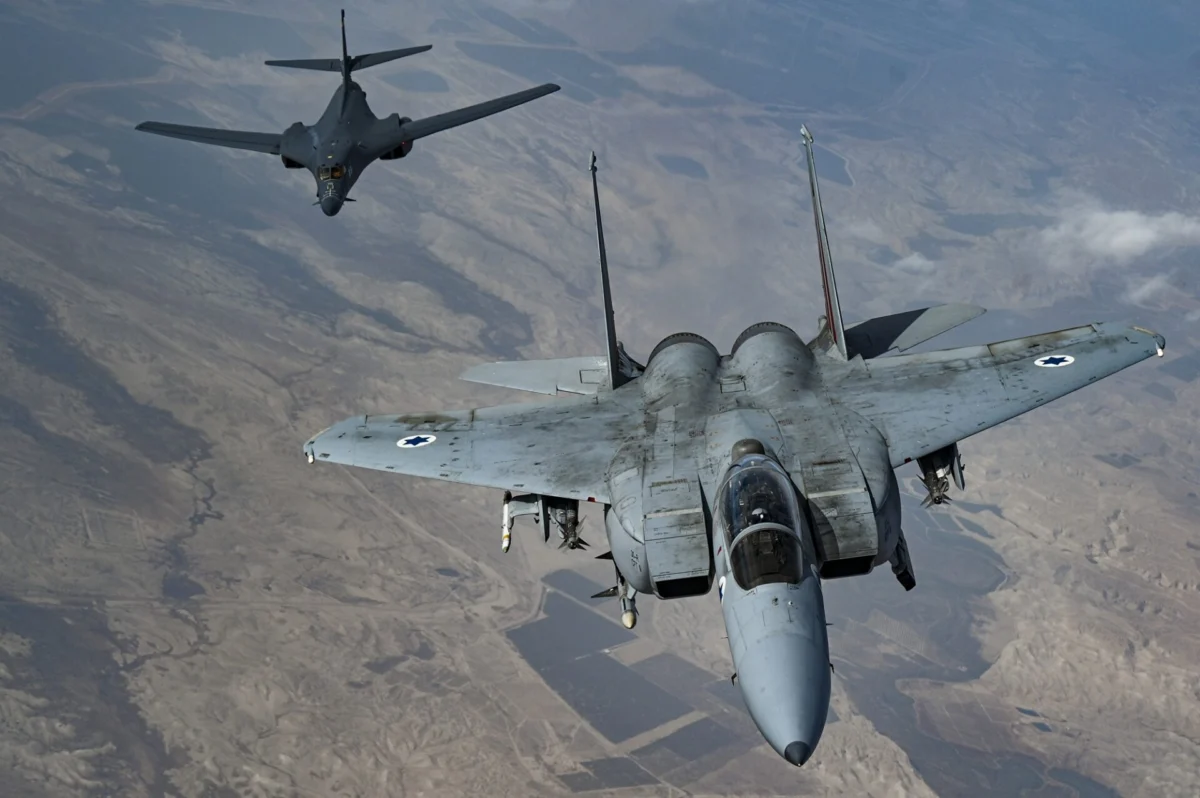
The escalation followed days of visible changes in the US posture in the region. A surge of US airpower was seen in the US Central Command area, including movements of F-35 and F-16 fighters, a contingent of F-22s, E-3 airborne warning aircraft, U-2 and RC-135 intelligence platforms, P-8 maritime patrol aircraft, and large numbers of KC-135 and KC-46 tankers, alongside C-17 and C-5 airlift.
A day before the strikes, the US Embassy in Jerusalem urged non-emergency personnel and family members to leave Israel “while commercial flights are still available,” warning that security incidents, including missiles and armed UAV intrusions, could occur without warning.