
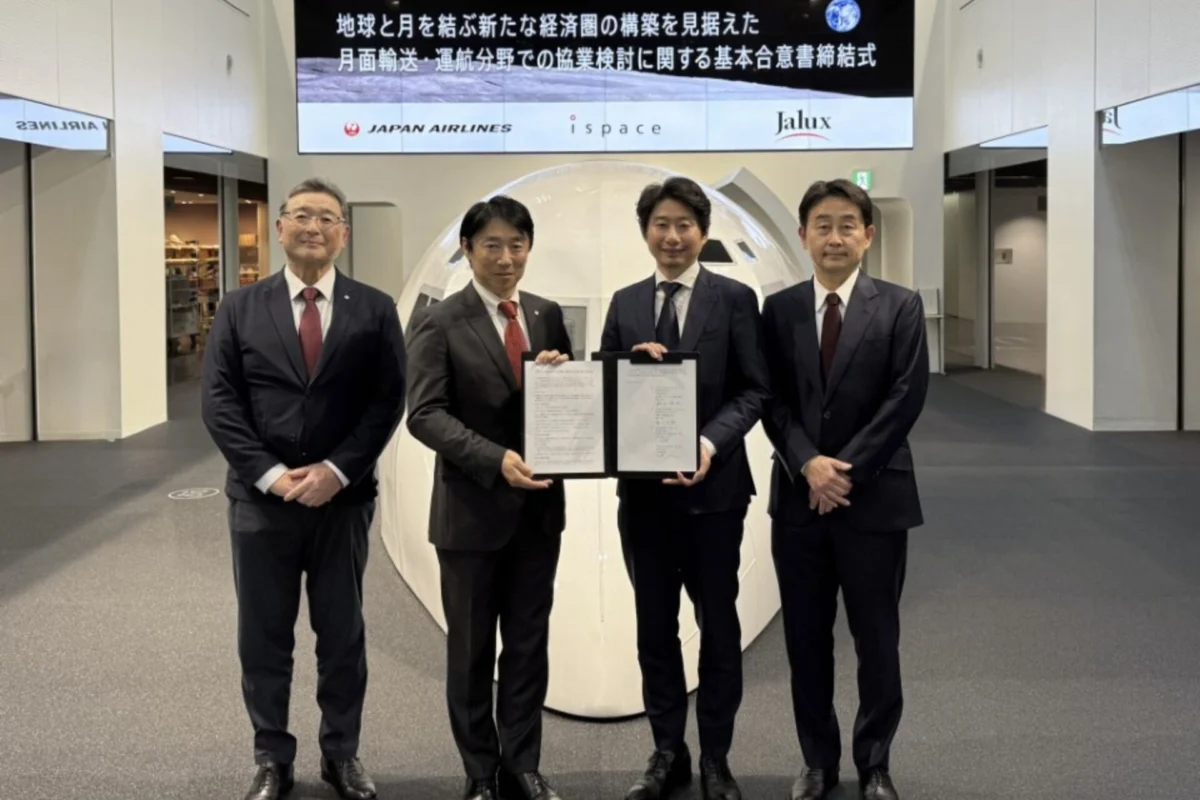
Japan’s space ambitions are all set to take a concrete step forward. Lunar exploration company ispace has teamed up with Japan Airlines, JAL Engineering, and JALUX to start building the transportation systems and infrastructure that could one day support long-term operations on the Moon.
The agreement, finalized on November 28, 2025, brings more than a decade of on-and-off collaboration into a formal partnership. It lays the groundwork for the companies to work together more closely as they look toward what JAL calls a “cislunar economy”, which is a developing network of services and technology meant to connect life on Earth with activity on the Moon.
A shared vision for a connected Earth–Moon economy
According to JAL, ispace’s vision centers on building a sustainable economic environment that treats the Earth–Moon system as a single, connected domain. The airline aims to apply its experience in safe, high-frequency aviation operations to space transportation, with the long-term goal of enabling regular human and cargo travel beyond Earth.
“We are encouraged to advance collaborative discussions with the JAL Group regarding future lunar transportation and operations,” said ispace founder and CEO Takeshi Hakamada.
“By combining the safety and quality expertise cultivated in commercial aviation with ispace’s experience, we will create new experiential value and drive its societal implementation toward realizing the cislunar economy,” Hakamada added.
📣 Announcement: ispace and JAL Group have signed an agreement to collaborate on building transportation systems and infrastructure to support sustainable future activities on the Moon!
— ispace (@ispace_inc) December 3, 2025
The agreement, signed by ispace, Japan Airlines, JAL Engineering, and JALUX, outlines an… pic.twitter.com/rNoUzofQkw
A decade of cooperation
The JAL Group’s involvement began during the Google Lunar XPrize era, when JAL supported Team HAKUTO, the predecessor to ispace’s HAKUTO-R program. Since 2018, JAL has remained a corporate partner, and JALEC has provided technical support such as welding propulsion system piping, assembling lander hardware, and performing non-destructive testing.
JAL has transported components for ispace’s landers during Mission 1 and Mission 2, including air transport of the TENACIOUS Rover in 2024.
The inclusion of JALUX expands the partnership’s scope to potential public-facing space services and cooperation in the sales of payload opportunities through ispace’s lunar transportation program.
Key milestones in the partnership
- 2015: JAL begins supporting Team HAKUTO
- 2018: HAKUTO-R program launches
- 2019: Continued partnership with JAL
- 2018–2022: JALEC supports assembly, testing, and propulsion system work
- Mission 1: Air transport of propulsion system piping
- 2024: Air transport of Mission 2’s TENACIOUS Rover
- 2025: JALUX joins; new collaboration agreement finalized
Building infrastructure for the lunar environment
Under the new agreement, the companies plan to advance studies and system development aimed at supporting future lunar bases and high-frequency travel to the lunar surface. JAL and JALEC intend to apply established aviation practices—such as maintenance technology, traffic management, and operations oversight—to emerging space transportation systems.
Takao Suzuki, executive officer and senior vice president of innovation at JAL, described the agreement as an extension of existing efforts, saying: “The JAL Group has supported ispace’s endeavors for over a decade. With the signing of this agreement, we will deepen our collaboration toward building a new economic sphere connecting Earth and the Moon.”
The partners plan to advance the work in phases, with an emphasis on business development, technology cooperation, and transportation services. By combining ispace’s lunar mission capabilities with the JAL Group’s expertise in aviation and global customer networks, the companies expect to broaden access to lunar transportation for a range of stakeholders.