
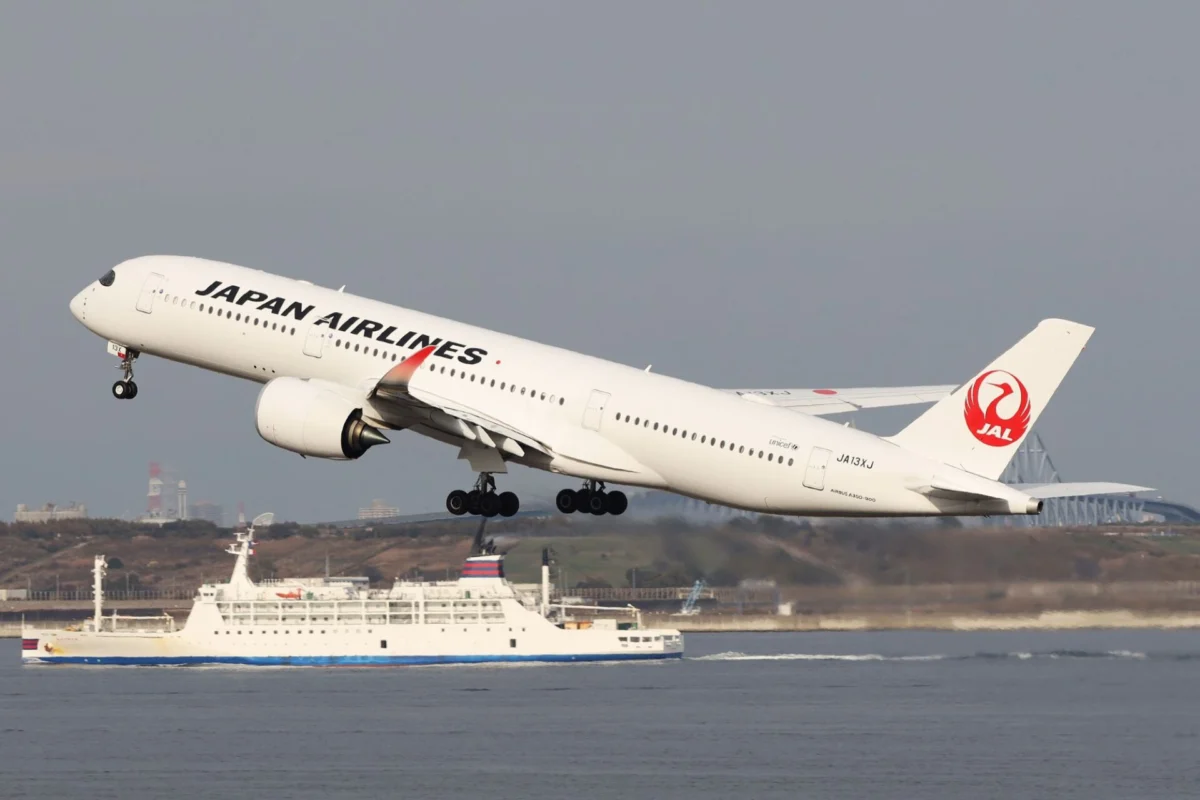
Japan Airlines (JAL) announced that it has joined Hitachi and Mitsui O.S.K. Lines in signing an agreement to run Japan’s first pilot test of a technology that pulls carbon dioxide directly out of seawater.
The companies announced on August 4, 2026 that the test will take place on Kume Island in Okinawa Prefecture.
The technology, known as Direct Ocean Capture, works by separating and removing CO2 that’s already dissolved in ocean water.
For the pilot, the companies will install containerized equipment on land on Kume Island that draws in seawater, strips out the carbon dioxide, and releases the water back to the sea.
JAL said that the goal is to see how well the technology works using real seawater from the area, while gathering practical data on operating challenges and environmental effects that could guide future use along Japan’s coastline.
The science behind pulling carbon from seawater
According to Japan Airlines, the idea behind Direct Ocean Capture relies on a natural balancing act.
Seawater constantly absorbs carbon dioxide from the atmosphere until it reaches a kind of equilibrium. If you pull CO2 out of the water, the ocean responds by soaking up more from the air to restore that balance.

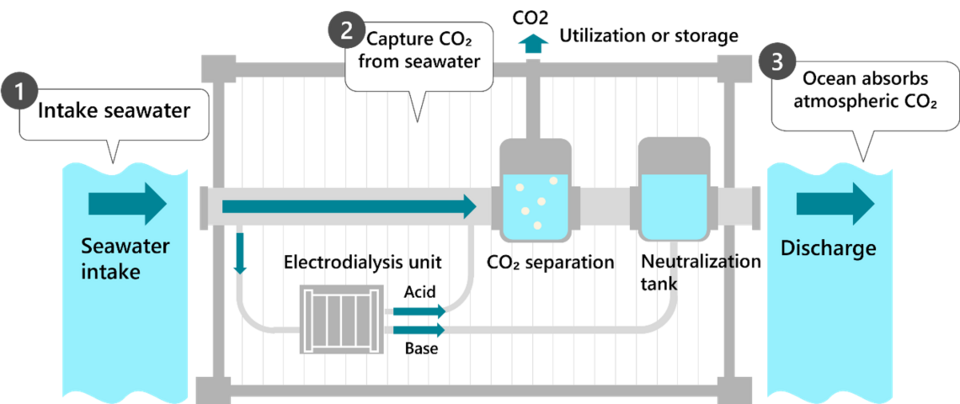
When that process is repeated enough times, it becomes a way to gradually lower the amount of CO2 in the atmosphere, using the ocean as the middleman.
Since seawater holds far more concentrated CO2 than air, roughly 100 to 150 times more, this approach is seen as a potentially cheaper and less energy-intensive way to remove carbon compared to pulling it straight from the atmosphere.
That matters a lot for industries like shipping and aviation, which are difficult to fully electrify and therefore have a harder time cutting emissions through conventional means.
For companies in those industries, offsetting emissions they can’t eliminate outright has become just as important as reducing them in the first place, and technologies like this one are seen as a promising piece of that puzzle.
Kume Island was chosen partly because it’s already home to other ocean-based energy research, including a system that generates electricity from temperature differences in seawater. That existing expertise and infrastructure made it a practical fit for this new test as well.
What each company brings to the project
The three companies have already invested in Captura Corp., a US-based developer of this ocean carbon capture technology, and have spent time exploring how to bring it to Japan. Each company is taking on a different role in the pilot.
Hitachi will handle much of the technical monitoring, using its analytical tools to track water quality and operating data, then feeding that information back into the system to help identify the most energy-efficient way to run it.
The company also plans to help build a data platform that can verify how much carbon is actually being captured, which matters for eventually turning that captured carbon into tradable carbon credits.
MOL, a major Japanese shipping company, will draw on an existing partnership it has with the local government on Kume Island to coordinate with residents and set up the pilot site itself.
The company sees this as an opportunity not just to test the technology, but to help create new local business opportunities on the island.
JAL, working alongside regional airline partners Japan Transocean Air and Ryukyu Air Commuter, both of which already fly to Kumejima, will lead outreach and awareness efforts around the project.
The airline is also interested in a longer-term payoff: using the captured carbon dioxide as a raw material for producing sustainable aviation fuel down the road.
Building toward a self-sufficient carbon economy
Beyond the pilot itself, the three companies say they are looking at this project as an early step toward building a small-scale, self-sufficient carbon economy on the island, one where captured CO2 doesn’t just get stored away, but gets put to use, including as feedstock for next-generation aviation fuel.
The companies also plan to use lessons from the project to explore educational and promotional efforts around ocean-based carbon removal more broadly.