

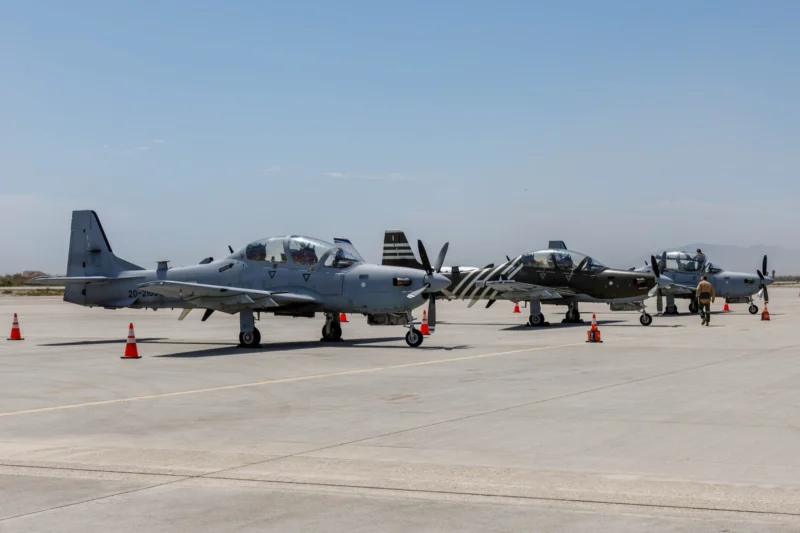
The US Air Force has divested the three A-29C Super Tucano turboprops assigned to its Test Pilot School at Edwards Air Force Base, California, after determining that they did not meet the school’s requirements.
“The A-29 Super Tucano was thoroughly evaluated but did not meet the intended use for Air Force Test Pilot School,” a spokesperson for Edwards Air Force Base told Breaking Defense on November 3, 2026.
The spokesperson said the Air Force was now exploring alternatives for spin training and mission systems instruction.
In a notice of intent posted on SAM.gov on October 29, 2026, the Air Force Test Center said it plans to award Sierra Nevada Company (SNC) a sole-source, firm-fixed-price basic ordering agreement for on-call maintenance and ground handling of the three aircraft.
“These aircraft are not expected to return to flight for use by the Air Force,” the notice states.
The work covers repairing fuel, hydraulic, and oil leaks, replacing tires, and towing the aircraft around the base. Return-to-flight maintenance and airworthiness restoration are excluded.
The notice does not specify what will ultimately happen to the aircraft. Responses are due by November 13, 2026.
An earlier request for information, posted on September 21, 2026, already described the aircraft as being in storage and outlined a three-year support arrangement consisting of one base year and two option years.
From special operations to the US Air Force Test Pilot School
The aircraft, delivered by Embraer and SNC, were originally acquired by Air Force Special Operations Command (AFSOC) for its Combat Aviation Advisor mission but were divested after the command’s requirements changed, according to the 412th Test Wing.
The aircraft were subsequently stored at Davis-Monthan Air Force Base, Arizona, before being transferred to Edwards in July 2024.
A January 2025 contracting notice described a memorandum of agreement between AFSOC and Air Force Materiel Command formalizing their transfer to the 412th Test Wing.
When the 412th Test Wing announced their arrival on October 9, 2024, Michael Banzet, director of Air Force Test Center plans and programs, said the move would repurpose “a $63 million taxpayer investment” and expand the school’s curriculum.
On March 13, 2025, the US Air Force awarded SNC a sole-source contract worth up to $13.1 million for A-29C fleet sustainment at Edwards, with work scheduled to continue through February 28, 2026.
A-29C training program ends after a short stint
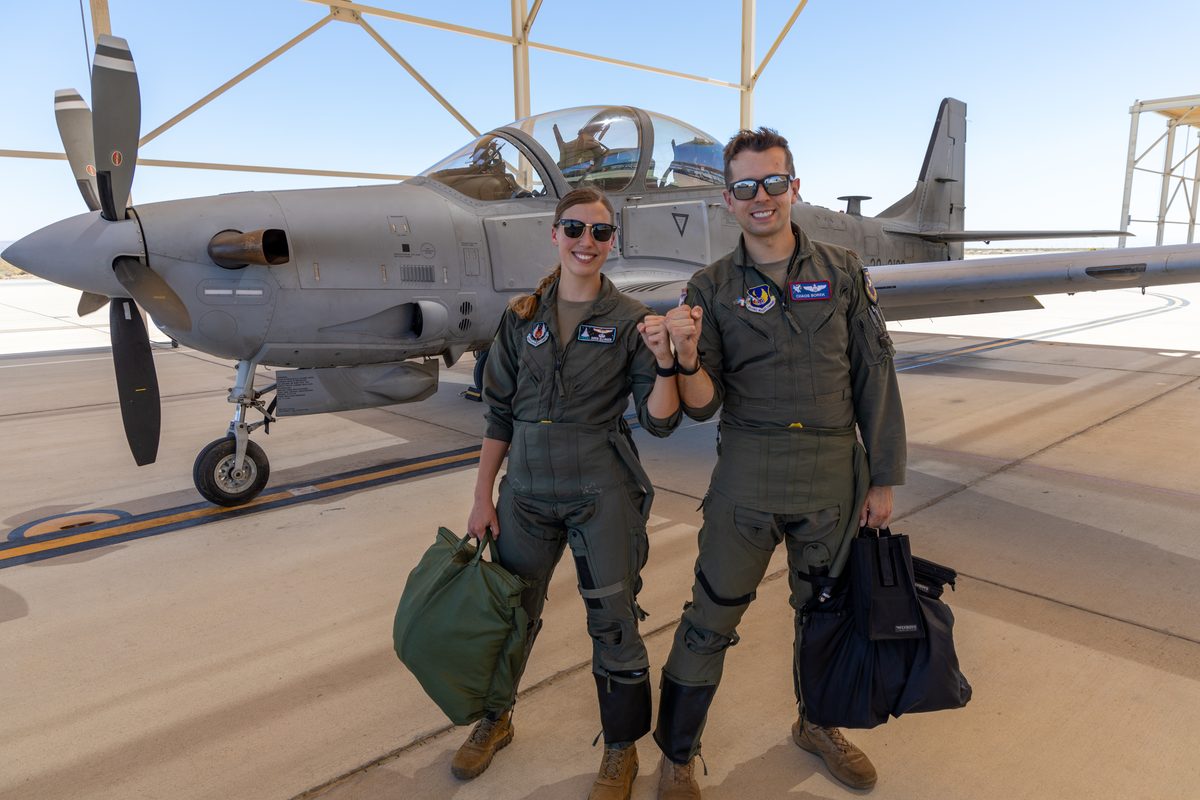
The Test Pilot School formally began integrating the A-29C into its curriculum in July 2025, with Class 25A becoming the first group of students to fly the aircraft.
The school initially planned to use the Super Tucano for stall and spin training, citing its ability to perform a variety of spins and remain airborne for more than 90 minutes.
Further instruction was expected to focus on mission systems, including the MX-15 electro-optical sensor turret, Link 16 datalink, and laser-guided weapons. The A-29C was also expected to take over some sensor and weapons demonstration flights from the F-16s at Edwards, reducing flying hours and maintenance demands on the fighter fleet.
The school also saw potential for research using the aircraft’s five weapons stations, while a controller station in the rear cockpit could eventually support training for combat systems officers and remotely piloted aircraft students.
Those plans have now been abandoned, leaving the Test Pilot School looking for another aircraft to fulfill the roles originally envisioned for the Super Tucano.