
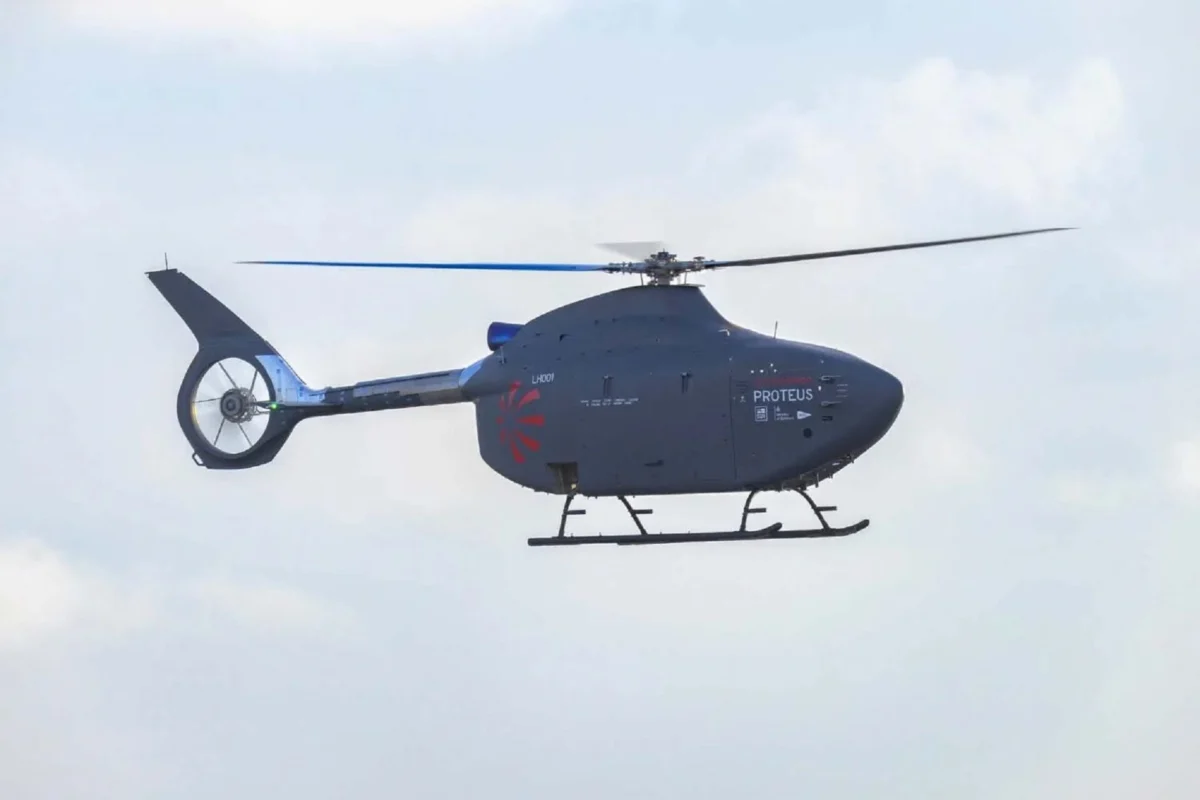
The British Royal Navy has successfully completed the maiden flight of the Leonardo Proteus, the UK’s first autonomous full-size helicopter.
On January 16, 2026, the Royal Navy announced that the demonstrator, built exclusively for its use, had operated from Predannack airfield in Cornwall.
In September 2025, Leonardo’s Managing Director of Helicopters UK, Nigel Colman, told AeroTime at DSEI in London that the Royal Navy wanted to see Proteus fly “this year”.
During its first flight, Proteus undertook a short test routine which saw the aircraft operate its own flying controls independently, while under supervision from test pilots.

The Royal Navy wants the Proteus demonstrator’s main mission to be Anti-Submarine Warfare (ASuW), but it is capable of much more.
Leonardo designed Proteus to conduct a range of missions including anti-submarine warfare, Intelligence, Surveillance, and Reconnaissance (ISR) and search and rescue. In total, Leonardo was tasked with 16 mission sets to explore by the Royal Navy.
Commodore Steve Bolton, Royal Navy Deputy Director Aviation Future Programs, said: “The successful first flight of Proteus is a significant step in delivering the Royal Navy’s maritime aviation transformation vision, and to demonstrating our steadfast commitment to investing in autonomy as part of a hybrid air wing.”
Under the UK’s Strategic Defense Review, there are plans for a ‘New Hybrid Navy’, with autonomous helicopters playing a central role in hybrid air wings and the Atlantic Bastion program to secure the North Atlantic.
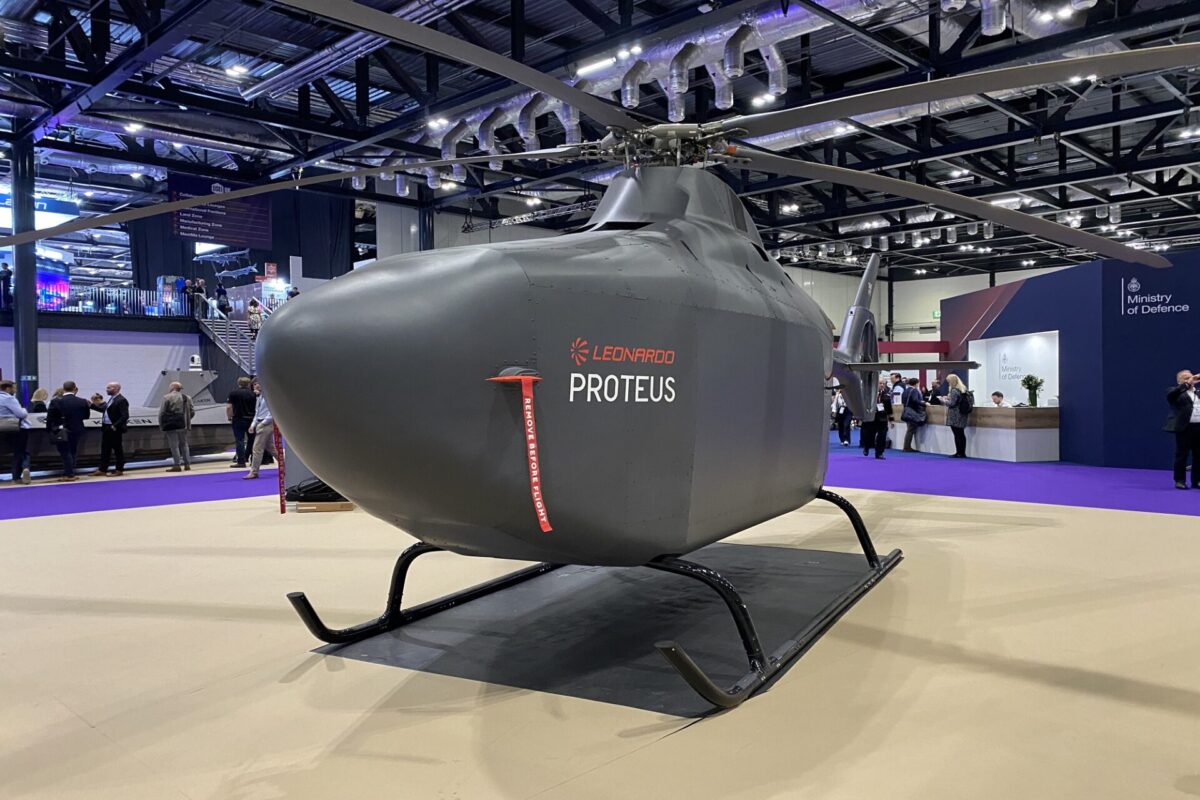
The Royal Navy currently operates several drones, including Malloy octocopters and Peregrine, but Proteus eclipses them in size, complexity and, above all, autonomy.
Commodore Bolton added: “This milestone signals our intent to lead technological innovation, to enhance the fighting effectiveness of the Royal Navy in an increasingly complex operating environment, and to maintain operational advantage against evolving maritime threats.”
Proteus relies on sensors and computer systems driven by cutting-edge software to understand and process its environment, make decisions, and act accordingly.
With a payload of over one ton, Proteus can carry a range of equipment to conduct tasks in extremely challenging weather conditions.
🚁 Liftoff!
— Leonardo Helicopters (@LDO_Helicopters) January 16, 2026
The UK’s first autonomous full-size helicopter, #Proteus, has completed a historic maiden flight at Predannack airfield in Cornwall.
Designed and built by #Leonardo in Yeovil, the Home of British Helicopters, Proteus is a major step forward in autonomous maritime… pic.twitter.com/nqZ9Qyp23Z
Leonardo’s Nigel Colman said: “Proteus represents a step-change in how maritime aviation can deliver persistence, adaptability and reach – conducting the dull, dirty and dangerous missions in challenging environments without putting human operators at risk.”
Leonardo showcased the Proteus concept for the first time at DSEI 2023, in collaboration with the Ministry of Defense (MOD).
The Royal Navy said that Proteus is “believed to be one of the world’s first full-sized autonomous helicopters”.