

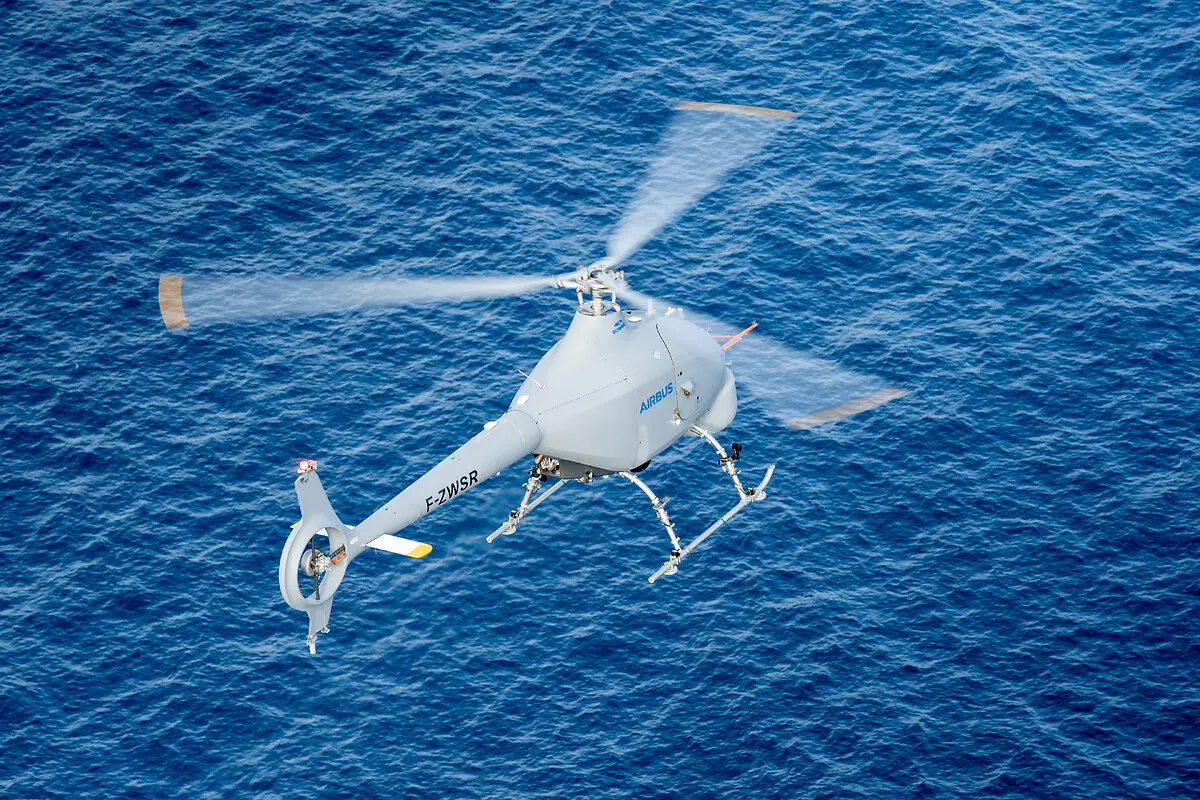
France’s defense procurement agency, the DGA, has awarded a production contract to Airbus Helicopters and Naval Group for six VSR700 uncrewed aerial systems (UAS). As announced by Airbus on January 16, 2026, the French Navy is set to begin operating them from 2028.
The contract marks the transition of the VSR700 from a demonstrator and test asset into a serial product for the French Navy under the SDAM (Système de drone aérien de la Marine) program. The effort is intended to provide major surface combatants with an organic vertical takeoff and landing (VTOL) drone, to extend surveillance and identification ranges beyond the horizon.
Airbus Helicopters described the award as the “next phase” of the program, following a framework agreement signed with the DGA in 2023 and unveiled at the Paris Air Show in 2025. The manufacturer has set up a dedicated industrial arrangement to support serial production for France and potential export customers.
ISR payload and Naval Group integration
The initial VSR700 systems for the French Navy will be configured for intelligence, surveillance and reconnaissance missions. According to Airbus, the standard fit will include a maritime surveillance radar, an electro-optical sensor, and an Automatic Identification System (AIS) receiver to track surface traffic around the host ship.
Naval Group will be responsible for integrating the VSR700 into shipboard architecture and combat systems via its Steeris mission system, which acts as the interface layer between the air vehicle and the ship’s combat management system. The UAS is intended to operate as an extension of the ship’s own sensor suite, rather than as a standalone asset.
From Cabri G2 roots to proven sea trials
The VSR700 is based on the Hélicoptères Guimbal Cabri G2 light helicopter, adapted and modified into an uncrewed platform for maritime and land-based missions. Over recent years, Airbus and the DGA have run an extensive test campaign on land and at sea to de-risk shipborne operations.
In May 2023, the prototype VSR700 completed its first operational-configuration sea trials off the coast of Brittany, flying from a civilian vessel’s helicopter deck. During this campaign, the drone conducted around 80 fully autonomous takeoffs and landings and logged roughly eight hours of testing across 14 flights. Trials were carried out in winds above 40 knots and in multiple sea states, validating the system’s automated approach, landing, and deck-handling logic in demanding maritime conditions.
For these tests, the VSR700 was already equipped with a maritime surveillance radar, an AIS receiver, and a maritime-optimized electro-optical pod, giving the DGA and Navy an early look at its intended ISR mission suite at sea.
Those initial sea trials were followed by tests from a French Navy frigate under the SDAM demonstrator phase, further validating launch and recovery procedures and the interface with naval combat systems.