
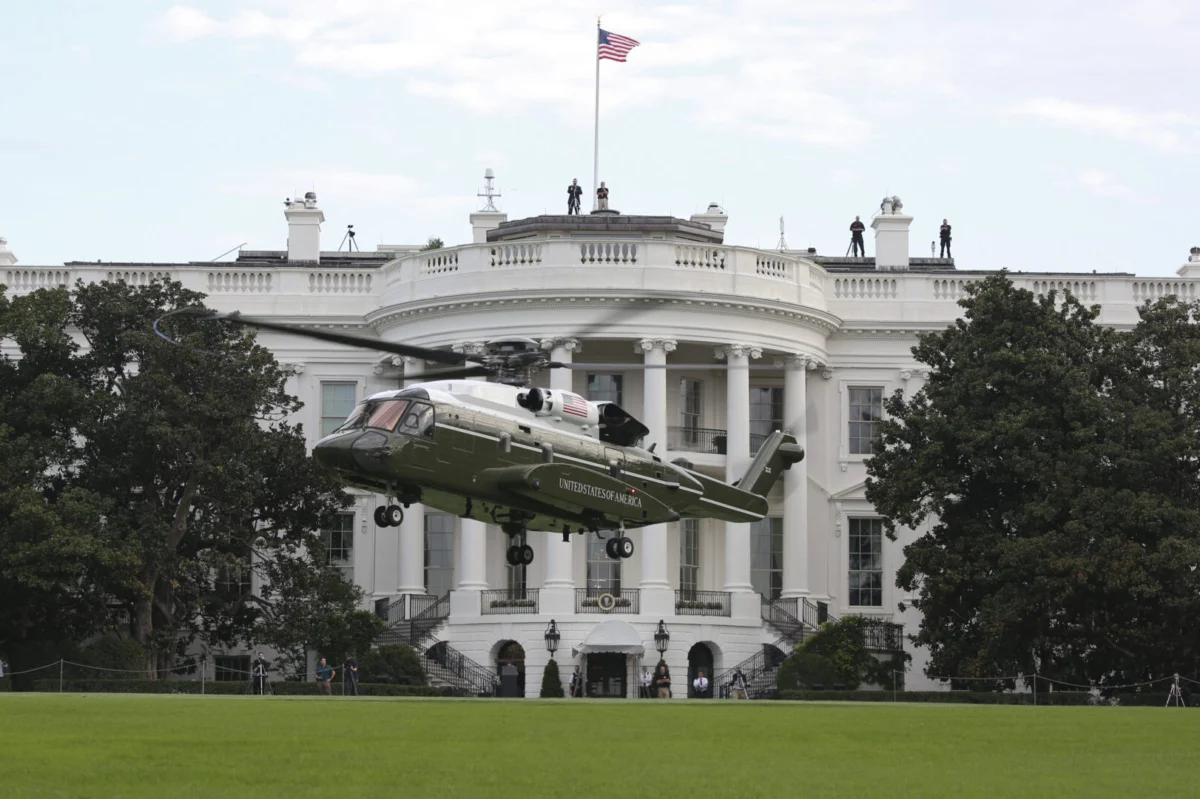
A radio communications failure between Marine One and air traffic controllers at Ronald Reagan Washington National Airport (DCA) on August 4, 2026, created a potentially dangerous situation when the presidential helicopter and an Envoy Air Embraer E170 came into close proximity.
The solution to the safety issue turned out to be surprisingly simple: move the radio equipment to a new location.
The preliminary report by the National Transportation Safety Board (NTSB) examining the incident found that inadequate line-of-sight radio coverage prevented the Marine One crew from getting its required departure call through to the DCA tower. After the Federal Aviation Administration (FAA) relocated the radio equipment from a residential neighborhood to the top of the control tower, subsequent tests encountered no further communications problems.
The August 4 incident occurred at around 14:34 local time as Marine One, a Sikorsky VH-3D carrying US President Donald Trump, departed the Ellipse while Envoy Air Flight 3742 was taking off from Runway 1 at DCA bound for Pensacola International Airport (PNS) in Florida.
Under an agreement between Marine Helicopter Squadron One (HMX-1) and Washington-area air traffic control facilities, a helicopter carrying the president is required to contact the DCA tower three minutes before departure. Once that call is received, controllers stop departures from Reagan National.
However, that call never reached the controllers on August 4, according to the NTSB.
Marine One’s first attempt to contact the tower was not received. A second transmission came through only as broken and unreadable. The crew also attempted to relay the required three-minute warning through the helicopter facility at Joint Base Anacostia-Bolling, but that effort was also unsuccessful.
Because the tower had not received any Marine One call, the local controller cleared Envoy Flight 3742 for takeoff. The E170 was becoming airborne at about the same time Marine One climbed high enough to establish radio contact with the DCA tower.
The FAA estimated that the two aircraft came within about 0.82 nautical miles laterally and 700 feet vertically of each other about two miles north of DCA.
According to the NTSB, the aircraft remained within required separation limits because they were about 700 feet apart vertically, exceeding the 500-foot minimum. Investigators are continuing to review surveillance data to determine the closest proximity between Marine One and the Envoy jet.
The Envoy crew received a Traffic Collision Avoidance System (TCAS) traffic advisory as they climbed away from Runway 1. Neither pilot saw Marine One, according to statements provided to investigators.
The Envoy pilots reported seeing about 600 feet of vertical separation displayed on TCAS as the helicopter passed behind and to the right of their aircraft. The system did not issue a resolution advisory directing the crew to take evasive action.
Once Marine One established communications with the tower, controllers issued a traffic advisory and the helicopter crew immediately reported the Envoy aircraft to be in sight.
Investigators found that the communication problem was not entirely without precedent. DCA air traffic control officials and HMX-1 representatives had met on July 30, five days before the incident. During the meeting, controllers raised concerns that they had not been receiving the required three-minute calls from HMX-1 crews recently.
HMX-1 representatives said communications had been “spotty,” according to the NTSB. The two sides agreed that crews would try alternate methods of contacting the tower when direct communications failed, including relaying the call through another aircraft.
Nevertheless, those alternate methods appear not to have worked.
FAA technicians investigated the issue after the encounter, ultimately determining that inadequate line-of-sight radio coverage between the radio site and the Ellipse was the culprit.
The FAA subsequently relocated the radios used for helicopter communications from the nearby neighborhood to the top of the DCA control tower. Tests conducted afterward with HMX-1 helicopters, at the Ellipse and elsewhere in the area, found no further communications problems.
The incident came amid heightened scrutiny of helicopter operations around Reagan National, following the January 2025 midair collision between an American Airlines regional jet and a US Army Black Hawk helicopter that killed 67 people.
The NTSB investigation into the August 4 Marine One incident remains ongoing.