
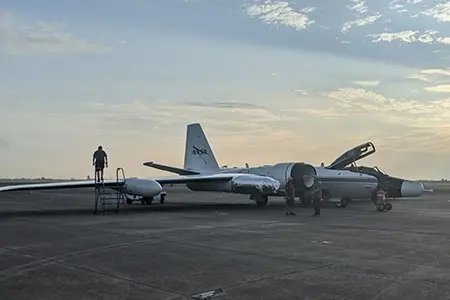
A NASA high-altitude research aircraft made a gear-up landing at Ellington Field in Houston on the morning of January 27, 2026, after experiencing a mechanical issue during landing. The two crew members onboard were uninjured, according to the agency.
The aircraft, a NASA WB-57, touched down around 11:30 a.m. local time on Runway 17R and slid along the runway before coming to a stop. Video from local media outlets showed the aircraft remaining upright as emergency responders quickly surrounded it.

Officials said the runway was temporarily closed while crews secured the aircraft and began recovery operations. First responders from a military subcontractor handled the initial response.
In a statement provided to local media, a NASA spokesperson said a mechanical issue led to the gear-up landing and confirmed that all crew members were safe.
“As with any incident, a thorough investigation will be conducted to determine what occurred,” the spokesperson said.
The WB-57 involved in the incident is based at Ellington Field near NASA’s Johnson Space Center. NASA operates a small fleet of the aircraft, which it uses for scientific and atmospheric research missions at altitudes above 60,000 feet.
Originally built in the early 1960s, the WB-57 traces its roots to the Martin B-57 Canberra, an US-built version of the British English Electric Canberra bomber. The high-altitude WB-57F variant was later developed for reconnaissance and research missions and has since been adapted by NASA for its current civilian science work.
Despite its age, the WB-57 remains one of the few aircraft in the world capable of carrying large scientific payloads to extreme altitudes for extended periods. NASA uses the aircraft for a wide range of missions, including atmospheric sampling, climate research, storm observation, wildfire monitoring, and space-related studies such as tracking rocket launches and observing solar eclipses.
The aircraft’s unique performance and payload flexibility have kept it in service decades longer than most aircraft of its generation. NASA officials have previously noted that there is no direct modern replacement that offers the same combination of altitude, endurance, and payload capacity.
Video of Tuesday’s incident circulated widely online, showing what appeared to be a controlled and stable touchdown with flames and smoke visible. The aircraft remained aligned with the runway centerline and did not appear to yaw or veer during the slide, minimizing damage and risk to the crew.
NASA did not immediately say how long the aircraft will remain out of service or whether it sustained structural damage during the landing. Recovery crews worked to remove the aircraft from the runway before normal airport operations resumed.
The incident marks the second notable runway event involving a NASA WB-57 at Ellington Field in recent years. In March 2019, a WB-57 overran the runway during takeoff and came to rest on grass adjacent to the pavement. Both crew members escaped without injury, and NASA said at the time the aircraft was shut down and moved to a hangar for inspection while the cause was investigated. No connection between the two events has been suggested.
The agency said it will release additional information as the investigation progresses.