
Joshua Kroeker is the CEO and founder of Reaktion Group. He advises governments and firms on geopolitics and military risk, as well as energy and business in Eastern Europe and Eurasia.
The views and opinions expressed in this column are solely those of the author and do not necessarily reflect the official policy or position of AeroTime.
The Russian war against Ukraine has become the first large-scale conflict in which unmanned aerial systems (UAS) are not merely a supporting capability, but a central instrument of strategic coercion.
What began as an improvised adaptation has matured into a systematic campaign in which long-range strike drones, loitering munitions, and reconnaissance platforms are used to degrade critical infrastructure, exhaust air defenses, and impose cumulative economic and psychological costs on a civilian population.
The effects of this campaign extend far beyond Ukraine. For Europe, the war offers an unambiguous warning: modern societies remain acutely vulnerable to sustained drone-enabled pressure on energy, transport, and industrial systems, and existing defense concepts are poorly calibrated to this threat.
Drones as a strategic infrastructure weapon
Russia’s use of drones against Ukrainian infrastructure is best understood not as terror alone, but as a deliberate strategy of systemic attrition. Shahed/Geran-type drones, decoys, and modified strike platforms are employed in large numbers to target power generation, transmission nodes, heating plants, and industrial facilities. The objective is not necessarily permanent destruction. Instead, the goal is to force repeated shutdowns, disrupt repair cycles, stretch defensive resources to the point where resilience erodes over time, and weaken resolve throughout Ukrainian society.
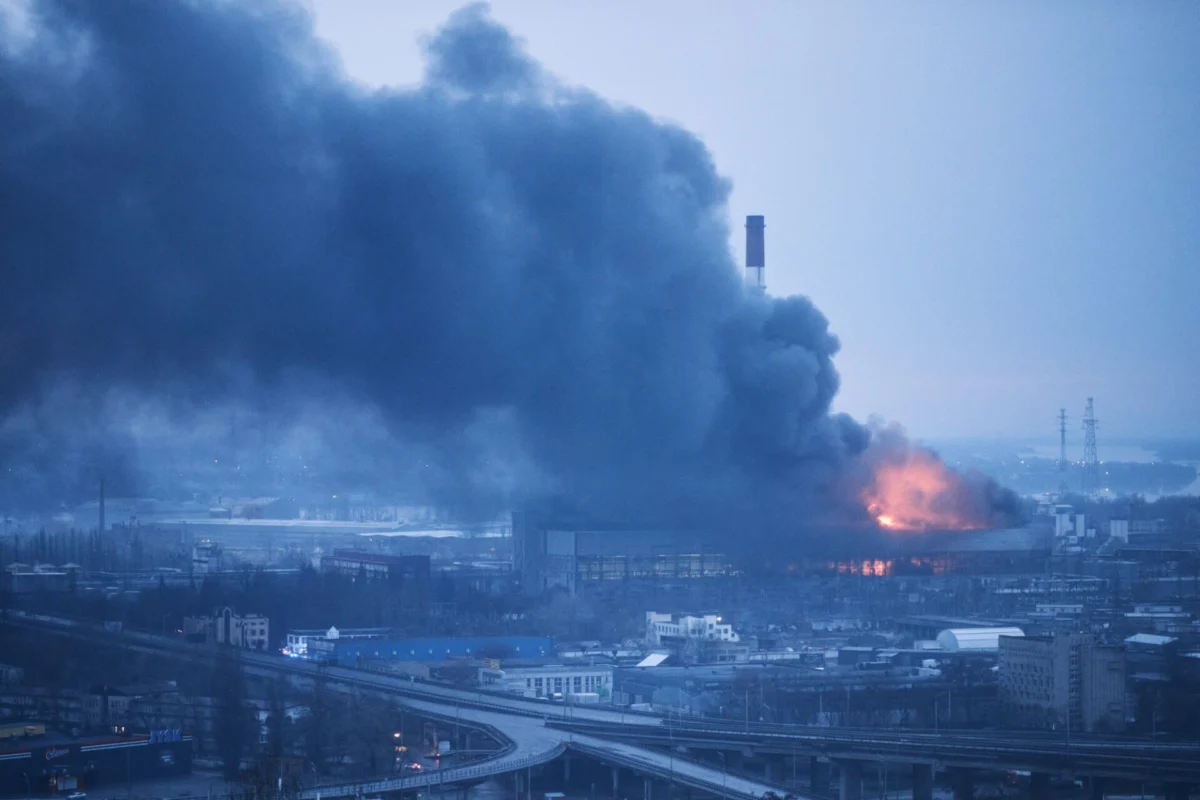
This logic has been especially visible in attacks on Ukraine’s energy and heating systems. Combined heat and power plants, thermal electricity stations, and electricity distribution networks have been struck repeatedly, often just as repairs are completed. Even when physical damage is limited, the loss of electricity can prevent facilities from restarting, creating cascading failures across interconnected systems. The result is a fragile equilibrium in which services function at reduced capacity only when attacks temporarily pause. At the time of writing, roughly 70% of Kyiv homes are without electricity at any given time, and heating and hot water are also seldom available. At -15-degree temperatures, the author has not had heating for over a week.
For Russia, drones are ideally suited to this mission. They are relatively cheap, can be produced at scale, and can be launched in mixed waves designed to overwhelm air defense. Their effectiveness does not depend on precision alone, but on persistence. Each successful penetration compounds the strain on infrastructure, maintenance crews, and the civilian population. This has negative effects for the country’s industrial output, especially for the military-industrial complex that supplies the Armed Forces of Ukraine. In the end, Russia has found a relatively inexpensive strategy to harm military output, operations, and civilian resilience.
The economics of exhaustion
One of the most critical lessons for Europe lies in the economics of this approach. Ukraine and its partners (such as NATO in Poland in September 2025) routinely intercept drones using surface-to-air missiles that cost orders of magnitude more than the incoming threat. Even when interception rates are high, the defender pays a disproportionate price. Over time, this imbalance creates a strategic dilemma: protect everything at unsustainable cost or accept selective degradation of infrastructure and even loss of life.
This dynamic has profound implications for European defense planning. Most European air defense architectures are optimized for aircraft and ballistic missiles, not for mass, low-cost, and unmanned threats. The Ukrainian experience demonstrates that drone campaigns do not need to be decisive in a military sense to be strategically effective. They function instead as a long-term pressure tool that exploits the defender’s economic and political constraints.
In peacetime Europe, similar attacks would likely trigger immediate political crises. Power outages, heating disruptions, or industrial shutdowns would cascade into public outrage, market instability, and pressure on governments to de-escalate or compromise. The Ukrainian case shows that resilience is not merely technical but also societal and political.
Over the past 12 months, Russia has, by a magnitude of some 200-500%, increased the cadence and amounts of drones that it is throwing at Ukraine. While back in summer 2024, four to six drones would attack Kyiv at night; the number now is easily over 100. Civilian deaths have notably increased, but the effects on critical infrastructure have been devastating, with Ukraine experiencing the worst losses of power and heating since the beginning of Russia’s full-scale invasion in 2022.
Critical infrastructure as the new frontline

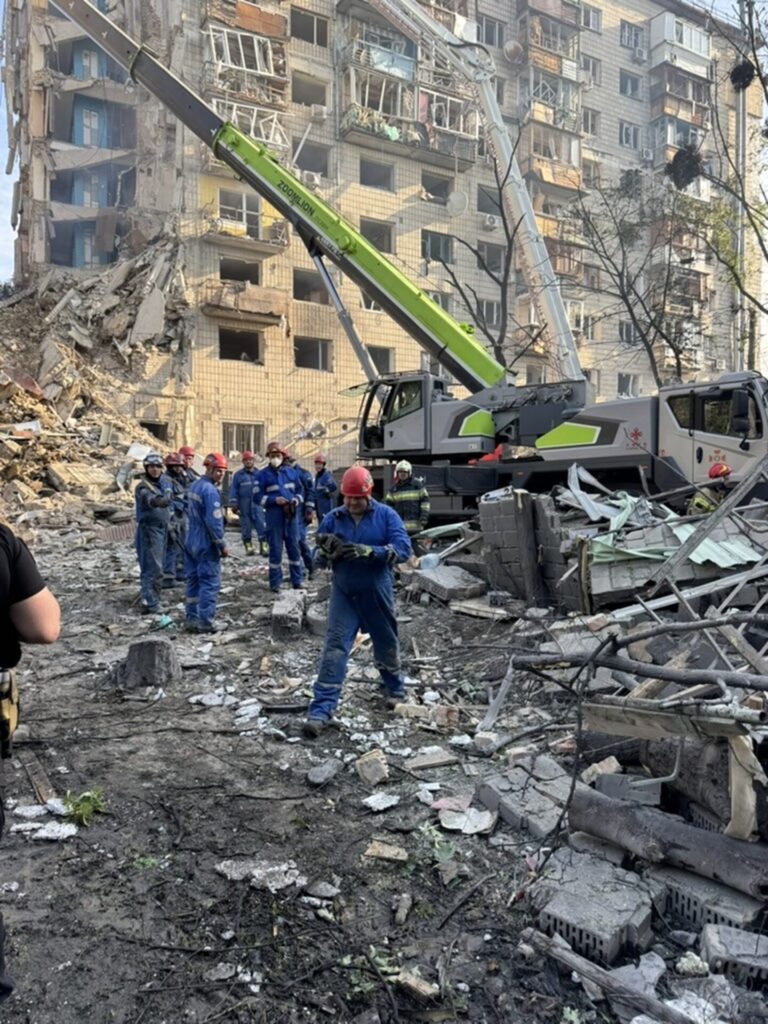
Ukraine’s war has also exposed how deeply modern warfare has blurred the boundary between the battlefield and civilian life. Energy systems, water supply, telecommunications, and transport infrastructure are no longer rear-area assets. Today, they are primary targets, with Russia attack Ukraine’s power and heating plans in December 2025 and January 2026 almost weekly.
European states face comparable vulnerabilities. Like Ukraine’s energy grid, European energy grids are centralized, digitally managed, and often poorly protected against physical attacks. Many rely on a small number of critical nodes whose disruption would have nationwide effects. The transition to renewable energy, while strategically necessary, has introduced additional exposure through dispersed but lightly protected assets such as substations, wind farms, and grid interconnectors.
Moreover, Europe’s infrastructure is designed for efficiency, not redundancy under attack. The Ukrainian experience demonstrates that distributed generation and decentralized systems are far more resilient to drone campaigns than large, centralized facilities – a lesson Ukrainians are experiencing now. Yet most European energy systems still depend heavily on precisely the kind of infrastructure Russia has learned to exploit.
Decentralized, numerous nodes of power and heat supply have proven more difficult and more costly for the aggressor to destroy. While this is not always possible or feasible, energy infrastructure can be designed – and even overhauled – to be less vulnerable to attack, or at the very least to be only one of many nodes in a much larger system that does not collapse when one is destroyed.
Adaptation and the arms race in the air
Another key risk lies in the speed of adaptation. Russia has demonstrated an ability to iterate quickly, modifying drones to counter electronic warfare, adjusting flight profiles, and integrating new guidance and navigation methods. The campaign against Ukraine’s infrastructure is not static, but rather a learning process.
Europe should assume that adversaries will apply these lessons directly, while China and others are watching. Drone swarms, decoys, and mixed attack profiles will be used to probe defenses, identify weak points, and refine tactics. The barrier to entry is also low. State and even non-state actors alike can (and currently are) acquire or manufacture systems capable of disrupting critical infrastructure with limited resources.
The Ukrainian case also highlights the limits of purely defensive adaptation. While air defense remains essential, it cannot be the sole answer. This is demonstrated in Ukraine. While the country has battle-effective air defense capabilities, large, combined attacks mean that the system can be overwhelmed, and destruction occurs. Military planners therefore need to go beyond traditional combat measures. Hardening infrastructure, dispersing and decentralizing generation, diversifying energy infrastructure, and building rapid-repair capacity are equally important. Yet these measures require time, investment, and political will, all of which are often lacking in peacetime Europe, nearly four years into Russia’s invasion of Ukraine.
Psychological and political effects

Beyond physical damage, drone campaigns exert a powerful psychological effect. The constant threat of attack, the unpredictability of outages, and the visible struggle to maintain basic services erode public confidence. In Ukraine, this pressure is mitigated by wartime solidarity and a clear understanding of the stakes. But even in Ukraine, after weeks of energy and heating deficiencies, societal cohesion does wear down. In Europe, similar conditions would be far more destabilizing.
Russian drone operations should therefore be seen as a form of political warfare. They test not only infrastructure, but governance. How quickly can authorities respond? How transparently can they communicate? How much disruption will societies tolerate before demanding political change?
For European adversaries, this is an attractive avenue of coercion. It offers plausible deniability, scalable escalation, and a means to exploit internal divisions without crossing traditional thresholds of war.
Implications for European defense
The central risk for Europe is complacency. Ukraine’s experience is often framed as unique, shaped by geography and the intensity of the conflict. This is a dangerous illusion. The underlying vulnerabilities are structural and widely shared.
European defense planning must therefore integrate several hard lessons:
- First, air defense must be rebalanced. High-end interceptors are necessary but insufficient. Europe requires layered systems capable of countering mass, low-cost drones economically, including guns, drone interceptors, short-range missiles, electronic warfare, and directed-energy systems.
- Second, critical infrastructure protection must become a core defense mission. This includes physical hardening, redundancy, and the ability to operate under degraded conditions. Energy, water, and transport systems must be designed with conflict in mind, not just efficiency. Critical infrastructure sites should also be equipped with electronic warfare and other security systems.
- Third, resilience must be institutionalized. Rapid repair, spare parts, stockpiles, trained crews, and clear command structures are as important as interception. Ukraine’s ability to restore partial functionality after repeated attacks has prevented collapse, but at enormous cost. Europe should not wait to learn these lessons under fire.
- Finally, strategic communication and civil preparedness are essential. Societies must understand that disruption does not equal defeat. Without public resilience, even limited attacks can achieve disproportionate political effects.
Conclusion
Russian drone operations against Ukrainian critical infrastructure represent a fundamental shift in how modern warfare targets societies. They demonstrate that strategic effects can be achieved not through decisive blows, but through sustained, adaptive pressure on the systems that underpin everyday life.
For Europe, the warning should be clear. The continent’s infrastructure, defense posture, and political systems are not prepared for this form of warfare. Addressing this gap requires more than technical fixes. It demands a rethinking of defense, resilience, and the relationship between civilian infrastructure and national security.
Ukraine is facing this lesson in real time. Europe still has the opportunity to learn it in advance.