

The war in Ukraine has made one battlefield reality impossible to ignore. Small, inexpensive drones can alter a fight in ways that far exceed their price. They spot targets, adjust fire, strike vehicles, and keep pressure on opposing forces day after day. Just as important, they force an uncomfortable choice. Defenders can try to use expensive interceptors to shoot down cheap, expendable aircraft, or they can absorb damage and accept limits on their own movement and control.
This dilemma has pushed militaries toward the next phase of unmanned aviation. The future is not just about more drones, but large numbers of drones acting together.
Enter the era of the drone swarm.
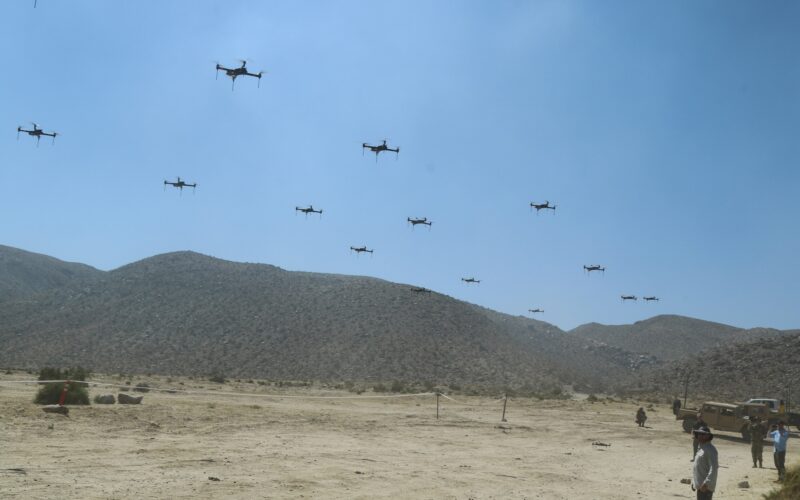
A true drone swarm is not simply a large number of unmanned aircraft in the same airspace. It is a coordinated system. The drones share information, time their movements, avoid collisions, and divide tasks. If one drone fails, the rest adapt and continue. In a swarm, the behavior of the group matters more than the performance of any single member.
How swarms work
At a basic level, a drone swarm works by sharing small pieces of information among its members rather than relying on a single controller. Each drone knows its own position, speed, battery state, and what its sensors detect. It exchanges that data with nearby aircraft and follows simple rules about spacing, task assignment, and priority.
One drone may focus on sensing, another on navigation, and another on communications. If a drone drops out, nearby aircraft detect the gap and adjust or take over its task. No single drone needs to understand the entire mission. Coordination emerges from many small decisions made locally, guided by software that keeps aircraft separated, assigns roles, and prevents the group from falling apart when links degrade.
This distinction explains why swarming is as much a software problem as an aviation one. A human operator can fly a single drone and still maintain full situational awareness. Managing dozens at once while monitoring sensors, avoiding conflicts, and reacting to threats quickly becomes impossible. Automation and artificial intelligence support that supervision by handling spacing, task assignment, and basic decision-making across the group, without removing humans from control of the mission itself.
This does not require full autonomy or machines making life-and-death decisions on their own. In practice, most current swarm development focuses on reducing operator workload, improving coordination, and keeping systems functioning when communications degrade. Across the industry, developers emphasize keeping human operators central to decision-making while using software to manage the complexity of coordinating many aircraft.
Multiple proving grounds
In testimony to the US House Armed Services Committee in May 2025, Defense Innovation Unit Director Douglas Beck warned that “commercially derived and custom-built small unmanned systems are operating at higher speeds, in swarms, and are increasingly resilient to disrupted and denied communications through constant updates.”
The takeaway is clear. Coordination and adaptability now matter as much as airframes or payloads.
While the implications are most visible on today’s battlefields, the same ideas are beginning to take hold well beyond them. The coordination and resilience that make drone swarms effective in war are also opening new possibilities in civilian aviation, for everything from infrastructure inspection to search-and-rescue missions.
Still, the battlefield remains the most potent proving ground. Ukraine did not introduce drone swarms, but it showed what happens when cheap drones are used relentlessly. Even when most aircraft are still flown one at a time, sheer numbers change the character of the fight. Drones are always present. They watch constantly, strike often, and return again the next day. Over time, that pressure reshapes how both sides move, hide, and defend themselves. It has also forced a blunt realization: modern air defense is no longer just a technical challenge. It is a question of cost, production, and endurance.
A defender can shoot down drones with missiles, but that approach is hard to sustain when each missile’s cost far exceeds that of its target. Swarms exploit this imbalance. They can saturate sensors, force defenders to reveal positions, and drain inventories. A defender may win individual engagements and still lose strategically by running out of money, missiles, or both.
“We must end the unsustainable pattern of shooting down increasingly sophisticated, lethal drones—that in many cases cost just a few hundred dollars—with exquisite multimillion-dollar weapons that are difficult to produce and to replace once expended,” Beck told lawmakers in his testimony.
This is why counter-swarm capabilities have become an urgent focus for research and development. Militaries still rely on guns and missiles, but they now need tools that remain effective against large numbers of low-cost threats. Electronic warfare can disrupt navigation and control links. Improved sensors can detect small drones earlier. But the most visible shift has come from directed energy, which promises a far lower cost per engagement.
Cheap shots matter
Directed-energy weapons have moved to the center of counter-swarm thinking, with high-energy lasers leading the way. The appeal is straightforward. Missile launchers run out of interceptors, but a laser can keep firing as long as the platform can supply power and manage heat. Against cheap, expendable drones, that endurance matters. Lasers also flip the cost equation, replacing six- or seven-figure interceptors with shots that cost only a few dollars in electricity.
The UK has been unusually clear in framing this shift. Its DragonFire laser program has been promoted not just as a technical achievement, but as an economic necessity in a world of mass drone threats. The same logic underpins US efforts such as the Compact Laser Weapon System, which the Pentagon has tested as part of layered air-defense concepts designed to counter large numbers of small aircraft without exhausting missile stocks.
Lasers do have limits, however. A laser needs a stable beam on target, and weather can be an issue. Fog, rain, dust, smoke, and sea spray can all degrade performance, particularly at longer ranges. Those constraints have pushed militaries to look beyond lasers alone.
This is where radio-frequency directed-energy weapons enter the picture. Rather than burning through a target, radio-frequency systems attack a drone’s electronics, disrupting or damaging components across a wider area. British trials in 2025 demonstrated the ability to disable large numbers of drones at once, with reported costs per engagement measured in pennies.
Layered defense
For operators, the appeal is practical as well as economic. Following those trials, a non-commissioned officer from the UK’s 106th Royal Artillery Regiment described the system as “quick to learn and easy to use,” adding that with greater range and power it could become “a valuable asset for multi-layered air defense.”
Unlike lasers, radio-frequency effects can remain useful when visibility is poor, making them a natural complement rather than a replacement.
Together, lasers and radio-frequency systems illustrate how counter-swarm defense is evolving. No single technology offers a complete answer. Instead, militaries are building layered defenses that balance cost, endurance, and environmental limits, driven by the same underlying reality: cheap drones demand defenses that are just as sustainable.
Offensive evolution
Defensive systems, however, tell only half the story. The offensive side of swarming is advancing just as quickly, and the United States has signaled its intent through initiatives like Replicator, a Pentagon effort to field large numbers of low-cost, expendable unmanned systems.
Announcing the program, US Deputy Secretary of Defense Kathleen Hicks framed it as a response to urgency rather than novelty. “We face an urgent challenge, and we intend to meet it with the courage to bet big,” she said, describing Replicator as an effort to move faster by relying on existing technologies and production capacity rather than waiting for bespoke systems.
At the strategic level, swarms are not just about striking targets. They can act as decoys, sensors, relays, and jammers. They can flood an area with uncertainty and force defenders into constant trade-offs. They also change how militaries think about loss. When drones are inexpensive and plentiful, losing aircraft becomes an expected cost rather than a crisis.
In many cases, the most valuable part of a swarm is not the drone itself, but the control software that allows different aircraft to fly together, avoid collisions, share information, and keep operating when communications break down. Swarming favors systems that are dependable, adaptable, and easy to replace, because the goal is reliability and persistence, not perfection.
As drone swarms become more capable, they also raise important questions. Faster coordination can help protect friendly forces by reducing the time between detection and action. But it can also increase the risk of mistakes, especially when civilians and civilian infrastructure are close to military targets. Even when a human approves a strike, software increasingly influences what information that person sees and how much time they have to decide.
China and Russia
China and Russia are both investing heavily in drone swarming, but they are approaching the problem from different starting points.
China has been the most open about its ambitions. Chinese state media and military researchers have published extensively on swarm concepts, including launches of large numbers of drones from trucks, aircraft, and ships. The People’s Liberation Army views swarms as a way to overwhelm defenses, gather intelligence, and complicate an adversary’s decision-making. Chinese firms have demonstrated containerized launch systems that release dozens of drones at once, as well as fixed-wing and quadcopter swarms designed to coordinate attacks or reconnaissance. Much of this work builds on China’s dominance in the commercial drone supply chain, which gives it a deep pool of hardware, manufacturing capacity, and rapid upgrade cycles.
Russian efforts have been shaped more directly by combat experience. Early in the war in Ukraine, Russia relied heavily on individual drones for surveillance and strike missions, often using commercially derived platforms. As the conflict dragged on, Moscow increased its focus on mass and persistence, fielding large numbers of inexpensive drones alongside longer-range systems. Russia has also explored coordinated drone attacks designed to saturate Ukrainian air defenses and force the use of costly interceptors. While Russia has spoken less publicly about advanced swarm autonomy, battlefield patterns suggest growing emphasis on numbers, redundancy, and constant pressure rather than on sophisticated individual platforms.
In both cases, the lesson mirrors what the United States and its allies are learning. Swarming is not just about clever algorithms or novel airframes. It is about production, supply chains, and the ability to adapt faster than an opponent. China’s strength lies in manufacturing depth and integration with civilian industry. Russia’s approach has leaned on improvisation and rapid battlefield feedback. Both reinforce the same conclusion: in future conflicts, the side that can field, replace, and coordinate drones most efficiently may gain an advantage even without technological superiority in any single aircraft.
Beyond the battlefield
Those concerns are inseparable from the battlefield, but they are not the whole story. Many of the same characteristics that make swarms powerful in war—coordination, redundancy, and speed—are also what make them valuable in civilian and commercial aviation. In those settings, the appeal is not autonomy for its own sake, but resilience. When one drone fails, the mission continues.
Aviation maintenance offers one of the clearest examples. Korean Air has demonstrated aircraft inspection using coordinated drone swarms equipped with high-resolution cameras. By inspecting multiple sections of an aircraft at the same time, the airline has said it can reduce inspection time from roughly ten hours to four, while improving safety by keeping maintenance staff off scaffolding and lifts. If one drone fails, the remaining aircraft complete the inspection.
Airports and aviation infrastructure represent a natural extension. Coordinated drones can inspect runways, lighting systems, fences, and navigational aids at the same time, reducing downtime and improving the detection of small defects. For large hubs, the ability to inspect wide areas quickly and repeatedly has obvious operational value.
Infrastructure inspection beyond aviation follows the same pattern. Power utilities already rely on drones to inspect transmission lines and substations. Swarms can make that work faster and more reliable. Multiple drones can fly coordinated routes, share imagery, and identify problems as they appear. The same approach applies to pipelines, rail corridors, bridges, cell towers, wind farms, and solar installations. Offshore energy presents another strong use case, where swarms can inspect platforms and turbines without exposing workers to hazardous environments.
Civilian advantages
Emergency response may be the most compelling civilian application. In search-and-rescue missions, a single drone can scan an area. A swarm can grid it. Coordinated drones can search terrain with optical and thermal sensors, adjust patterns as new information emerges, and relay communications when ground networks fail. After earthquakes, floods, or hurricanes, swarms can rapidly map damage, identify blocked roads, and locate survivors long before crewed aircraft or ground teams arrive.
Wildfire monitoring fits the same model. Swarms can track fire lines, monitor wind-driven changes, and provide data to firefighters while operating in conditions that are dangerous for piloted aircraft. Keeping multiple eyes on a fast-moving fire can improve situational awareness when minutes matter.
Environmental monitoring and scientific research can also benefit from coordinated flight. Swarms can track wildlife populations, monitor migration routes, measure air and water quality, and survey coastlines or forests in detail. In agriculture, multiple drones can survey crops at once, identify stress patterns, and apply treatments precisely where needed. The result is reduced chemical use, better yields, and faster response to emerging problems.
Logistics and industrial operations represent another frontier. Public attention often focuses on one drone delivering one package. Coordinated fleets change that picture. Multiple drones can manage deliveries at once, share airspace awareness, and reroute as conditions change. Inside large warehouses, ports, and shipyards, swarms can perform inventory scans, monitor operations, and inspect containers or structures in parallel.
Why it matters
Entertainment may be the most familiar civilian example. Drone light shows use hundreds or thousands of aircraft flying tightly choreographed patterns to form images in the sky. They work not because any one drone is special, but because the group is predictable, precise, and reliable. If one aircraft drops out, the show goes on.
That same principle runs through nearly every civilian use case. Drone swarms work not because they remove people from the process, but because they allow people to oversee more work with less risk. They shorten inspections, widen coverage, and keep operations moving even when individual aircraft fail.
This is why swarms are likely to keep spreading. They make it possible to use many inexpensive aircraft without overwhelming operators, and they allow missions to continue even when losses occur. Ukraine has shown why numbers matter in combat. Civilian aviation and industry are now showing why the same logic applies far from the battlefield.
Swarming does not require perfect machines or full autonomy. It rewards systems that are dependable, adaptable, and easy to replace. That combination, more than any single technology, is what makes drone swarms hard to ignore.
The remaining questions are not about whether swarms will become common. They are about who will build them fastest, how societies will regulate them, and whether defenses can keep up without going broke.