

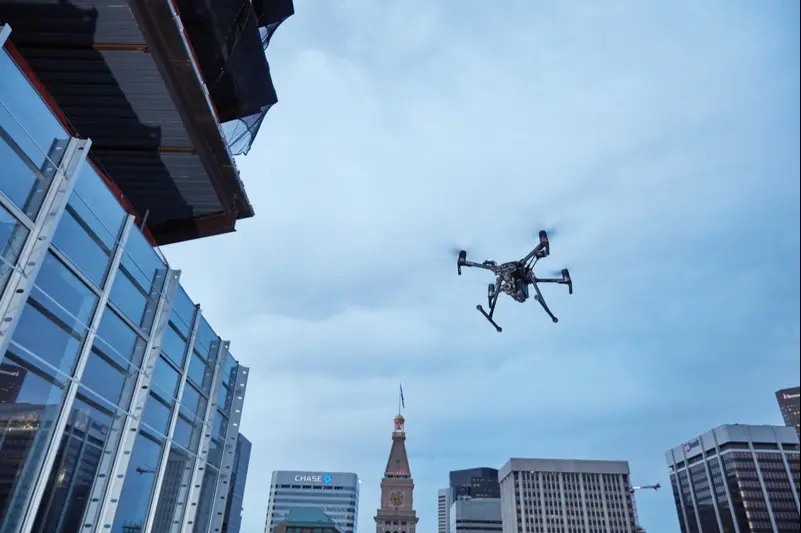
The Federal Aviation Administration has issued a nationwide security notice, effectively creating a moving drone no-fly zone around operations conducted by Immigration and Customs Enforcement (ICE) and other components of the Department of Homeland Security.
The notice, NOTAM FDC 6/4375, prohibits unmanned aircraft systems from operating within 3,000 feet laterally and 1,000 feet vertically of DHS facilities and mobile assets, including ground vehicle convoys and their escorts. The restriction applies nationwide and continuously, rather than at fixed locations or during defined time windows.
Because ICE operates under DHS and routinely conducts enforcement actions using mobile vehicle convoys in public spaces, the restriction functions as a drone no-fly zone around ICE operations, including arrests, transport activities and other field actions.
The FAA classifies the restricted airspace as “national defense airspace,” and cites its authority under federal security statutes. Drone operators who violate the restriction may face criminal prosecution, civil penalties, administrative enforcement actions, or revocation of FAA operating privileges. The notice also states that drones deemed a credible security threat may be intercepted, seized, damaged, or destroyed.
Unlike traditional Temporary Flight Restrictions, the NOTAM does not provide geographic coordinates, activation times, or public notification when the restriction is in effect near a specific location. Instead, the restricted airspace moves with DHS assets, meaning the no-fly zone can appear wherever ICE or other DHS units operate.
The new NOTAM replaces an earlier security notice, FDC 5/6378, which covered similar federal agencies but was less explicit about mobile operations. The updated version removes ambiguity by clearly stating that the restriction applies to moving DHS assets, including vehicles and convoys, and not just fixed facilities such as offices or bases.
That clarification has drawn attention from drone operators and civil liberties groups because it creates dynamic, invisible exclusion zones that may be impossible to identify in real time. The FAA does not publish public tracking of DHS or ICE movements, and the NOTAM does not include a mechanism for drone pilots to determine when covered assets are nearby.
In practical terms, a drone operator flying legally in a public area could unknowingly enter restricted airspace if an ICE convoy passes within the protected radius. The FAA instructs operators to “exercise caution” when flying near DHS facilities and mobile assets, but offers no specific guidance on how to do so in environments where enforcement activity is not publicly disclosed.
The notice mentions limited exceptions. Drone operations conducted in direct support of national defense, homeland security, law enforcement, firefighting, search and rescue, or disaster response missions may be authorized with advance coordination. Operators seeking approval are instructed to coordinate with DHS or other covered agencies, or contact the FAA’s System Operations Support Center.
The FAA cites multiple federal statutes as the legal basis for the restriction, including laws governing national defense airspace and counter-UAS mitigation.
4 comments
Will DHS publish the locations of all its facilities including the detention centers it is trying to hide? Will it provide realtime updates of its roving kidnap vans?
More BS from our “leaders”. Next, journalists will not be permitted to record with still cameras or video, but no restrictions on cell phone use- that will be the final push.
This is so frustrating and pointless because how would you know if you are in Airspace violation if you don’t know where they are at. This puts pilots at risk of themselves getting shot or shot at if they have the legal authority to operate. If they aren’t aware of on going ICE operations, how would they know to stay 3000/1000 rule if they don’t know the exact long/lat?
This is sick. They should at least say we are expected to land immediately if we realize we are inside an ICE operation and recheck the airspace. There is no way to monitor airspace while we fly. It is really scary whats happening to our country and the fact that so many people are okay with it. The FCC is also telling talk show hosts what they can and cant say..