
If Russia attacked Sweden, the Swedish Air Force would not confine itself to defending Swedish territory but would seek to strike military targets deep inside Russia, according to Colonel Carl Bergqvist, head of the service’s Air Warfare Center.
In an interview with Swedish daily Aftonbladet, Bergqvist described an approach intended to make aggression costly, with potential targets including military infrastructure, bases, command nodes and logistics.
Swedish Armed Forces planning documents show how that concept is taking shape. They combine a growing long-range strike capability with dispersing Gripen fighters across military bases, civilian airports and road strips to keep the force operating after an opening attack.
Gripens disperse to survive an opening attack
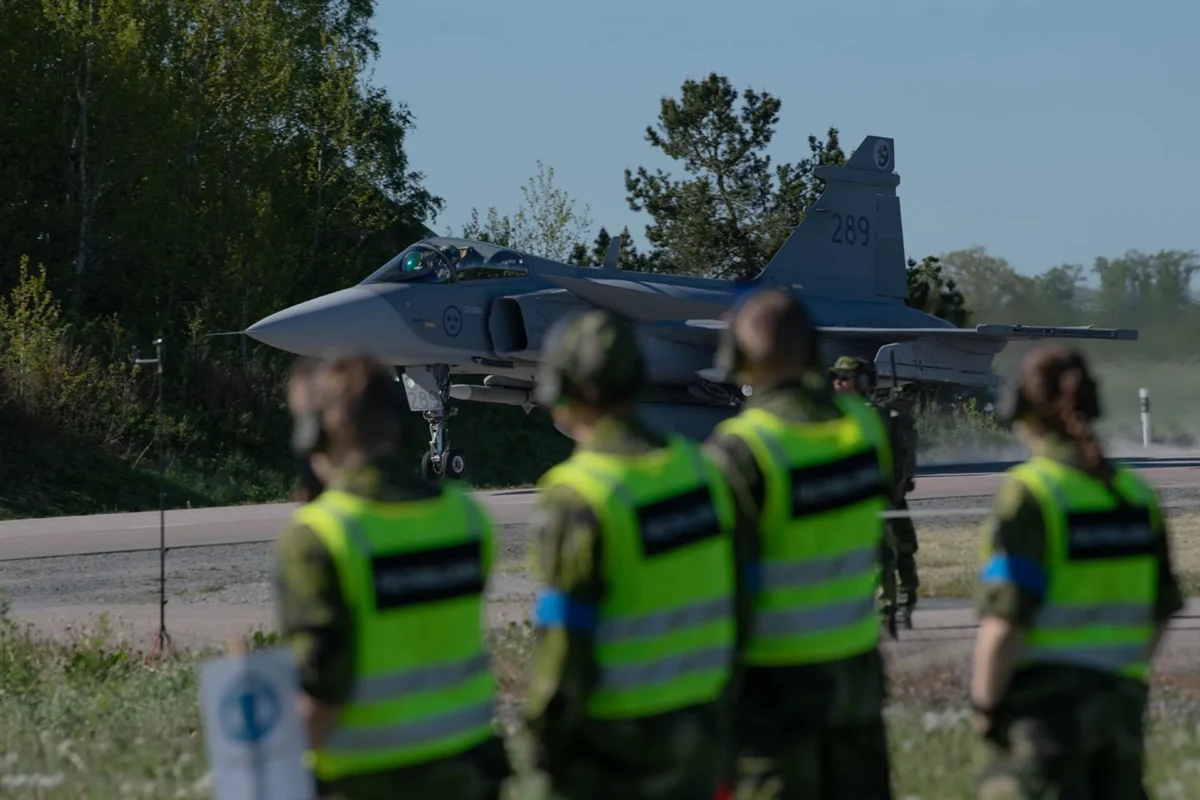
During the Aurora 26 exercise, Gripens from the Blekinge Wing (F 17) spent five days operating from short runways at Hagshult, a Cold War-era dispersed base.
Each strip is 800 meters (approximately 2,620 feet) long and can be used if the main runway is knocked out. The aim was to make the force less vulnerable to external threats, the Swedish Armed Forces said on April 30, 2026.
“It is through dispersal that Ukraine is handling the war,” said Lieutenant Colonel Robin Ohlsson, commander of the 171st Fighter Squadron, adding that Sweden’s short-runway experience could feed into NATO’s Agile Combat Employment concept.
Sweden’s 2027 budget submission says the Air Force will continue developing dispersal between military bases and civilian airfields and road bases through 2030, alongside mobile units capable of servicing fighters away from their main bases.
Taurus gives Gripen a new deep-strike capability

(Credit: Swedish Air Force)
Dispersed operations form only one part of Sweden’s approach. The other is ensuring that aircraft can strike back using long-range weapons.
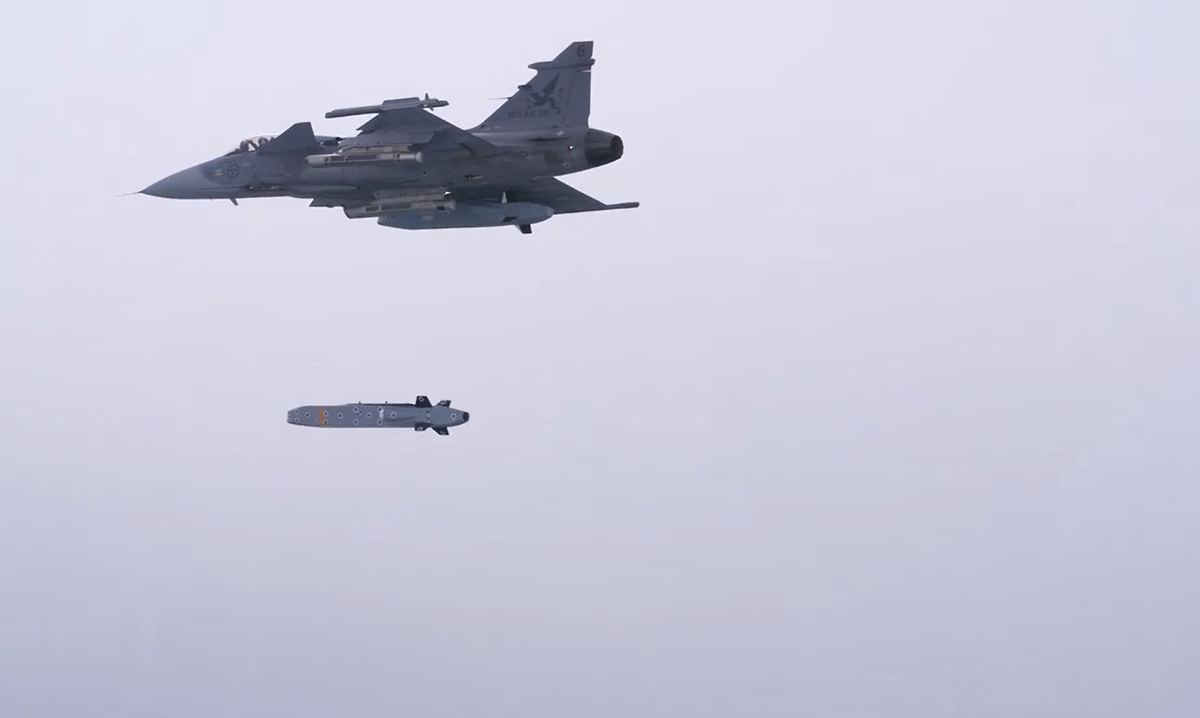
Sweden is already moving toward a shorter-range airborne strike capability with the Taurus KEPD 350 cruise missile.
The Swedish Air Force announced on August 21, 2026, that a Gripen had launched a Taurus for the first time at the Vidsel Test Range.
Saab, whose joint venture with MBDA Deutschland produces the Taurus family, lists the missile’s range as more than 500 kilometers (approximately 310 miles) and describes it as designed to attack hardened and deeply buried targets.
In its 2024 annual report, dated February 21, 2025, the Armed Forces said the Swedish Defence Materiel Administration had been tasked with procuring the KEPD 350 from Germany and integrating it first on the JAS 39C to provide an initial capability. Integration on the JAS 39E is planned at a later stage.
Swedish plans envisage strikes at strategic depth
In its budget submission for 2027, dated February 27, 2026, the Swedish Armed Forces define long-range strike as including the ability to engage targets at strategic depth, up to approximately 2,000 kilometers (approximately 1,240 miles).
The document says such a capability would strengthen deterrence by allowing Sweden to degrade an adversary’s critical infrastructure and military installations.
It does not identify the weapon system that would provide the approximately 2,000-kilometer reach, saying further analysis will precede the choice. None had been selected as of that date.
The document also does not say the 2,000-kilometer capability would come from a Gripen-launched weapon.
Sweden deploys Gripens from forward base in Poland
That emphasis on operating Gripens away from their main bases is also visible in Sweden’s current NATO deployment on the Alliance’s eastern flank, although the mission serves a different operational purpose.
Gripens from Blekinge Wing began a two-month NATO mission on October 1, 2026, protecting the logistics hub in southeastern Poland that supports Ukraine. The aircraft are based mainly in Sweden, with a smaller forward base in Poland.
On October 6, 2026, the Swedish Armed Forces announced that the Air Defense Regiment (Lv 6) would deploy Air Defense System 103, the local designation for the Patriot air defense systems, and about 100 soldiers to the hub at Rzeszów under NATO command in December 2026.
It will be Sweden’s first NATO operation involving the Patriot. Planning is underway to extend the deployment into the first half of 2027.