

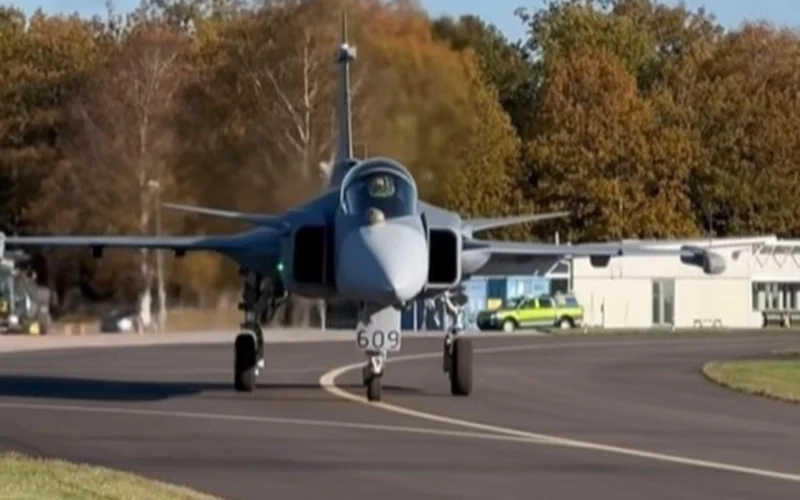
The Swedish Armed Forces formally received their first Saab Gripen E fighter aircraft during a ceremony held at the Skaraborg Air Wing (F 7) in Såtenäs on October 20 2025, marking a major milestone in the modernization of Sweden’s air power.
The handover was attended by Defense Minister Pål Jonson, who described the event as “an important day for the Air Force and for Sweden’s defense.”
“Gripen E is an example of Sweden’s technological edge, and a modern combat aircraft that, in almost every respect, is entirely new,” Jonson said on X. “The aircraft includes advanced electronic-warfare systems and can receive new software updates within hours. This enables rapid innovation and flexibility. Gripen E is also being tested with AI capabilities that have attracted international attention.”
På plats vid F7 Såtenäs där Försvarsmakten idag tar emot den första av 60 JAS Gripen E. Det är en viktig dag för flygvapnet och det svenska försvaret. Gripen E är ett exempel på svensk teknologisk framkant och är ett modernt stridsflyg som i allt väsentligt är helt nytt. (1/3) pic.twitter.com/Bse70Hb5DX
— Pål Jonson (@PlJonson) October 20, 2025
The ceremony saw a pilot from the Swedish Defence Materiel Administration (FMV) hand the aircraft’s logbook to Air Force Chief Jonas Wikman, symbolizing its official transfer into Swedish Air Force service.
“The receipt of the JAS 39 Gripen E marks an important milestone in the development of the Swedish defense,” said Commander-in-Chief Michael Claesson. “This is the result of long-term work and close collaboration between the Armed Forces, FMV and Swedish industry.”
“We are getting a fighter aircraft that is developed to meet a qualified adversary and the complex operational environment we must operate in,” Swedish Air Force Chief Jonas Wikman added. “It builds on the flexible characteristics of the current Gripen but with better performance and an advanced sensor suite that gives us superior situational awareness.”
A new capability for a new strategic era
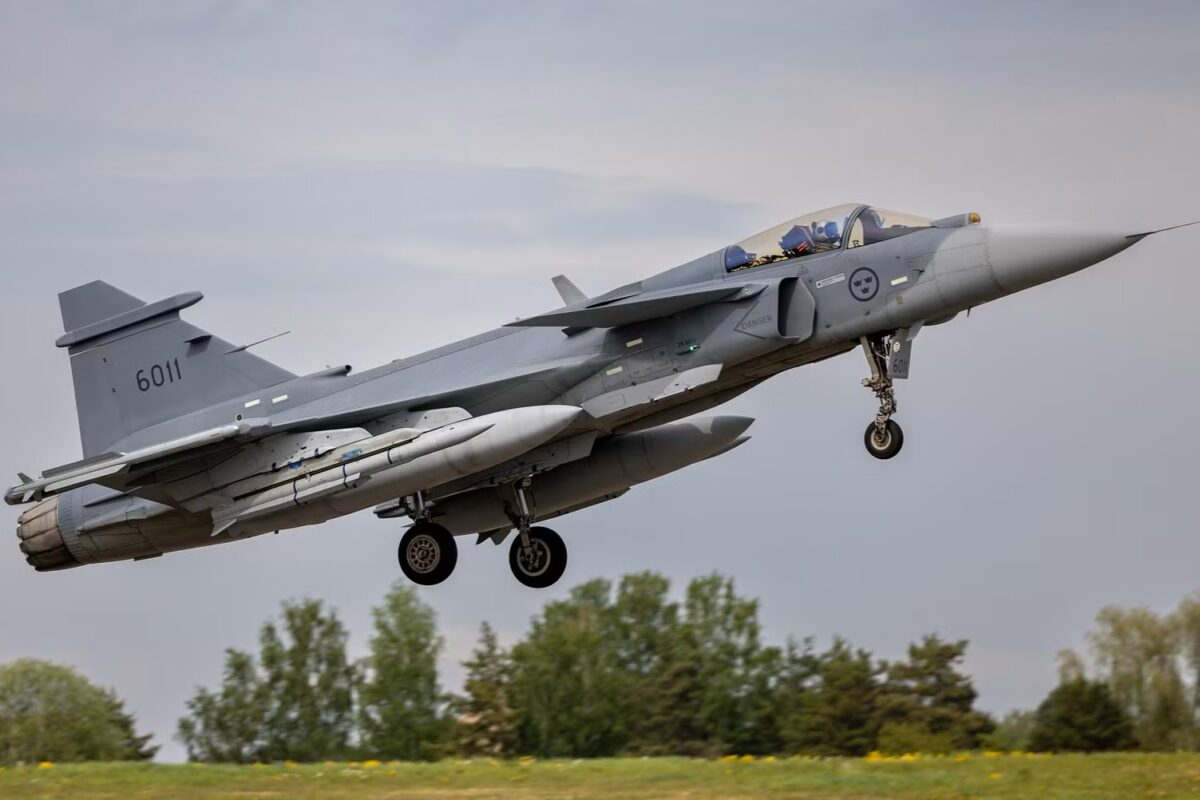
The Gripen E brings several significant upgrades over the C/D variant, including a more powerful GE F414G engine, increased internal fuel capacity, and ten external hardpoints for greater weapons and sensor payloads.
It also incorporates a modular software-defined architecture, the Raven ES-05 AESA radar, Skyward-G infrared search-and-track system, and Arexis electronic-warfare suite. These systems are designed to be rapidly reconfigurable to meet evolving operational demands.
As with previous generations, the aircraft remains optimized for Sweden’s dispersed-basing doctrine, capable of operating from short stretches of road or auxiliary airstrips to complicate enemy targeting.
The Gripen E will employ air-to-air weapons such as the Meteor beyond-visual-range missile and IRIS-T for short-range combat, alongside precision-strike munitions as the fleet matures.
Jonson added that Sweden is already studying concepts for a next-generation combat aircraft, with growing foreign interest and research funding paving the way for future advances in aerospace technology.
Bridging generations of Gripen
Skaraborg Air Wing F 7 will be the first to introduce the Gripen E into daily operations. Initial training and tactics development will be followed by progressive integration into Swedish and NATO mission profiles. Further deliveries are expected to continue through the late 2020s as Saab ramps up production.
The Gripen E’s arrival follows more than a decade of preparation. Saab’s development of the new variant began in 2011, and a 2013 agreement between FMV and Saab set the foundation for production of 60 aircraft for the Swedish Air Force. Follow-on contracts have since supported testing, integration, and industrial readiness, including a SEK 2.9 billion ($270 million) package in 2025 to sustain dual-fleet operations as C/D aircraft remain in service.
Sweden has invested heavily to keep its Gripen C/D fleet operational until the E takes over.
In 2023, FMV awarded Saab a SEK 579 million ($54 million) contract to develop upgrades improving the C/D’s mission systems and aligning them with Gripen E capabilities. A year earlier, a SEK 3.5 billion ($335 million) agreement covered engine, radar, and avionics upgrades across the fleet, ensuring continued interoperability between the two variants.
From national defense to NATO integration
Sweden’s acceptance of the Gripen E comes 18 months after it joined NATO in March 2024. The Gripen E is expected to reinforce Sweden’s contribution to the alliance by providing a modern, networked multirole fighter capable of operating seamlessly alongside allied forces.
Earlier in 2025, Swedish Gripen C/D fighters deployed to Malbork Air Base in Poland for the first time, as part of NATO’s enhanced Air Policing mission.
4 comments
I love the Gripe. Jet. Like so much of the weapons systems Sweden produces it is tailored to their specific needs and requirements while meeting the needs of so many other militaries across the globe.
It’s been in service since 2021. The article is just misinformation
That’s not accurate. The Gripen E has been in testing and evaluation with Saab and the Swedish Defence Materiel Administration (FMV) since 2021, but it only entered operational service with the Swedish Armed Forces on October 20, 2025.
If it had really been “in service” for four years already, the Swedish MoD and Chief of Defence quoted in this article must have missed the memo.
Our government (Canada) has been shopping the the market for the optimum aircraft for upgrading our sirforce. After personally studyimg the various available fighter aircraft, aircraft versatility & cost, our country’s size & topography, climate, shared building, and service facilities, It’s my opinion that the multi-equipped and versatile Saab Grupen is the ONLY choice.