
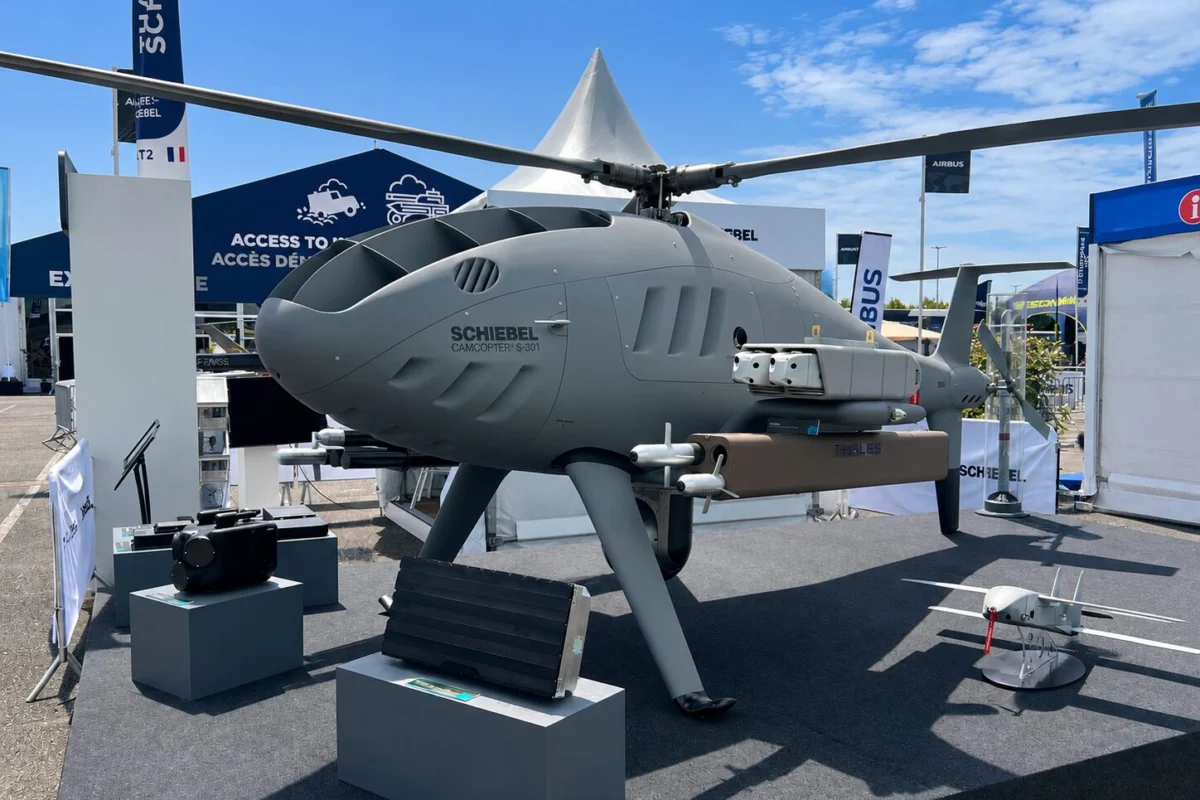
At Eurosatory 2026 in Paris, Thales has taken the opportunity to present the Schiebel S-301 as a larger, higher-performance uncrewed helicopter built around its own payloads, effectors, avionics and mission systems. The French aerospace and defense corporation is thereby positioning the aircraft for intelligence, surveillance and reconnaissance (ISR), precision strike and counter-drone missions from a single airframe.
The S-301 is the largest member of a rotary-wing family that traces back to the Camcopter S-100, the vertical take-off and landing (VTOL) drone sold by Schiebel to more than 25 operators since 2005. It has now logged several hundred thousand flight hours at sea and ashore.
The newer aircraft is derived from the heavier Camcopter S-300, first shown in 2022, and is built and marketed by Schiebel Defence, a subsidiary established by the Austrian group in 2025 in Wiener Neustadt specifically for armed, unmanned systems.
Compared with the roughly 200-kilogram S-100, the S-301 offers a substantial step up in size and load. In an ISR configuration, Thales cites endurance of up to 24 hours with a payload of around 50 kilograms, swapping fuel for heavier sensors or weapons and reducing endurance accordingly.
Across the family, Schiebel quotes payloads roughly three times those of the original S-100. This opens the platform up to mission equipment ranging from electro-optical/infrared turrets and laser designators to compact radars, and, in the armed configurations launched in 2025, to guided weapons.
A multi-role weapons fit
At DSEI in London in September 2025, Schiebel unveiled two separate armed Camcopters, the smaller S-101 and the larger S-301, thereby marking the company’s entry into the weaponized tactical UAV market.
At Eurosatory, Thales discussed a multi-role effector set spanning loitering munitions, missiles and rockets. Candidate weapons include the Thales Toutatis loitering munition, the Lightweight Multirole Missile (LMM), known in Royal Navy service as ‘Martlet’, and laser-guided rockets. While the S-101 has been pitched as carrying a pair of Thales Martlet missiles, the S-301 has been shown capable of carrying up to ten.
The LMM is a natural fit. The 13-kilogram, 76 mm laser-guided missile is already cleared for the Camcopter S-100 and reached full operating capability with the Royal Navy in October 2025, having seen combat use in Ukraine and the Red Sea.

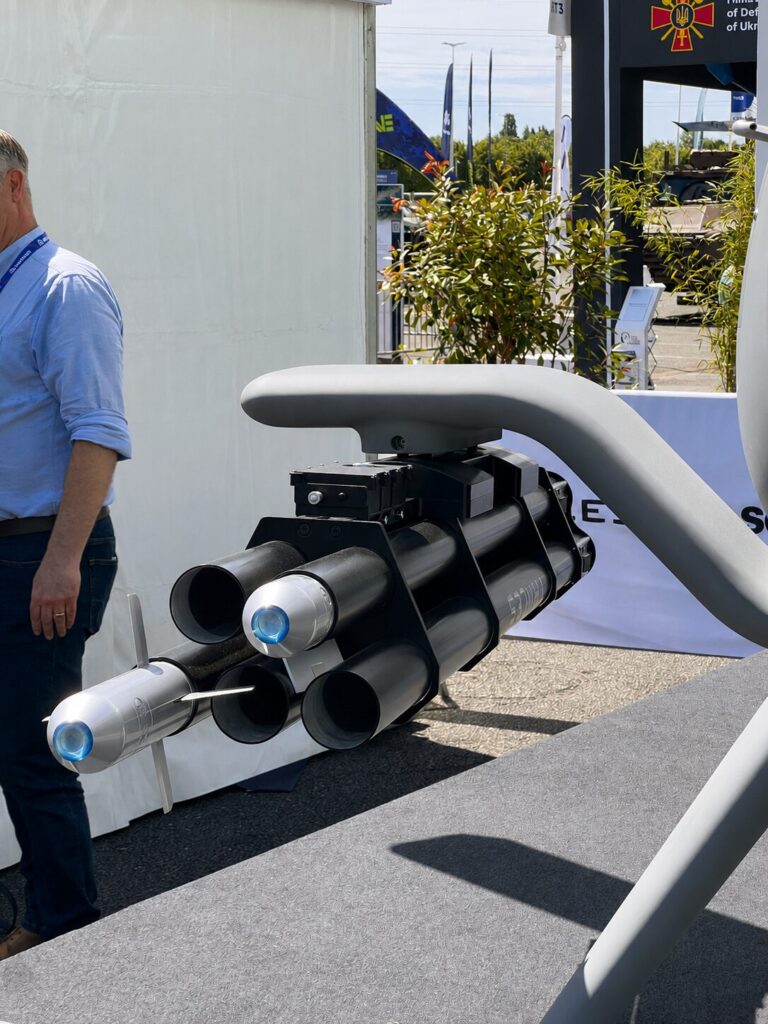
For rockets, Thales’ obvious in-house option is the 70 mm (2.75-inch) FZ275 laser-guided rocket from its Belgian rocket business. This year, Thales is also promoting the weapon as a low-cost counter-drone effector.
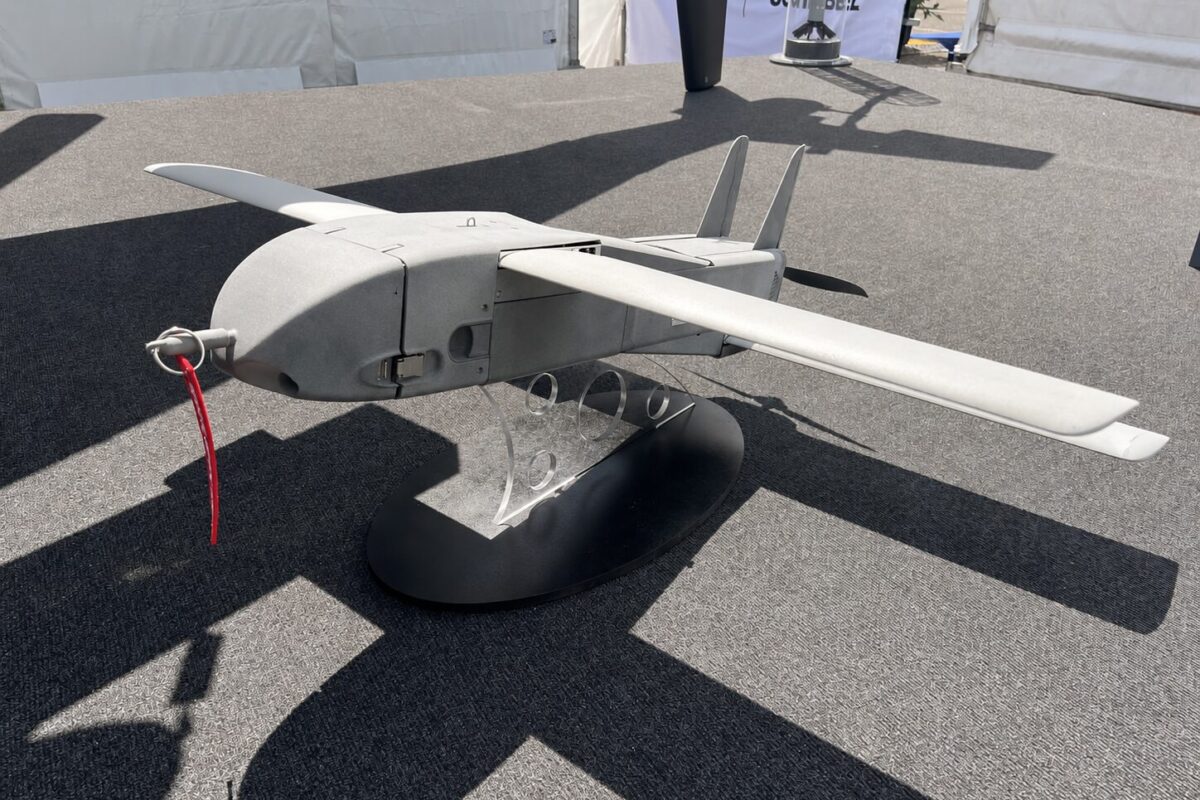
Toutatis is a more forward-looking proposition. The short-range loitering munition, fitted with an interchangeable one-kilogram warhead and a range of on the order of 30 kilometers (18 miles), has been ordered by the French Army for trials. At Eurosatory, Thales also unveiled a partnership with Renault Group to mass-produce it at up to 1,000 units per month from 2027.
But Thales has not yet fired Toutatis from the S-301 and is seeking a customer to fund that integration. Company representatives indicated the first air launch of Toutatis is more likely to come from a crewed platform. The Airbus Helicopters Tiger is the leading candidate, with the S-301 following later, partly due to the complexity of securing regulatory approval for one autonomous system to launch another.
A British ‘loyal wingman’ candidate
The S-301’s most concrete near-term opportunity may be in the United Kingdom. Thales and Schiebel are among four teams selected in May 2026 for Project NYX, the British Army’s program to develop uncrewed ‘loyal wingman’ aircraft to operate alongside its AH-64E Apache attack helicopters.
The other three finalists are Anduril, BAE Systems and Tekever. The British Ministry of Defence has said that it will assess the four designs before downselecting up to two for a prototype phase in the autumn, with an operational capability targeted for 2030.
According to Thales, a first demonstration involving the S-301 in this role is expected in September 2026. The aircraft would perform reconnaissance, target acquisition, strike, and electronic warfare tasks under what the MoD calls a “command rather than control” model. This involves the drone operating with a high degree of autonomy, while a human retains ultimate decision-making authority over the use of weapons.
That approach rests on the autonomy software being built by Thales. For the S-301 itself, the company has announced that it is developing an onboard mission-autonomy stack: software agents able to take high-level instructions, deciding their own routing and operate sensors during a mission, rather than relying on continuous operator control.
Separately, at the fleet level, Thales is developing Swarm Master, a drone-agnostic control layer intended to let a single operator command several aircraft at once, whether identical or mixed. The company is refining the system with the French armed forces with the expectation of delivering a first product by the end of 2027. Claims suggest that it can already coordinate as many as 10 drones through a single operator.
Both efforts target the contested, jamming-heavy environments that Thales and the UK MoD cite as the reason for moving toward autonomous teaming.
Built on the Peregrine partnership
The Thales–Schiebel relationship is not new. The two companies already supply the Royal Navy’s Peregrine system, which pairs the Camcopter S-100 with the Thales I-Master radar and an electro-optical/infrared sensor for maritime surveillance. Peregrine completed factory acceptance testing and was cleared for Royal Navy service in 2025, deploying from Type 23 frigates.
The larger S-300, meanwhile, has been selected by South Korea. Schiebel, with Hanwha Systems and UI Helicopter, won a 2024 contract to supply three aircraft for ISTAR missions with the Republic of Korea Navy and Marine Corps, with deliveries due by 2027. The same airframe serves as the dedicated air vehicle for the Thales-led SEACURE anti-submarine seabed warfare project under the European Defense Fund.
Schiebel currently has three S-301 pre-production prototypes flying in test campaigns. With the S-301, Thales and Schiebel are betting that a proven, ship- and field-capable VTOL airframe, re-rolled for autonomy and weapons, can meet a demand — sharpened by the war in Ukraine and by Europe’s drive for sovereign drone capacity — for armed, persistent and comparatively low-cost unmanned helicopters.