

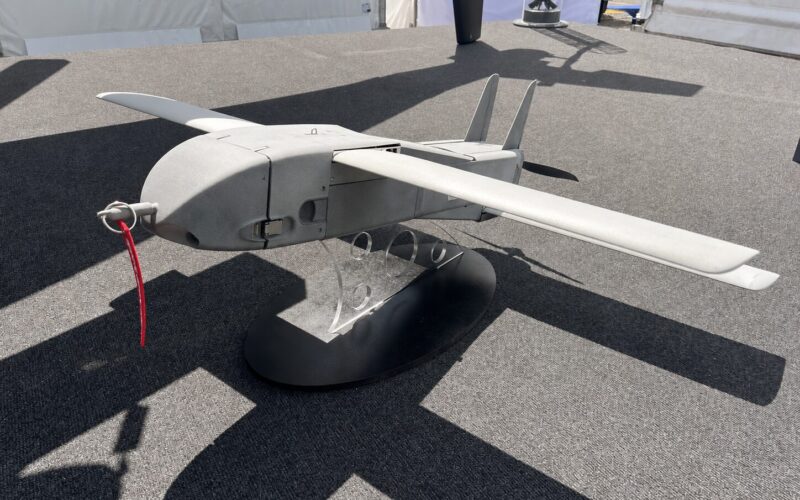
Renault Group and Thales are joining forces to prepare the Toutatis loitering munition for mass production, an alliance unveiled at the Eurosatory defense exhibition in Paris as demand for short-range precision strike drones continues to climb in active conflict zones.
According to Cecilia Aguero of Thales, Toutatis is the company’s short-range loitering munition, offering a range of around 10 kilometers and an endurance of about 30 minutes. The system is designed to engage targets such as light armored vehicles and carries a one-kilogram fragmenting warhead.
Thales presents Toutatis as a compact munition that delivers a high military effect relative to its size. Its foldable wings allow it to be launched from a range of platforms, including backpacks, helicopters, surface ships and ground vehicles. A dedicated terminal guidance algorithm provides what the company describes as metric targeting accuracy.
Scaling production with Renault
The tie-up with Renault Group is intended to address one of the central challenges facing loitering munitions: producing them at scale. Renault is expected to contribute mass industrial expertise, while Thales brings its military know-how, system design and guidance technologies.
Thales currently builds an estimated 100 to 150 Toutatis units a year. Under the new industrial roadmap, the munition will be redesigned to reduce its part count and make it compatible with automotive production methods. A reworked version is expected around mid-2027, with serial production slated to begin by the end of that year. The partners are targeting output of roughly 10,000 units annually, or about 1,000 a month on average.
Thales sees the principal market for Toutatis as international, particularly among countries currently engaged in conflict or preparing for high-intensity warfare.
Aguero described the arrangement as a pairing of complementary competencies: Renault contributes experience in mass production and industrial optimization, while Thales provides military system expertise, operational requirements and a background in guided weapons.
The move is not uncontested within Renault. In a statement released on June 18, 2026, the CGT Renault union came out against the group’s deepening shift into defense work, arguing that the Eurosatory announcements with Thales confirm an acceleration toward armaments that, contrary to management’s position, does not command consensus among employees.
Swarm Master and open architecture
Alongside the production push, Thales is developing swarm-control software designed to let a single operator command several drones simultaneously. The system, known as Swarm Master, is intended to support both homogeneous and heterogeneous swarms [groups made up either of identical drones or of different platform types – ed. note]
The software is built to allow missions to be modified in real time, and experimentation with the French armed forces is underway to define the operational requirements for such systems. Thales expects a first product by the end of 2027.
According to Aguero, the emphasis is not only on how many drones can fly at once but on how many effects can be generated on the battlefield. France is currently experimenting with flights of seven drones simultaneously, while Thales says it can already control as many as 10 drones through a single operator.
The swarm-control system is designed to be drone-agnostic and open to third-party platforms. Thales is positioning itself to provide the software layer and mission-management architecture that allows different systems to be coordinated.
The company is also drawing on cortAIx, Thales’ AI accelerator, to support specific Swarm Master use cases through software agents, handling functions such as automatic target recognition and mission management.