
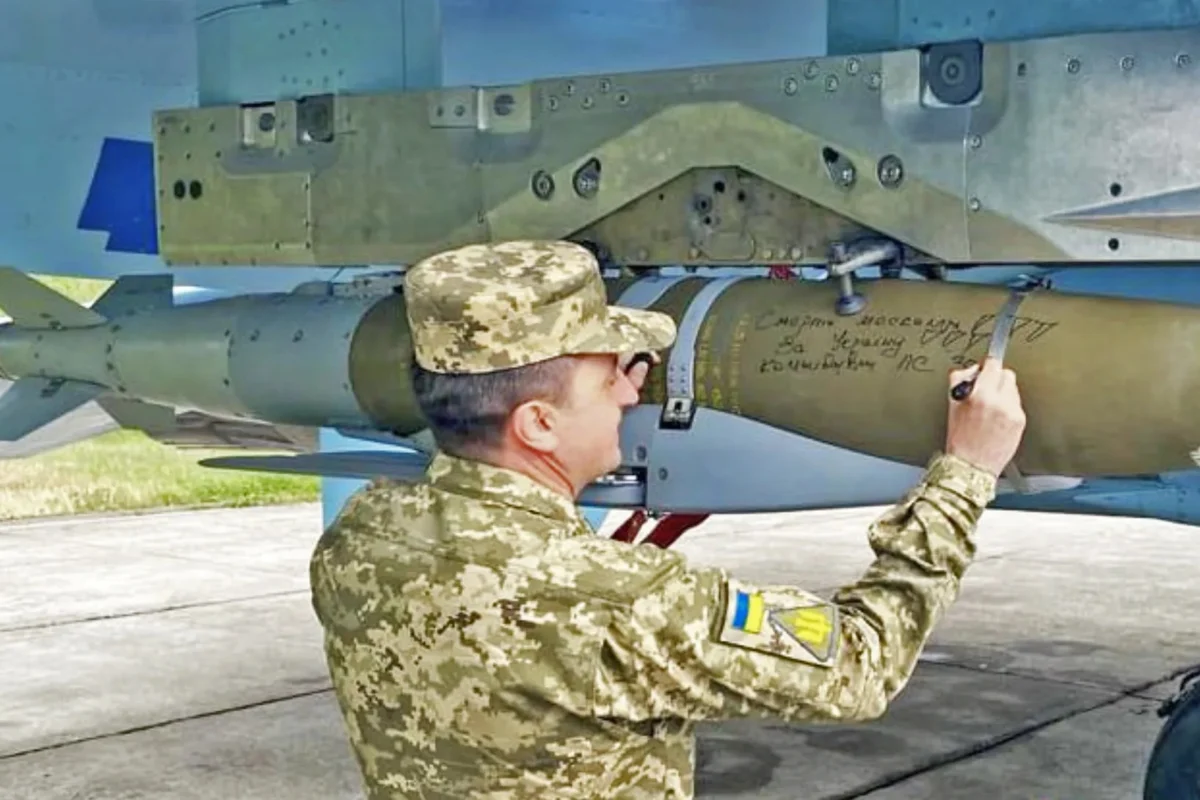
The US State Department approved a possible Foreign Military Sale of extended-range Joint Direct Attack Munition (JDAM-ER) tail kits and associated equipment to Ukraine, valued at an estimated $373.6 million.
The package, notified to Congress on May 5, 2026, would deliver to Kyiv 1,200 KMU-572 tail kits, which arm 500-pound (227 kilograms) Mk-82 bombs, and 332 KMU-556 tail kits, fitted to 2,000-pound (907 kilograms) Mk-84 bombs. FMU-139 fuze systems, weapon software, technical documentation, support equipment, spares, transportation, and US Government and contractor logistics services are also included in the deal. Boeing has been designated as the principal contractor.
1,532 tail kits to expand Ukraine’s strike inventory
The proposed sale would bolster Ukraine’s stock of GPS-guided air-to-ground weapons, which Kyiv has relied on increasingly through more than four years of full-scale war with Russia. JDAM kits convert standard unguided gravity bombs into precision-guided munitions by adding a tail unit with movable control fins, an inertial navigation system, and a GPS receiver.
The Extended Range variant additionally fits the bomb with a folding wing kit, which deploys after release and extends the weapon’s standoff range from roughly 24 kilometers (15 miles) for a baseline JDAM to around 75 kilometers (47 miles).
The capability has become a cornerstone of Ukrainian aviation operations. JDAM-ER kits were first integrated onto Kyiv’s Soviet-era fighter fleet, including Su-27s and MiG-29s, in early 2023, and have since been used against Russian command nodes, ammunition depots, and air defense positions in occupied territory. Ukrainian F-16s delivered by NATO partners are also expected to carry the weapon, alongside the GBU-39 Small Diameter Bombs already in their air-to-ground arsenal.
The US is not Ukraine’s sole supplier of JDAM-ER kits. Australia has transferred ER kits retired from Royal Australian Air Force F/A-18A/B Hornet service to Ukraine as part of its broader military aid, including a $250 million package announced in July 2024.
Ukraine’s standoff precision air-to-ground arsenal also extends to a French-made counterpart. Safran’s AASM Hammer, broadly comparable to the JDAM-ER but using a rocket booster rather than a folding-wing kit to extend range, has been supplied to Ukraine since 2024.
The weapon has been adapted for Ukrainian MiG-29s and has also been reported in use on Su-25s, while France’s delivered Mirage 2000-5s have been modified for air-to-ground missions, potentially including carriage of AASM. Safran’s Montluçon plant, which was producing 830 kits in 2024, targeted 1,200 in 2025 to keep pace with operational demand in Ukraine and France.
Video posted yesterday from Ukraine's 1st Separate Marine Battalion showing another possible AASM or JDAM strike on a Russian position in Kherson Oblast. 2/https://t.co/m7PkkyO8da pic.twitter.com/OhoUptD4nw
— Rob Lee (@RALee85) March 28, 2024
Approval comes a week after $400 million Pentagon release
In its notification, the State Department said the sale would equip Ukraine to conduct self-defense and regional security missions with a more robust air defense capability. The classification of a JDAM-ER package as a contribution to “air defense” is a notable choice of wording for what is, in essence, a stand-off offensive air-to-ground weapon. The phrasing is consistent with recent FMS notifications for Ukraine, which have relied on defensive language aligned with current US policy lines.
The go-ahead follows the Pentagon’s release on April 28, 2026, of $400 million in previously authorized US military funding for Ukraine, allocated through the Ukraine Security Assistance Initiative (USAI) under the FY2026 National Defense Authorization Act passed in December 2025.
The funding had sat unused for months, prompting public criticism from Senator Mitch McConnell and other lawmakers before Defense Secretary Pete Hegseth confirmed its release during a House Armed Services Committee hearing on April 29, 2026.
The JDAM-ER notification also lands at a moment when the Pentagon has been weighing the diversion of Ukraine-bound weapons to replenish stockpiles drawn down by Operation Epic Fury in the Middle East, with PAC-3 MSE interceptor supply lines under particular strain.
FMS notifications open a 30-day Congressional review window during which lawmakers can attempt to block a sale. They do not constitute a signed contract or a guarantee of delivery, and final quantities, configuration, and pricing may change before procurement is locked in.
If finalized, the deal would mark another significant restocking of Ukraine’s precision-guided air-to-ground arsenal at a time when Ukrainian aviation has become more reliant on standoff weapons to operate amid dense Russian air defenses along the front.