

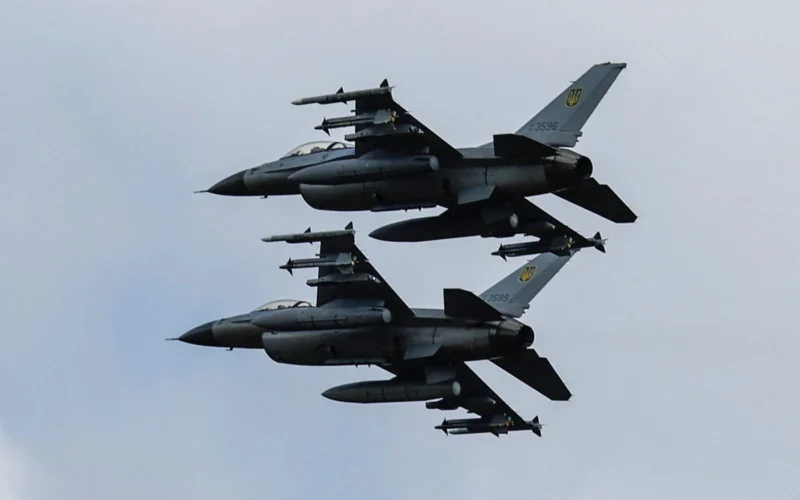
Ukraine’s air force says its F-16s have destroyed more than 1,000 Russian aerial targets since entering combat, a milestone that offers the clearest picture yet of how the Western fighter is actually being used in the war.
The figure comes from a Ukrainian Air Force video interview with an F-16 pilot, who says the aircraft have primarily served in an air-defense role, intercepting cruise missiles and one-way attack drones aimed at Ukrainian cities and infrastructure. The F-16s began flying combat missions in August 2024 after Ukraine received aircraft from Belgium, Denmark, the Netherlands, and Norway.
According to the pilot, Ukrainian F-16s have focused less on air-to-air combat with Russian fighters and more on plugging gaps in ground-based air defenses strained by sustained missile and drone attacks. Typical targets include Shahed-type long-range drones, jet-powered drones, and cruise missiles.
That mission profile raises an obvious question: how efficient is it to shoot down cheap drones with expensive fighter jets?
The answer, based on the pilot’s account and available imagery, is mixed. Ukrainian F-16s have used AIM-9 Sidewinder and AIM-120 AMRAAM missiles to intercept aerial targets, but pilots have also relied heavily on the aircraft’s internal 20mm cannon. In at least one reported sortie, a pilot claimed to have engaged six cruise missiles and seven drones, with the drones likely destroyed using gunfire rather than missiles.
More recently, Ukrainian F-16s have begun flying with targeting pods and laser-guided 70mm rockets, suggesting a deliberate effort to reduce costs when engaging slow, predictable targets. Those rockets offer a cheaper alternative to air-to-air missiles and reflect the improvisation that has defined much of Ukraine’s air campaign.
So far, Ukrainian officials have not claimed any confirmed F-16 kills against crewed Russian aircraft. Russian fighters such as the Su-35, MiG-31, and Su-57 often remain at high altitude, launching long-range missiles while staying outside the effective reach of Ukrainian jets. That threat, combined with dense ground-based air defenses, has forced Ukrainian F-16s to operate mostly at low altitude.
Dogfighting, in the traditional sense, does not appear to be part of the mission set. Instead, the F-16s often act as decoys or escorts, drawing Russian missiles away from other strike aircraft. On one mission described by the pilot, a three-ship formation deliberately provoked missile launches from Russian fighters, allowing Ukrainian strike aircraft to hit ground targets before all aircraft returned safely to base.
The Ukrainian Air Force says its F-16s have also flown more than 1,600 ground-attack sorties, using weapons such as Small Diameter Bombs, while navigating a battlespace saturated with surface-to-air missiles. Nearly every sortie, the pilot says, involves missile launches by Russian forces.
Ukraine has lost four F-16s since the type entered service. Officials have not disclosed full details of each incident, but the losses underscore the risks of operating fourth-generation fighters in contested airspace dominated by long-range missiles and layered air defenses.
To reduce vulnerability on the ground, Ukraine regularly disperses its F-16s across multiple airfields and secondary strips, sometimes relocating aircraft shortly after landing. That mobility, the pilot says, makes it harder for Russian forces to track and target the jets.
Western training played a critical role in bringing the F-16 into Ukrainian service, but the pilot acknowledged that many of the tactics taught abroad did not translate cleanly to the realities of its war. Ukrainian crews adapted quickly, developing their own methods for countering drones, cruise missiles, and threats near the front line.
The pilot describes the F-16 as potent, particularly in air defense, but argues Ukraine would benefit from more capable variants with improved sensors and survivability. For now, the aircraft’s greatest contribution may be less about air superiority and more about endurance by staying airborne, absorbing risk, and intercepting threats before they reach Ukrainian cities.