
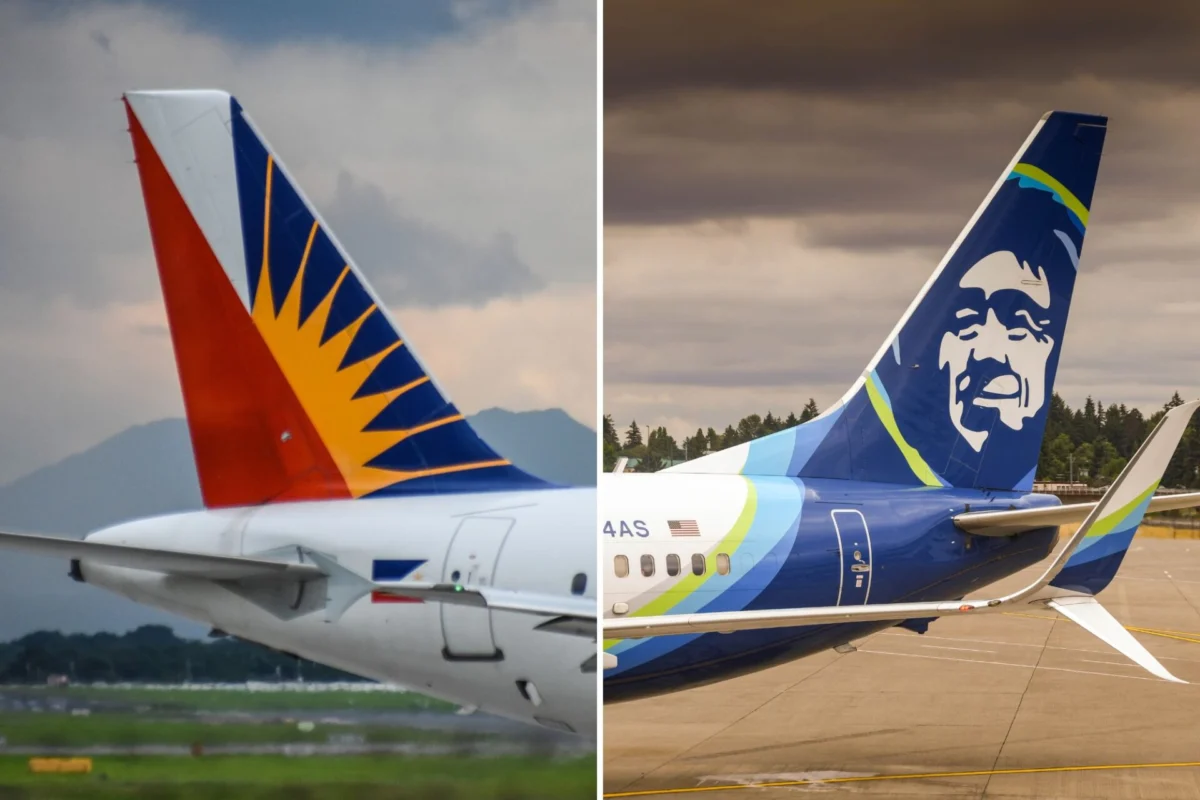
Major US airlines have signaled support for the proposed expanded codeshare agreement between Philippine Airlines and Alaska Airlines, clearing a key hurdle for the partnership.
Manila Bulletin first reported on May 11, 2026, that American Airlines, Delta Air Lines, and United Airlines, the three largest carriers in the United States, have all indicated no objection to the deal. The development was disclosed in a May 6, 2026, filing submitted by Alaska Airlines to the US Department of Transportation (DOT).
Beyond the big three, other US carriers and cargo operators also raised no concerns. These include JetBlue Airways, FedEx, UPS, Atlas Air, Kalitta Air, ABX Air, Sky Lease, National, Eastern, and Amerijet.
What the deal covers
Philippine Airlines and Alaska Airlines signed a codeshare agreement on April 22, 2026 and are now seeking regulatory approval from the US DOT to expand their commercial partnership.
Under the proposed arrangement, Alaska Airlines would place its “AS” code on PAL-operated flights between the Philippines and the United States, as well as on routes beyond the Philippines. In return, PAL would place its “PR” code on Alaska Airlines’ domestic US flights, allowing passengers to book connecting itineraries under a single ticket.
The partnership would give travelers better access to destinations across both networks. Passengers flying PAL from Manila to US gateways could connect onward to cities served by Alaska Airlines, while Alaska customers could tap into PAL’s network for Philippine destinations.
Tapping into Hawaii and beyond
The expanded codeshare is expected to strengthen access to Hawaii, a key leisure market, by linking Alaska Airlines’ domestic network with PAL’s transpacific services.
PAL currently holds exemptions allowing it to serve US destinations beyond its primary gateways, including Hilo, Kahului, Kona, and Lihue in Hawaii, as well as Atlanta, Denver, Houston, Las Vegas, Miami, New Orleans, Orlando, and Washington, DC.
Proposed codeshare routes would connect PAL’s transpacific flights from Manila to mainland US gateways such as Los Angeles, Seattle, San Francisco, and Honolulu. The partnership would also cover select Northeast Asian points including Japan and South Korea.
On the Philippine side, Laoag City in Ilocos Norte would feed into Manila as the primary hub for international connections, while Cebu would serve as a secondary hub for northern Asian routes to Tokyo, Osaka, and Seoul.
Regulatory framework
The two carriers are seeking exemptions to operate the codeshare to the fullest extent allowed under the 1995 US-Philippines Air Transport Agreement, which governs air traffic rights between the two countries.
The filing also reflects changes in the US aviation landscape following Alaska Air Group’s 2024 acquisition of Hawaiian Airlines’ parent company. Hawaiian Airlines had previously been authorized to use PAL’s PR code for codesharing purposes, and certain operational rights have since transferred to Alaska Airlines.
Both carriers said they plan to begin marketing the expanded codeshare services once all government approvals are in place.