
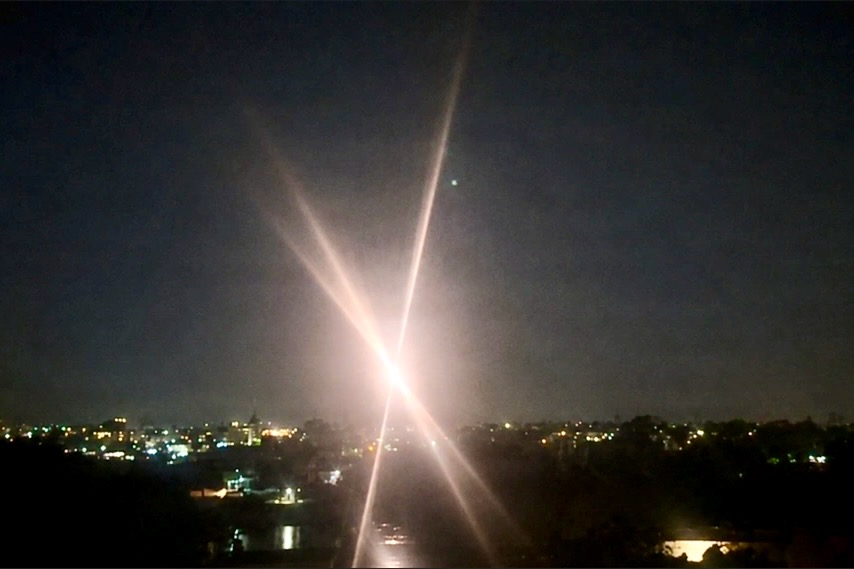
The US military used a high-energy laser to shoot down three cartel-linked drones near the US-Mexico border, marking confirmed operational use of directed-energy technology against aircraft the military deemed hostile.
Joint Task Force–Southern Border (JTF-SB) said personnel used an Army Multipurpose High Energy Laser (AMP-HEL) during the late-night hours of August 25 and 26, 2026, to engage and destroy three unmanned aircraft systems (UAS).
The military said the drones were considered hostile because they were being used in direct support of activities that posed a physical threat to US military personnel and US Customs and Border Protection (CBP) agents.
The engagements occurred in the Rio Grande Valley in southern Texas. The military has not disclosed their precise location or said whether the drones were over US or Mexican territory when they were destroyed.
US Northern Command told CBS News that the engagements were coordinated with partners operating along the border but declined to provide further details, citing operational security and ongoing counter-cartel and counter-drone operations.
The military also did not identify which criminal organizations were believed to be operating the drones.
“Cartel networks are increasingly employing unmanned aircraft systems to facilitate illicit human-smuggling and actively spy on our personnel and law enforcement partners,” Maj. Gen. Curtis Taylor, commander of JTF-SB, said.
Taylor said the use of layered countermeasures and directed-energy systems showed that the military would not tolerate hostile surveillance along the border. He also credited cooperation with the Mexican Army in combating threats in the region.
The AMP-HEL is a mobile counter-drone system designed to use concentrated laser energy to disable or destroy small unmanned aircraft.
AeroVironment delivered the first two AMP-HEL prototypes to the US Army in 2025. The system is intended to provide a comparatively low-cost way of engaging drones without expending conventional missiles or ammunition.
The latest engagements come after a much less successful use of directed-energy counter-drone technology along the southern border earlier this year.
In February 2026, a US military laser-based counter-drone system mistakenly shot down a CBP drone near Fort Hancock, Texas. The incident contributed to Federal Aviation Administration (FAA) flight restrictions and renewed concerns about coordination between the military, CBP and civilian aviation authorities.
A separate counter-drone operation near El Paso earlier in February prompted the FAA to temporarily close a large area of airspace around El Paso International Airport (ELP). The restriction was lifted within hours.
The FAA and Pentagon subsequently developed procedures allowing military anti-drone lasers to operate near commercial air traffic without requiring airport closures. The FAA said in April that a safety assessment found the technology did not pose an undue risk to passenger aircraft when appropriate safeguards were followed.
Around 8,000 US service members are currently deployed under JTF-SB along the 1,954-mile southern border. The task force said its personnel have conducted tens of thousands of detection and monitoring patrols and thousands of observation flights since assuming the mission in March 2025.