
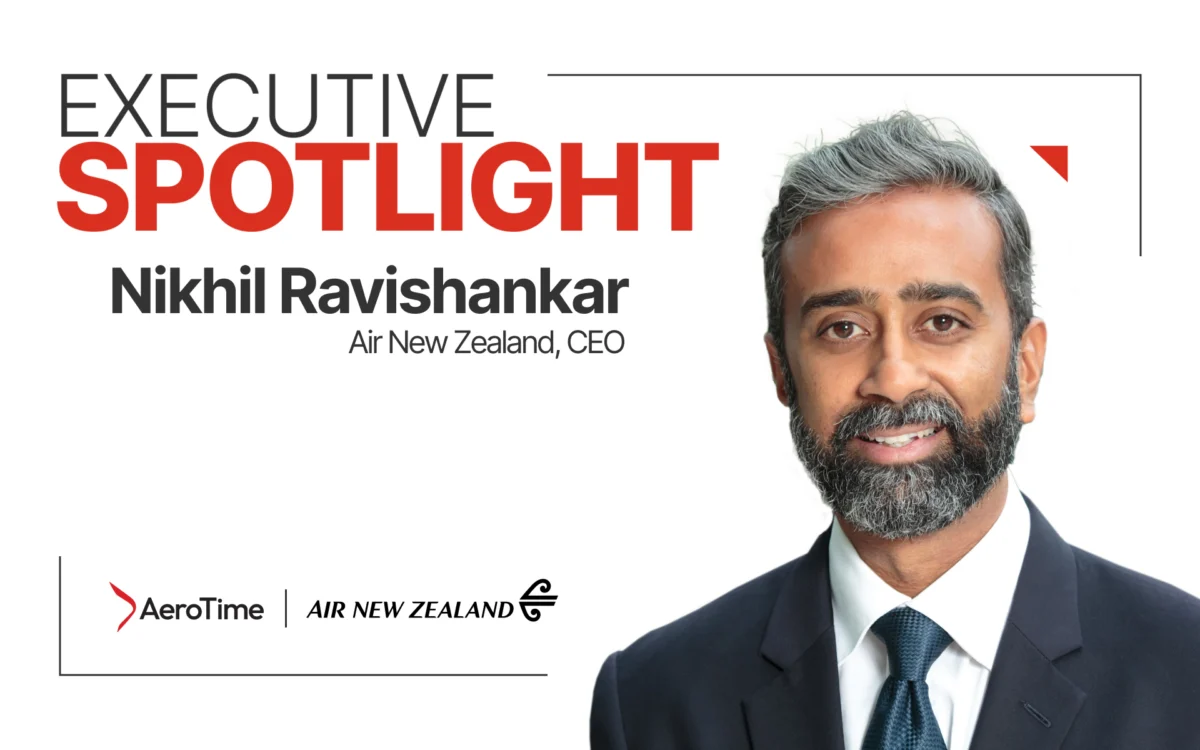
When even your closest neighbor is several hours’ flight away, concepts such as air connectivity and passenger experience become even more important.
For many decades, Air New Zealand has successfully connected one of the most geographically remote countries to the rest of the world, while innovating its aircraft cabins with fresh and unique concepts aimed at making long journeys more enjoyable for regular passengers.
In June 2026, seven months after his appointment to the role of Air New Zealand CEO, Nikhil Ravishankar met with AeroTime during the International Air Transport Association (IATA) 82nd Annual General Meeting (AGM) in Brazil to discuss the Kiwi airline’s unique market positioning.
At the time of our conversation, a topic that was the focus of much of Ravishankar’s attention was the fuel crisis triggered by the conflict in the Middle East. In fact, Air New Zealand was one of the first airlines to cancel flights in the first half of 2026 in response to this exogenous supply shock.
“At the moment we are now facing more tailwinds than headwinds. I like using a sort of rugby analogy to describe it as ‘a game of two halves’,” he stated, before going on to dissect the overall situation at the airline, beginning with the positives.
“On one side, our operational performance as an airline is as good as it’s ever been. We’re now consistently one of the top five airlines when it comes to on-time performance, cancelation rates and operational performance. So, our operational performance is really fantastic,” he said. “Our customer satisfaction scores are also as high as they’ve ever been. Air New Zealand has a legacy of being very good at customer experience, we have a very unique Kiwi service proposition, and our customers love flying with us, which is always helpful.”
“Your customers liking your product is always a good starting point,” he added.
“For a long time, we’ve been suffering engine issues, both on the narrowbody and widebody fleets. This time last year, about 20% of our fleet was grounded,” he continued. “We’re now in a place where most of our aircraft are flying and, at the end of this month, we will only have one aircraft on the ground [AOG] because of engine issues, and that’s a huge improvement in 12 months.”
Ravishankar then switched to the challenges faced by the airline, the “headwinds” as he described them.
“On the flip side, of course, like everybody else, we’re now dealing with the fuel crisis and Asia-Pacific is a little bit more exposed,” he said. “A lot of our crude comes from the conflict zone, and that has sort of impacted us, but the markets continue to clear.”
“This is a pricing issue for us, not a supply issue,” he continued. “So, we haven’t seen any challenges with supply. Since it’s a price shock, we’re trying to minimize it, but we can’t do so fully. We are mitigating about 40% of the price increase through a combination of fare increases, flying consolidation, frequency reductions and cost management.”
“It’s the same algorithm that all airlines are using to deal with this situation,” he added. “So that’s a bit of a headwind, and that in turn has an impact on the demand profile.”
But what is the traffic profile Ravishankar referred to? Here, the CEO offered two points as a way to frame an answer to the question.
“New Zealand is actually a bigger country than many people think. It’s the size of Japan, but only has 5.3 million people, versus Japan’s 125 million. So, we’re a large, hilly, sparsely populated country. Domestically, aviation is very important to us to connect many smaller communities to our main centers.”
Ravishankar explained how Air New Zealand flies to 20 domestic destinations, quite a dense domestic aviation network for the population size of the country.
“And we’re far away from everywhere else in the world. If you put a 2,000-kilometer circle around Auckland, you don’t even hit the East Coast of Australia, but if you did that over Berlin, you cover from Western Russia to the Nordics, the UK, and even parts of North Africa. So international connectivity is very important too.”
“Those two dynamics are critical because we do about 16 million flights a year, about 10 to 11 of those are domestic flights, so a lot of the flying we do is just to connect New Zealanders with each other,” he added. “The remaining you could say is a 50-50 split between Kiwis going abroad and incoming visitors, a large portion of whom, around 43%, are tourists.”
Tourism is New Zealand’s second largest GDP earner, Ravishankar said, adding that tourism demand into New Zealand is currently as strong as it’s ever been.
“I often say I’ve never met anyone around the world who says they never want to visit New Zealand. It’s on everyone’s bucket list and, particularly now, in this sort of chaotic world, it’s an oasis of peace, tranquility and stability,” he said. “So, our tourism proposition is very strong.”
Beating the tyranny of distance
The growth in international demand has been somewhat balanced out by weaker domestic demand, whether it is for movement within the islands or Kiwis traveling abroad.
“That demand is much softer at the moment and that’s reflective of the strength of the underlying economy and the New Zealand dollar, but that’s part of economic cycles, and that will come right,” Ravishankar explained.
Interestingly, Ravishankar named Singapore, not neighboring Australia, as the airline’s single largest foreign market. Australia, the United States, and parts of Asia follow suit. China, the giant of the Asia-Pacific region, is also a growth market for Air New Zealand.
“China visitor numbers have started to pick up again,” he said. “So, I think it’ll always remain an important market for New Zealand. 40% of our global trade is with China, so it’s a very, very important market for us. We fly to Shanghai, Hong Kong, and Singapore, and they all act as sort of hubs for us.”
In response to the strong international demand, Air New Zealand has reactivated its B787 fleet, part of which had been grounded since the COVID-19 pandemic (the last of those stored aircraft re-entered service in early July 2026), but also preparing for a significant expansion of its long-haul capacity, adding 10 more Dreamliners and bringing the fleet from 14 to 24.
“It’s an aircraft that works for us really well in terms of our network design,” Ravishankar said.
“On the long-haul fleet, if I could summarize our strategy into a single line, it would be ‘to win on sleep’. So, if you look at our first two new long-range B787-9s which are to be delivered shortly, these are fitted with SkyNest, that is bunk beds in economy class,” he explained. “And alongside SkyNest, those new aircraft will have seven different seat products within a single aircraft, five of those seven seats are optimized for sleep.”
Here, Ravishankar was talking about the rather unique, innovative product which will allow economy class passengers to pay a bit extra to spend a few hours sleeping in a proper bed. Air New Zealand first unveiled SkyNest in 2020, with sales going online in May 2026.
“We’re excited about the bunk beds. The early signs are very promising commercially as well. They’re selling well, so you can buy it today. It’s on sale,” he said. “That’s going to be interesting for all our widebodies.”
But SkyNest is far from a one-off, it follows in the footsteps of SkyCouch, which entered service in 2011. SkyCouch allows families traveling together to combine the three economy class seats in a row to make a bed.
“Sky Couch is very popular with families with young kids,” Ravishankar said, before also going on to talk about the other types of seats on offer onboard Air New Zealand’s Dreamliners. “We’ve also got our premium economy offering, which is a brand-new seat, and then, obviously, Business Premier and Business Premier Luxe which are two different flavors of our business class.”
The airline executive returned to the topic of sleep since this is, obviously, an important element to position Air New Zealand in the market for ultra-long-haul flights.
“We are extremely strategically focused on winning on sleep,” he said, “because in some of our key markets, one of the reasons we struggle to convert this demand that exists for New Zealand-bound travel, as I said, it’s on everyone’s bucket list, is the fact that people feel like we’re far, far away. It’s the tyranny of distance that we have to break. In the US and Asian markets we say that ‘we are one sleep away’, since it’s the most comfortable sleep in the sky.”
Reality check on sustainability
There was also time to ask Ravishankar about the status of the “Mission Next Gen Aircraft” project, through which Air New Zealand shortlisted several low-emissions clean-sheet aircraft types for close evaluation to be a future replacement for the firm’s DeHavilland Canada Q300 turboprop fleet.
Only two of the five startups originally selected are still in the race to develop a low-emissions aircraft, Heart Aerospace and BETA Technologies, with the latter having already completed a flight test campaign in New Zealand with a cargo version of its all-electric conventional takeoff and landing (CTOL) ALIA CX300 aircraft.
“It was actually a very successful trial because we learned a lot,” he said. “Just because you’re good at the liquid fuels-based aviation game doesn’t mean that this naturally translates to being good at managing other propulsion systems. The infrastructure needs change, the procedures change, and so on and so forth.”
“So, we wanted to get some really early learnings on what it would mean [to operate electric aircraft] and what the future of aviation would look like. From that perspective, the trial was hugely successful,” he added, referring to the BETA Technologies ALIA flight tests. “We also learned the requirements we would need for it to be commercially viable in our market.”
“I often say New Zealand’s is an incredible petri-dish or laboratory for aviation and particularly sustainable aviation because 65% of our domestic routes are under 350 nautical miles, so it’s the perfect environment to trial and test,” he explained.
New Zealand is doubtlessly a very environmentally minded country, however, Ravishankar warned, any new aircraft will need to prove itself profitable.
“It also needs to be commercially viable, and we think a slightly larger passenger variant might be the one that we could make work commercially within our environment. So, we continue to work with BETA. I know they’re working on the development of an over 19-seater [aircraft],” he said. “We’ll keep a close eye on that, and we’ll continue to work with other partners in that space, as well.”
One of the key learnings from the pilot test with BETA was the need for a larger aircraft than the ALIA to best fit into Air New Zealand’s operations, Ravishankar said.
“What I have come to learn throughout my career is that these big disruptive moments happen very slowly at first, and then very quickly,” he explained. We have to keep an open mind about how these technologies evolve. But we are talking about aircraft technologies; it’s not a purely digital innovation cycle that’s going on.”
“Everything we’re seeing is quite promising,” he added. “Actually, I’m an optimist when it comes to the innovation and disruption we may see, but we also have to be patient and sensible about all of these things.”
So, what’s next for Air New Zealand? What about new routes and destinations?
“We’re leading into growth for the first time in a long time because those engine issues meant we’ve been managing a very constrained fleet. Now with those issues starting to sort themselves out, and new aircraft being delivered, we can start to put our mind to growth again,” Ravishankar said. “With 24 Dreamliners you can go to quite a few places.”
“One of the first things we’ve done is to announce some new flights out of the South Island of New Zealand. So, we’re going to fly from Christchurch (CHC) to Japan, Singapore, and Perth in Western Australia. Connecting the world directly to the South Island is very interesting from a tourism flow perspective. That’s where the fjords are, where the Southern Alps are, where Queenstown and other popular destinations are,” he continued. “That’s also where some of our high-end producers, for example, the world-famous king salmon is obtained. You carry that in the belly [of aircraft], cherries and high-end produce like crayfish, etc. Getting it from the source to the table at those larger markets around Asia and Australia, that’s an exciting prospect! So, that’s the first of many moves we all make around where we grow again.”
“The perfect blend for us is a route which is a combination of VFR [visiting friends and relatives] traffic, corporate and business travel, and leisure. That’s the sort of holy trifecta,” he added. “And as Asia continues to grow from an aviation market perspective, it opens up a lot of frontiers for us. I guess most is going to be in Asia.”
Ravishankar also confirmed that returning to Europe, where Air New Zealand had once served London-Heathrow (LHR), is currently not on the cards.
“Flying to the East Coast of the United States is more attractive to us,” he said.
“The other thing we’re quite excited about, which I think will open up new frontiers around customer experience, is in-flight connectivity, so there’s a lot of work that the airline is doing around really getting world class connectivity available,” Ravishankar, explained, although he declined to name the partner in this project
“We’re not ready to announce this yet,” he said, “But we’ve been trialing.”