
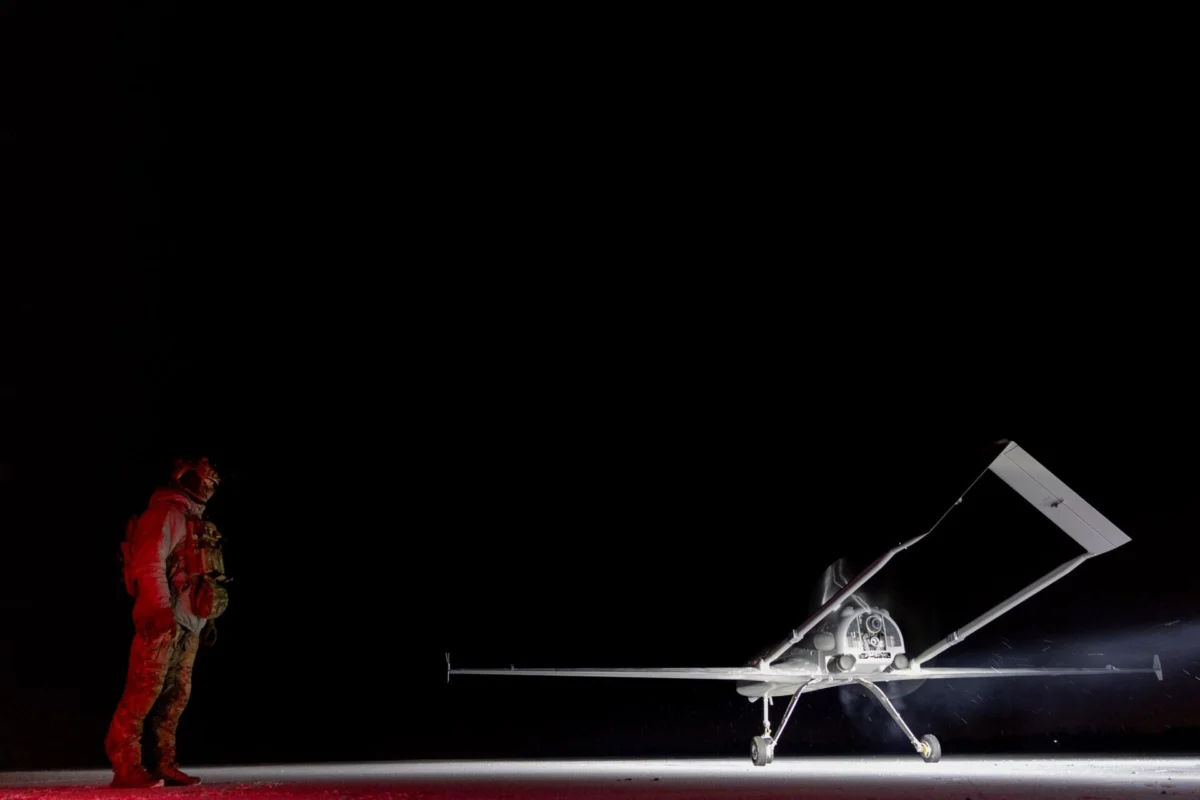
Two drones crashed in southeastern Finland on March 29, 2026, with the Finnish Air Force confirming that at least one was a Ukrainian-made AN-196 Liutyi long-range attack drone. President Alexander Stubb called the incident a serious violation of Finland’s sovereignty and convened an emergency government meeting.
The drones came down near the city of Kouvola in the Kymenlaakso region, roughly 130 kilometers northeast of Helsinki and about 70 kilometers from the Russian border. One crashed north of the city, and the other to its east. No injuries or property damage were reported.
Finnish Air Force Hornets scrambled but held fire
Finnish authorities detected several small, slow-moving objects flying at low altitude over the Baltic Sea and southeastern Finland on Sunday morning, the Finnish Defense Ministry said. The Air Force scrambled F/A-18 Hornet fighters to identify and track the targets.
At 8:45 a.m. local time, an F/A-18 pilot identified one of the objects as a Ukrainian AN-196 Liutyi. The pilot chose not to engage with weapons in order to avoid collateral damage, and the drone subsequently crashed into the ground. Some of the other initially detected targets turned out to be flocks of birds.
What is the AN-196 Liutyi?
The AN-196 Liutyi, whose name translates to “fierce” in Ukrainian, is a long-range one-way attack drone produced by state defense conglomerate Ukroboronprom and credited to the Antonov aircraft company.
Developed in late 2022 as Kyiv’s answer to the Iranian-made Shahed-136 drones fielded by Russia, the Liutyi is powered by a rear-mounted gasoline engine driving a three-blade propeller, carries a warhead of up to 75 kilograms, and has a confirmed operational range exceeding 1,000 kilometers. It uses a combination of satellite and inertial navigation, along with onboard terrain-matching, to fly autonomously toward its target. The type has been credited with successful Ukrainian strikes on Russian oil refineries and energy export infrastructure.
The origin of the second drone was still under investigation at the end of March 29, 2026, though Prime Minister Orpo said both were likely Ukrainian.
Stubb: no military threat to Finland
“Drones have strayed into Finnish territory. We take this very seriously,” Defense Minister Antti Hakkanen said. “Security authorities have responded immediately. The investigation will continue and more detailed information will be provided once the facts are confirmed.”
Prime Minister Petteri Orpo described the territorial violation as a very serious matter and said the drones were not intercepted and fell on their own.
Stubb confirmed the Ukrainian origin of at least one drone in a post on X, writing that drones had entered Finnish territory that morning. He stressed that Finland faced no military threat but convened a defense committee meeting over the incident.
“I emphasize that Finland is not under any military threat. Our authorities reacted immediately,” Stubb said, adding that the investigation was ongoing and that Finnish authorities remained ready to protect the country’s territory.
This morning, drones have strayed into Finnish territory. One of the drones has been confirmed to be Ukrainian in origin.
— Alexander Stubb (@alexstubb) March 29, 2026
I want to emphasize that there is no military threat to Finland.
Our authorities reacted to the situation immediately. I thank the authorities for their…
Stray drones linked to Baltic oil campaign
The incursion was linked to Ukraine’s intensifying campaign of drone strikes against Russian oil infrastructure on the Baltic coast. The drones crashed in Finland on the same morning that Ukraine’s Security Service claimed its third strike in a week on the Ust-Luga oil terminal in Russia’s Leningrad Region, a major petroleum export hub on the Gulf of Finland that handles around 700,000 barrels of oil per day. The nearby port of Primorsk was also hit during the same campaign.
Like shooting fish in a barrel. For the third time in a week, Ukraine successfully attacks Russia’s major oil and gas export terminal in Ust Luga on the Baltic Sea. It’s as far from Ukraine as Sweden is from Italy. Special thanks to the Indian sailor for the BDA. pic.twitter.com/CzJecO9722
— Yaroslav Trofimov (@yarotrof) March 29, 2026
Previous cross-border drone incidents in Estonia, Latvia, and Lithuania have also coincided with Ukrainian strikes on oil facilities in the same region, raising concerns about the risks that long-range drone warfare poses to countries along the flight path between Ukraine and northwestern Russia.
The stray drones are believed to have deviated from their flight path toward these targets, possibly due to Russian electronic warfare interference.
Finland, which shares a 1,340-kilometer border with Russia and joined NATO in April 2023, has invested heavily in air surveillance and counter-drone capabilities since the start of Russia’s full-scale invasion of Ukraine in February 2022.