

Stray Ukrainian drone tied to Primorsk strike, Lithuanian PM says
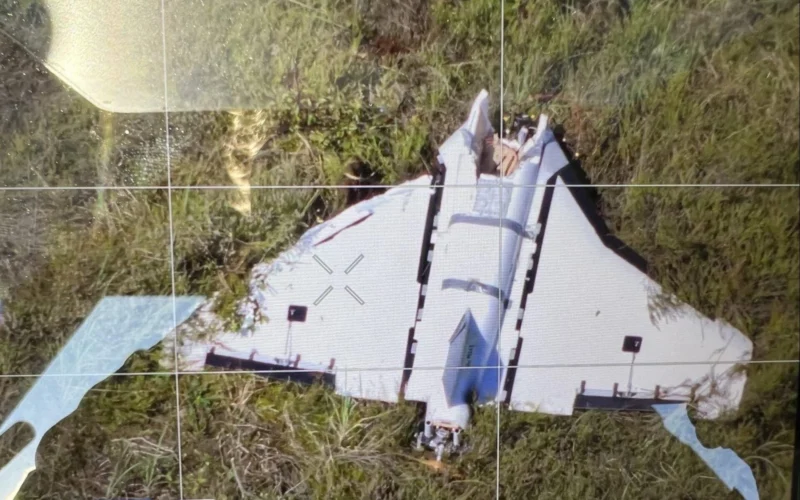
Prime Minister Inga Ruginienė said in a follow-up briefing cited by LRT that the drone that entered Lithuanian airspace and crashed in the Varėna district was a stray Ukrainian drone linked to an overnight strike operation targeting the Russian port of Primorsk. Defense Minister Robertas Kaunas said the drone had likely been disrupted by electronic warfare and flown below roughly 300 meters, which is why it was not detected by either Belarusian or Lithuanian systems.
On March 23, 2026, a swarm of Ukrainian drones targeted Russia’s Baltic oil export infrastructure, halting operations at the major ports of Primorsk and Ust-Luga. While Ust-Luga later resumed operations after the alert was lifted, neighboring Primorsk remained shut following the strikes. Footage shared online early on March 24, 2026, appeared to show heavy smoke still hanging over the Primorsk port area.
The oil terminal in Russia's Primorsk, Leningrad region, remains on fire more than a day after a Ukrainian drone attack that damaged fuel storage tanks and loading infrastructure. Primorsk is Russia's largest Baltic Sea oil export hub and the endpoint of the Baltic Pipeline… pic.twitter.com/Gvof7QpWOR
— Aleksandar Djokic (Александар Джокич) (@polidemitolog) March 24, 2026
Lithuanian authorities are investigating after an unidentified object, believed to be a drone, exploded overnight near the village of Lavys in the Varėna district, close to the border with Belarus.
The Lithuanian Armed Forces said preliminary information suggests the object may have crossed into Lithuanian airspace before crashing into a lake in the area. Emergency services and the military were dispatched to the scene, and authorities activated plan “Skydas” (Shield), Lithuania’s standard response protocol for incidents involving possible explosives or hazardous objects.
Debris found, but many questions remain
Lithuanian Minister of National Defense Robertas Kaunas said the object crossed into Lithuanian territory and crashed around 23 kilometers from the state border. He said there is no danger to public safety and that all relevant institutions, including the police, fire and rescue services, and the Lithuanian Armed Forces, are working at the scene.
Kaunas said the likelihood of similar incidents remains high as long as Russia’s war against Ukraine continues. He argued that Lithuania must accept this “new reality” without using it as an excuse, and instead move faster to strengthen its air-surveillance and air-defense capabilities. He also urged residents to remain vigilant, avoid touching debris, and report suspicious objects to emergency services.
According to Lithuanian public broadcaster LRT, surveillance camera footage indicates the incident occurred at 03:04 local time on March 23, 2026.
Lithuanian Armed Forces say a suspected drone crashed in Lithuania -NATO territory- near the border with Belarus, after crossing into Lithuania near Varena district. In a video of the crash obtained by LRT, it sounds similar to Shahed or Gerbera drones used extensively by Russia pic.twitter.com/ZRSe6E6I9L
— Augustinas Šemelis (@a_semelis) March 23, 2026
Speaking during an evening press briefing, Lithuanian Armed Forces representative Major Gintautas Ciunis said investigators had recovered debris, including an internal-combustion engine, metal fragments, and plastic parts. He said the hole in the lake ice appeared consistent with an explosion, making it reasonable to suspect the object was a drone, though its exact type will only be confirmed once the investigation is complete.
Ciunis also said no explosives had yet been found at the site, but cautioned that this does not mean the object was not carrying them before impact. Recovery efforts have been slowed by unstable ice conditions on the lake, and debris collection may continue on March 24, 2026.
One of the most significant details to emerge from the military briefing is that the object was not detected by Lithuania’s main airspace-surveillance radars. Ciunis also said, to the military’s knowledge, border guards did not spot it either. He said the most likely assumption, given the location, is that the object came from Belarus, although that has not yet been confirmed by the investigation.
Gerbera drones, originally developed as a decoy designed to overwhelm and saturate enemy air defenses by mimicking the radar signature of Shahed loitering munitions, are generally built from largely non-metallic materials such as plywood and plastic foam, a construction that gives them a very small radar signature and makes them harder to detect with conventional air-surveillance radars.
Prime Minister Inga Ruginienė said she will convene a meeting of Lithuania’s National Security Commission at 10:00 on March 24, 2026, to review the circumstances of the incident. She added that there is no current threat to public safety.
Latest in a series of airspace security incidents
The Varėna explosion is the latest in a series of incidents that have exposed Lithuania’s vulnerability to low-flying aerial threats approaching from Belarus. In July and August 2025, Lithuania registered two Gerbera drones crossing over from Belarus, one of which carried an explosive warhead. Remains of a similar drone were found on the Baltic coast of Latvia on September 18, 2025.
These incidents prompted renewed calls from Vilnius for stronger NATO air defense measures on the Alliance’s eastern flank. Lithuanian officials also acknowledged at the time that low-altitude targets of this kind are difficult to detect consistently, voicing concerns about gaps in the country’s layered air-defense network.
Lithuania has faced other airspace-related provocations in recent months. In October 2025, the defense ministry said a Russian Su-30 fighter and Il-78 tanker briefly crossed into Lithuanian airspace near the Kaliningrad border, triggering a NATO response.
Separately, repeated balloon incursions from Belarus between October and November 2025 disrupted around 320 flights and caused more than €750,000 in losses to Lithuanian airports, according to state airport operator LTOU.