

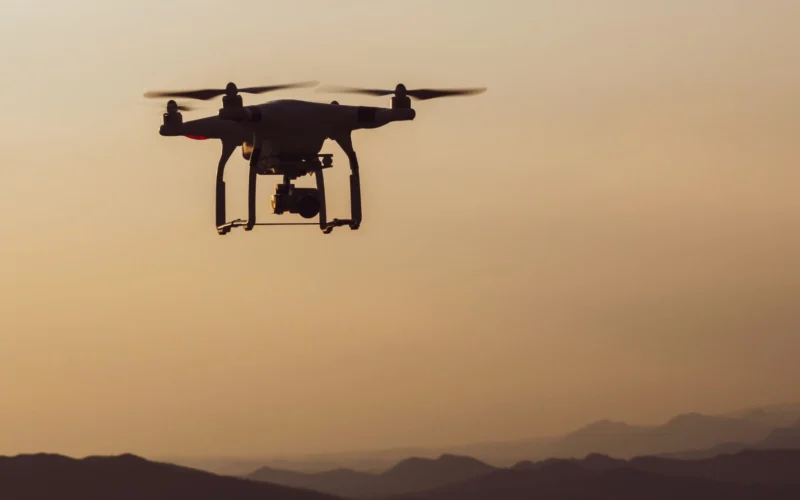
Drones equipped with ground-penetrating radar could one day help to locate water beneath the surface of Mars, according to new research from the University of Arizona.
A team from the university’s Lunar and Planetary Laboratory tested the technology by flying radar-equipped drones over debris-covered glaciers in Alaska and Wyoming. The flights demonstrated that drones can map the thickness of rocky material sitting on top of buried ice, a capability that could guide future drilling missions on the Red Planet.
The study was published on April 28, 2026 in the Journal of Geophysical Research: Planets.
Why drones?
Ground-penetrating radar has been used on glaciers before, but typically on clean ice where the surface is visible. Imaging through layers of rock and debris is more difficult, and orbital spacecraft lack the resolution to measure exactly how deep the covering material runs.
Drones can solve this problem by flying much closer to the surface, capturing data at far higher resolution than satellites are capable of.
“If you want to make decisions about where to drill on Mars, you need to know if the ice you’re trying to find is under one meter of debris or 10,” said Roberto Aguilar, a doctoral researcher at the Lunar and Planetary Laboratory and lead author of the study. “That’s the kind of information a drone-based system could provide.”
NASA has already proven that aerial vehicles can operate on Mars. The Ingenuity helicopter, which landed aboard the Perseverance rover, completed more than 70 flights between 2021 and 2024. Future drone missions could build on that success by carrying instruments designed to scout for resources.
Learning to fly with radar
The Arizona team spent weeks in the field refining how drones should operate when carrying ground-penetrating radar. Flights took place over debris-covered glaciers in Alaska and Wyoming, where years of prior research had already provided data on ice thickness and composition.
“We already knew ground-penetrating radar works, but this was the first time we mounted it to drones and tested how we could put it into practice,” Aguilar said. “For instance, we learned at what altitude and speed the drone should fly, as well as the importance of flying in the direction of the glacier’s flow, and how to make sure the radar was properly aligned to detect the ice.”
The team validated its radar readings by comparing them with data from excavating and drilling into the glaciers. The measurements matched, thereby confirming that the method works.
Scouting for ice on Mars
Satellite images have revealed debris-covered glaciers on Mars, located in mid-latitude regions roughly halfway between the equator and the polar ice caps. Some sit in craters filled with ice and later buried by dust. Others formed in valleys or mountainous areas where rockfall shielded the ice beneath.
Drones could scout these sites before astronauts arrive, identifying locations where ice lies closest to the surface. Instead of drilling blindly through layers of rock and dust, mission planners could then target the most accessible deposits.
Water ice on Mars could serve multiple purposes: supplying drinking water and oxygen for astronauts, supporting agriculture, and preserving a record of past climate conditions that researchers could study for signs of ancient life.
The drone radar also detected internal layers within the glaciers, which represent different periods of ice accumulation over centuries or millennia. Similar layers on Mars might offer insights into the planet’s climate history.
Fieldwork challenges
The university revealed that testing the technology was not always comfortable. In Alaska, researchers hauled equipment through swarms of mosquitoes and rough terrain. In Wyoming, the team sometimes hiked across boulder fields to reach targets higher on the glaciers.
“It’s not fun walking on those rocks,” Aguilar said. “That’s why it’s better to fly a drone.”