
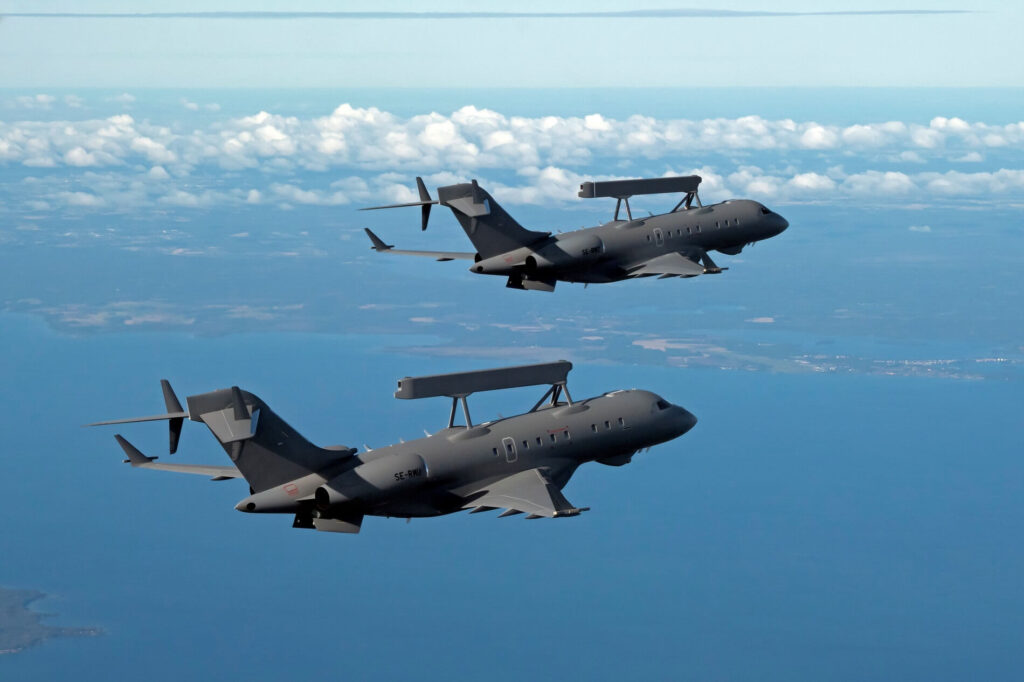
Saab has signed a memorandum of understanding with Canadian artificial intelligence company Cohere to explore AI applications linked to the GlobalEye airborne early warning and control aircraft, adding a new technology angle to the Swedish group’s campaign in Canada.
The company said on March 23, 2026, that the agreement is tied to its GlobalEye offer for Canada but could also support existing and future international operators of the platform.
According to Saab, the partnership will look at data-driven mission support, maintenance tools, and information processing, with a particular focus on on-premises integration in secure and complex aerospace environments. The company said initial pilot projects have already been identified, suggesting the cooperation is meant to move quickly into practical applications.
“Canada offers outstanding industrial and advanced technology partners,” said Micael Johansson, President and CEO of Saab. “Working with Canadian companies like Cohere on emerging technologies strengthens our global supply chain and enhances Saab’s international competitiveness.”
Another piece of Saab’s Canada pitch
The announcement comes as Saab continues to press its case in Canada, where it has argued that local production of Gripen fighters and GlobalEye aircraft could support more than 12,000 jobs, with expanded Canadian industrial participation stemming from Bombardier’s Global business jet family, the platform on which GlobalEye is based.
Saab has also floated a longer-term role for Canada in future combat aviation. The company has said Ottawa could potentially contribute to Sweden’s Koncept för Framtida Stridsflyg, or KFS, a national effort launched in 2023 to shape next-generation air combat capabilities across crewed and uncrewed systems. In that context, the Cohere agreement strengthens the company’s message that a Canadian partnership could eventually extend into future air combat development.
Saab widens its AI push
The Cohere deal also fits into Saab’s broader AI push. In June 2025, the company said it had completed Gripen E flight tests with Helsing’s AI agent controlling the aircraft during beyond-visual-range combat scenarios over the Baltic Sea. Those trials focused on autonomous decision-making in flight.
Saab’s AI work is not limited to its own platform. In Germany, the company’s Arexis electronic warfare suite for the future Eurofighter EK variant is also being paired with Helsing’s Cirra AI software, which is intended to help detect, classify, and respond to hostile emitters in real time.