

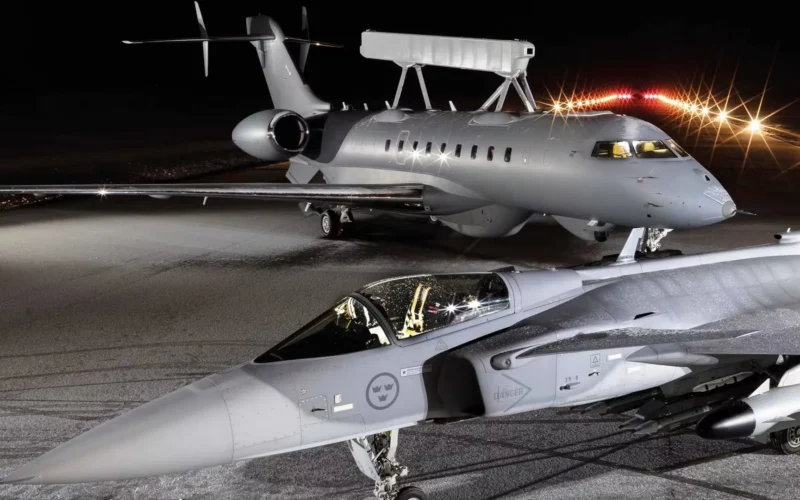
Swedish defense company Saab says it could support up to 12,600 jobs in Canada by localizing production of its Gripen fighter jet and GlobalEye airborne surveillance aircraft, as Ottawa continues to review its future fighter plans.
According to reporting by The Globe and Mail, Saab has presented Canadian officials with an industrial proposal that would see both aircraft assembled in Canada, potentially in partnership with Bombardier. The company argues that the plan would significantly expand Canada’s aerospace workforce and strengthen domestic production capacity.
The proposal comes as the Canadian government reassesses its planned purchase of 88 F-35A Lightning II fighters from Lockheed Martin, a review launched earlier this year by Prime Minister Mark Carney amid cost pressures, trade tensions with the United States, and questions over industrial return.
Joly highlights industrial and security alignment
Industry Minister Mélanie Joly confirmed that Ottawa is examining Saab’s proposal and framed it within the broader Canada–Sweden aerospace and defense partnership announced earlier in 2025.
Speaking to The Globe and Mail, Joly said the Swedish offer aligned with Canada’s objective of strengthening domestic industrial capacity while working with trusted partners. She pointed to Saab’s existing cooperation with Bombardier on the GlobalEye program as a concrete example of how such partnerships could be expanded.
GlobalEye is based on Bombardier’s Global 6000 and Global 6500 business jet platforms, with Saab integrating the Erieye extended-range radar and mission systems in Sweden. Saab has suggested that additional assembly and integration work could be shifted to Canada under its proposal.
Gripen still part of Saab’s pitch

Alongside GlobalEye, Saab continues to promote the Gripen E as a candidate for Canada’s future fighter fleet, emphasizing lower operating costs, rapid maintenance, and the potential for domestic assembly and long-term industrial participation.
The renewed pitch comes despite recently disclosed Radio-Canada data showing that the F-35 significantly outscored the Gripen in Canada’s Future Fighter Capability Project evaluation, particularly in mission performance and growth potential.
Saab has not commented publicly on the evaluation scores but maintains that industrial sovereignty, supply-chain resilience, and job creation should remain central to Ottawa’s decision-making.
Balancing jobs and capability
Canada has already committed to purchasing 16 F-35s, with options for up to 72 additional aircraft, but the government has left open the possibility of adjusting the final fleet composition as part of its ongoing review.
Canada is not alone in reassessing its F-35 plans. Switzerland has recently moved to scale back its F-35 procurement after projected costs exceeded the spending envelope approved by voters in a national referendum.