
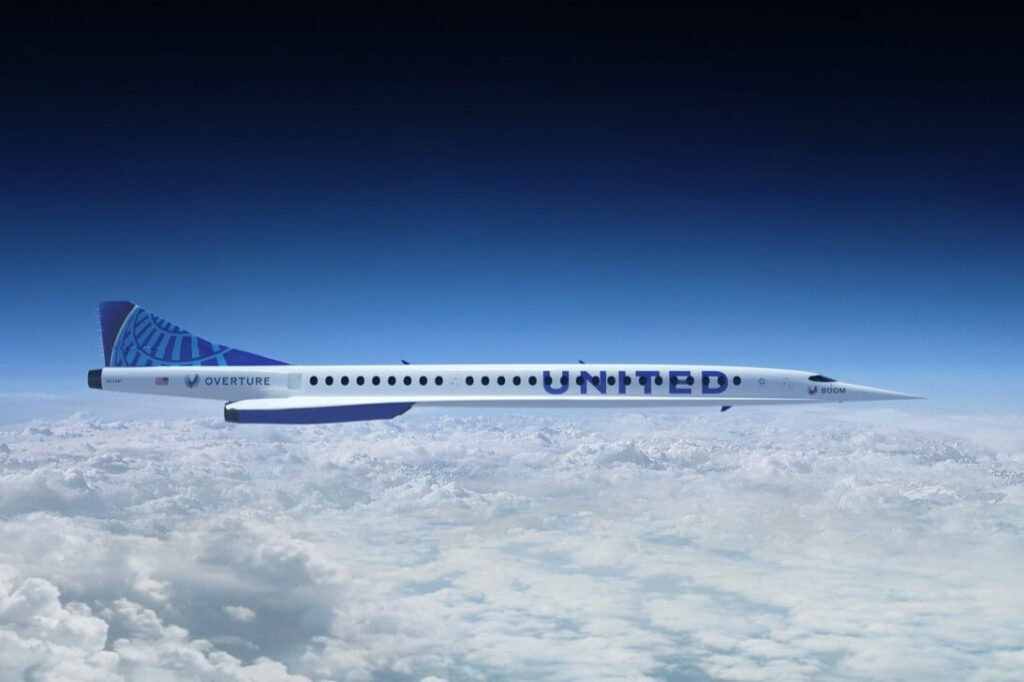
United Airlines CEO Scott Kirby says Boom Supersonic will miss its 2029 entry-into-service target for the Overture airliner, casting doubt on the timetable for an aircraft his airline has agreed to buy if it meets performance and safety requirements.
Speaking on the Office Hours: Business Edition podcast in an interview published on October 28, 2026, Kirby said development and certification would take longer than Boom has projected.
“It’s not going to happen in ’29. It’s going to take longer,” Kirby said.
Kirby said United could become the first airline to operate Overture if the program succeeds, but cautioned that significant hurdles remain and success is far from guaranteed. He also praised Boom founder and CEO Blake Scholl, including the company’s expansion into turbines that generate electricity for data centers.
United announced its agreement with Boom in June 2021, covering 15 Overture aircraft and options for another 35. The purchases depend on the aircraft meeting the airline’s safety, operating and sustainability requirements. At the time, the companies outlined plans for a rollout in 2025, a first flight in 2026 and passenger service in 2029.
Boom is developing Overture to cruise at Mach 1.7, with a range of 4,250 nautical miles and capacity for 60 to 80 passengers. Its advertised order book includes 130 orders and pre-orders from United, American Airlines and Japan Airlines. The company plans to manufacture the aircraft in Greensboro, North Carolina.
The latest engineering update concerns the propulsion technology intended to support both the airliner and Boom’s growing energy business.
On October 22, 2026, Boom announced that it had completed its first prototype turbine core, called Sprint Core. The assembly combines the compressor, combustor and high-pressure turbine, with initial firing expected before the end of November 2026 at the company’s Colorado test site.
Boom says the core will support Symphony, the engine being developed for Overture, and Superpower, a 42-megawatt natural gas turbine designed to power AI data centers. The prototype carries more than 1,000 sensors to measure its behavior during testing, Boom says.
The company has also unveiled a nearly 200,000-square-foot turbine manufacturing campus in Centennial, Colorado, representing a planned $150 million investment. Boom targets initial Superpower deliveries for mid-2027, followed by production of 25 turbines annually in 2028 and 50 in 2029.
Boom presents the energy business as a way to advance its aircraft engine in an economical way. Its Overture program page says operating experience and reliability data from Superpower will help inform Symphony’s development once the stationary turbine enters service. That puts the ground-based product ahead of the aircraft engine in the company’s stated development sequence.
The effort comes more than two decades after Concorde’s final commercial flight in October 2003. Another would-be supersonic manufacturer, Aerion, halted its AS2 business jet program in 2021 after failing to secure needed funding.
NASA is separately testing its X-59 research aircraft to demonstrate quieter supersonic flight and gather data for regulators.
The FAA has proposed replacing the longstanding US restriction on civil supersonic flight over land with a noise-based operating standard. The agency aims to finalize its supersonic operating and noise rules by mid-2027, but those changes would not replace the need to certify Overture and its engines.