

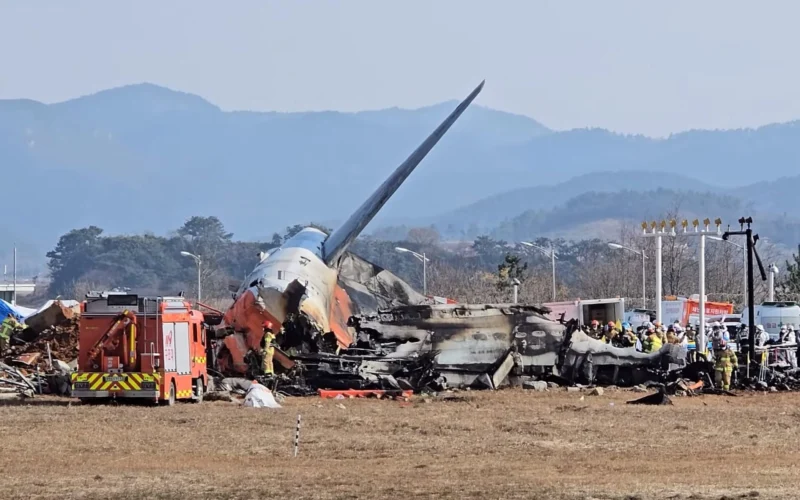
South Korea’s Aviation and Railway Accident Investigation Board (ARAIB) said in an interim report that the Jeju Air Boeing 737-800 crash at Muan International Airport (MWX) on December 29, 2024, in which 179 people died, may have resulted from the pilot mistakenly shutting down the wrong engine after a bird strike.
The findings, presented to victims’ families during a briefing at Muan Airport on July 19, 2025, reveal that the pilot mistakenly shut down the left engine, which was operating normally, instead of the right engine, which had been severely damaged by a bird strike during approach.
Critical error under pressure
Flight data and cockpit voice recordings revealed that the captain instructed to “shut down engine number two,” referring to the damaged right engine. However, investigators found that the fuel cutoff switch for engine number one, on the left, was pulled instead. The pilot then activated the fire extinguisher on the left engine, permanently disabling it from being restarted.
Both engines were later sent to France in March 2025 for detailed examination, which confirmed that the left engine had no mechanical issues and its electronic systems were functioning normally.
With the right engine already powerless due to the bird strike, shutting down the left engine caused a complete loss of thrust, leaving the crew with no available power. Investigators also confirmed that the landing gear lever had not been activated, meaning the wheels were never deployed before the aircraft performed a belly landing and crashed into a concrete embankment beyond the runway.
A preliminary report released in January 2025 had pointed to bird strikes as the likely cause after DNA from Baikal teals, a duck species common in East Asia, was found in both engines. Initial interpretations assumed that damage to both engines led to electrical and hydraulic failures. The new findings, however, indicate that while the right engine ingested birds and caught fire, the left engine failed due to an incorrect shutdown command.
Families object to findings
Families of the victims strongly objected to the conclusions, arguing that the investigation overlooks critical questions.
“The explanation by the Hangcheolhoe Committee omits key issues, such as the specific condition of the engine damage and how many birds flocked there to lead to the engine failure,” the families’ association said, according to Yonhap. “We have requested the disclosure of FDR [flight data recorder] and CVR [cockpit voice recorder] data for objective verification, but this has not been accepted so far.”
After the briefing by ARAIB, family representatives arrived at the venue for the scheduled press conference and demanded its cancellation. The commission agreed, retracted the press release that had already been distributed, and canceled the official announcement.
The Korea Civil Aviation Pilots Association also criticized the report, arguing that it focuses solely on cockpit mistakes and shields government agencies and the Korea Airports Corporation, both of which are currently under police investigation for possible negligence.
“The investigation team has clear evidence and backup data, so its finding will not change,” a source told Reuters.
The investigation will continue with a review of crew training and emergency response procedures. ARAIB has not yet announced when the final report will be published.
7 comments
Sadly not the first time this “other left” confusion arises. Could there be no interacting AI to ask the pilot “should I shut down the affected engine ?” and, with a positive reply, taking automatically the correct action ?
It’s amazing the pilots have no ability to see what is going on with the aircraft behind them. I have work on aircraft and understand how hard it is to qualify any system, but every new car has cameras that allow you to see all kinds of stuff behind you. It’s not the first accident that has occurred because the pilots misunderstood where the damage was.
While there is no doubt that human error led to the situation in which the B737 experienced a dual engine shutdown, it is important to acknowledge the commendable actions of the crew following the procedural mistake. Despite the critical failure, they successfully returned the aircraft to the airport and landed on a runway — a task that is far from easy under such circumstances.
Had the concrete wall at the end of the runway not been present, the outcome might have been very different. Whether everyone would have survived is something only a higher power can truly answer.
Going forward, I believe ICAO should re-evaluate the criteria for runway environment design. This is not the first incident in which a rigid wall — used to support the localizer antenna — has contributed to catastrophic damage. Alternative methods exist, including the use of frangible or breakaway structures that fulfill the same technical purpose while enhancing safety. Adopting such approaches could help prevent similar tragedies in the future.
This is a clear example of failure of CRM procedures. When the Capt gave command First Officer takes action and Shuts off engine only after Capt visually checks that First Officer hand is on the correct engine which needs to b shut down. Capt probably failed to cross check and FO shut off the good engine. Clear violation of training imparted in simulator. It can happen and will happen in future also as human behaviour under stress can lead to mistakes.
So easy to blame the pilot. He’s the one party unable to defend or speak for him/herself.
Engine problem 1. Verify 2. Identify 3. Pilots agree and flying pilot places his hand on the good engine . Non flying pilot verbalizes as he is closing the thrust lever . No change and then the Captain calls for the QRH checklist . Transfer control to the first Officer ! And the Captain then methodically completes the checklist . Take your time !!!!
Really a pilot error? Here a link to an interesting article taking despite being from India this point of view should be taken into account: https://www.indiatoday.in/opinion/story/story-of-the-crash-of-flight-ai-171-and-a-very-flighty-investigative-report-air-india-ahmedabad-2764682-2025-08-01