

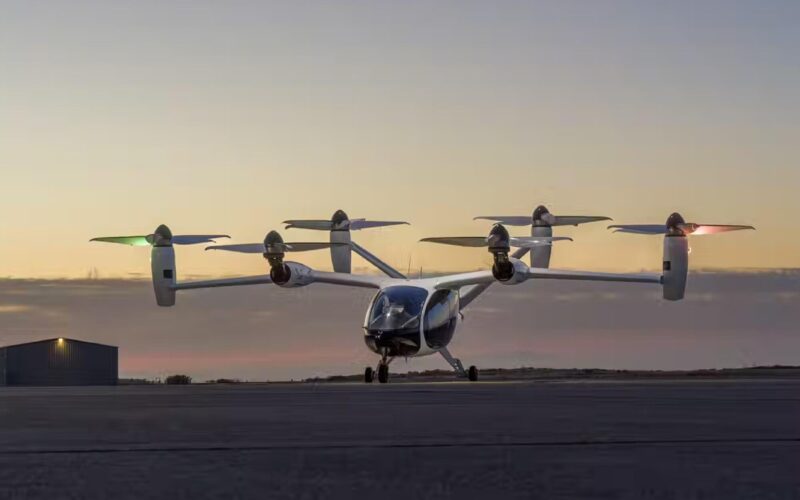
The White House has launched a federal initiative to accelerate the introduction of electric vertical takeoff and landing (eVTOL) aircraft in US cities, with Archer Aviation and Joby Aviation among the first manufacturers to confirm their participation.
The Electric Vertical and Landing Integration Pilot Program (eIPP), detailed in the Federal Register on September 12, 2025, stems from President Trump’s June executive order titled Unleashing American Drone Dominance. The Department of Transportation and the FAA will oversee at least five pilot projects, pairing aircraft developers with airlines, municipalities and state governments to test advanced air mobility operations in real-world environments.
According to Archer, it plans to use its Midnight aircraft in the program, working alongside airline partners and city governments. CEO Adam Goldstein called the initiative “a landmark moment for our industry and our country,” claiming early flights will show that air taxis can operate “safely and quietly” while helping establish US leadership in advanced aviation.
United Airlines, which invested in Archer in 2021, welcomed the move. Executive Vice President and CFO, Mike Leskinen said United saw from the start that electric air taxis could “redefine how we move our passengers in and around the cities they are departing and arriving at every day,” and that the new program brings that vision closer to reality.
Joby Aviation, which has logged more than 40,000 miles of flight testing and expanded manufacturing in California and Ohio, has indicated its readiness to demonstrate aircraft under the eIPP. Chief policy officer Greg Bowles said the company has spent “more than 15 years building the aircraft technology and operational capabilities that are defining advanced aerial mobility” and is prepared to “bring our services to communities” through early operations in participating states and cities.
US officials said the pilot projects are designed to allow limited operations before full FAA type certification, giving regulators and industry partners data on safety, performance, and public acceptance. The lessons will help regulators to create certification standards and policies for integrating eVTOLs into the national airspace.
While questions remain about infrastructure, costs and market demand, the participation of Archer and Joby gives the White House program immediate credibility. With two of the sector’s leading manufacturers engaged, the effort will provide the clearest test yet of whether eVTOLs can move from concept to practical service in the years ahead.
2 comments
I was talking to some city administrators in Long Beach, California. Long Beach is unique in that. It has plenty of space in the harbor in order to build landing platforms for VTOL aircraft. The problem was it the city administrators didn’t know what I was talking about. So.
We really have a communication issue with these type of aircraft. We need to have a VTOL Association formed if it isn’t already, that does a good job of spreading the message. Every industry that I can think of has an association who’s purpose is primarily to get out the word on behalf of the manufacturers.
I have a couple of issues that have not really been publicized.
The first is if you’re flying in a large metropolitan area in one of these vehicles, what keeps the vehicles from running into each other? Who’s going to fly them? If the weather is not good, then what happens to the service?
I know the vehicles are not very noisy, but like helicopters, the blades of the propellers are really the noisiest part of the vehicle. How quiet are they? I don’t wanna have to go before a city Council meeting with 300 angry citizens demanding that the city council do something about the noise.
Places like Seattle San Francisco, Long Beach, San Diego, and anywhere that has a large lake ocean nearby would be ideal for these type of vehicles. I imagine landing platform two or 300 yards off the beach. With Electric boat service over to a nearby PUBLIC DOCK. Once you land on the floating platform, you get on the electric boat and four or five minutes later you’re at the dock. You’ve already arranged for an Uber to pick you up and take you to your business destination.. but what happens if the fog rolls in? Will these vehicles be certified to land in 00 weather? I hate to play the devils advocate, but nobody’s talking about this or at least I haven’t read anything about it.. and I am heavily involved in aviation.
Floating offshore vertipads sounds like a version of the out of town airport with the same isolation and access issues rather than an integrated ‘seamless’ personal air mobility system as once described in the NASA SATS and PAV visions. Roadable (dual mode) air vehicles address most of the issues quoted and work on dry land ,anywhere with much higher safety and economy than VTOL if using ATOL (Assisted..) and a much less onerous infrastructure than needed for Uber connected multi modal schemes. Anti collision systems and HITS type autonomous ATC will be neccessary for any significant traffic volume and poor weather operation (reverting to road travel at worst )
Being Devil’s advocate is essential to avoid another fiasco like the VLJ scheme and certainly others are talking about the shortcomings of proposed aircraft and operations (mostly in journals like RAeSoc Aerospace and Linkedin forums, design websites etc but the hype machine is far more effective and visible on media who are uncritical and uninformed. ( starry eyed investors are fueling the money tsunami behind it not experienced experts )
It is good to question (and receive answers) to the unspoken -(in media) – concerns of engineers and pilots who are
independently analyzing the shortcomings of the highly publicized eVTOL PR blitz so do not feel bad for noticing the emperor’s nakedness.