

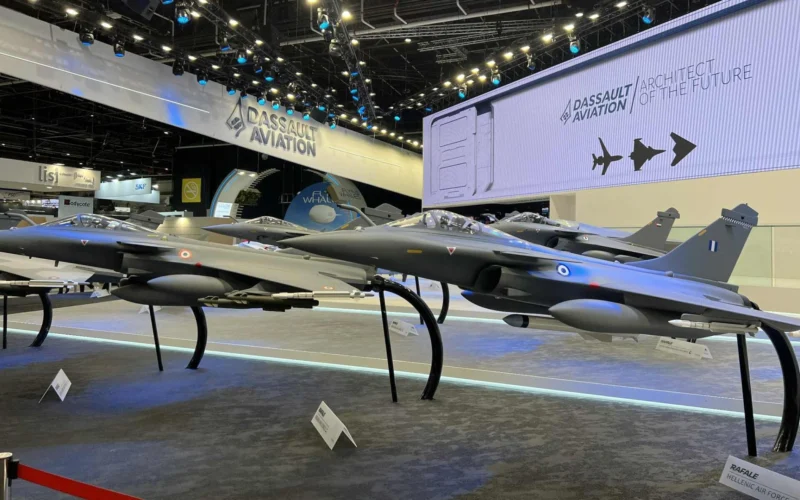
China’s attempt to exploit the May 2025 India-Pakistan clash to undermine the Rafale fighter has now been formally documented in a US congressional report, confirming allegations first raised by French intelligence earlier this year.
The 2025 Annual Report of the US-China Economic and Security Review Commission (USCC) described a coordinated effort by Beijing to use the four-day conflict as both a live-fire demonstration of Chinese systems and an information campaign targeting Dassault’s flagship fighter.
The assessment aligns with reporting by intelligence sources and defense officials, which detailed how Chinese diplomatic officials and online networks amplified claims that Pakistan had downed multiple Indian Rafale jets using Chinese-built weapons.
Operation Sindoor becomes a marketing campaign
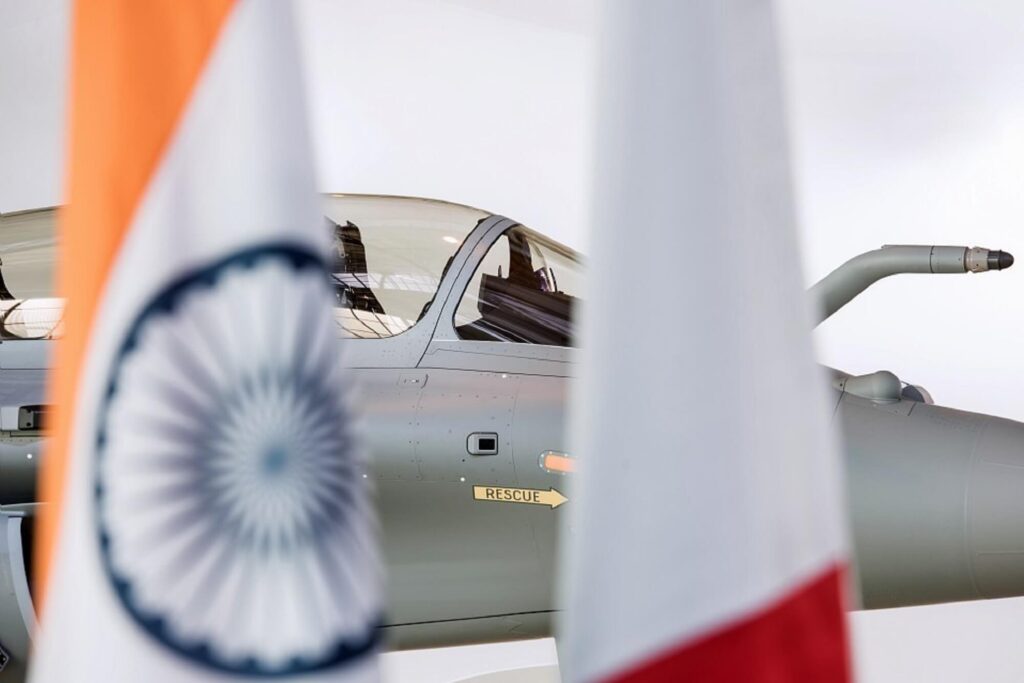
According to the commission, the confrontation between India and Pakistan from May 7 to 10, 2025, triggered by the Pahalgam terrorist attack a month prior, provided China with the first real combat outing for several key systems, including the HQ-9 air defense system, PL-15 beyond-visual-range missile, and J-10 fighters.
Pakistan, which sources more than 80% of its defense imports from China, leaned heavily on these systems as it responded to India’s Operation Sindoor airstrikes.
Islamabad initially claimed that five Indian aircraft were shot down, including three Rafale jets. While Indian authorities have not confirmed any Rafale loss, open-source assessments point to at least one.
The US report notes that only three Indian aircraft were likely downed in total, and “all may not have been Rafales”. In July 2025, French Air and Space Force Chief of Staff General Jérôme Bellanger had reported having received evidence indicating that India lost three aircraft during the operation: a Rafale, a Sukhoi, and a Mirage 2000.
But this did not prevent Beijing from framing the episode as a demonstration of Chinese technological superiority.
China targets Rafale exports
The USCC cites French intelligence in outlining how Chinese embassies and state-directed online networks used the incident to disparage the Rafale.
According to the report, Chinese [and Pakistani – ed. note] officials pushed AI-generated and video game imagery of supposed Rafale debris, presented as battlefield evidence to prove that Western fourth-generation fighters were outmatched by cheaper Chinese systems.
Welp.
— OSINTtechnical (@Osinttechnical) May 9, 2025
Thats the official Pakistani government account posting ARMA 3 game footage and claiming it’s real. pic.twitter.com/uqsUJrTLGi
A notable example was amplified by Zhao DaShuai, identified as part of the People’s Armed Police Propaganda Bureau, who shared a fabricated CNN-branded graphic reporting supposed Indian losses, including two Rafale jets. The network later confirmed the image was fake.
Losses from the Pakistan-India conflict, according to a 3rd party perspective, CNN.
— Zhao DaShuai 东北进修🇨🇳 (@zhao_dashuai) May 12, 2025
It's clear which side won. pic.twitter.com/QBqa6J1fid
Beijing then leveraged these narratives directly in arms-sales diplomacy, particularly in Southeast Asia. One of the report’s most striking claims is that Chinese embassy officials persuaded Indonesia to pause a Rafale purchase already “in process.”
Jakarta, which has a binding contract for 42 Rafale jets and has activated all tranches, has not signaled any reversal. But its subsequent decision to also acquire Chinese J-10C fighters suggests that the reported disinformation push targeting the Rafale may have had an effect.
Fighter contracts at stake
The USCC’s framing suggests that China’s objective was not necessarily to displace Rafale contracts already underway, but to sow doubt among undecided buyers and muddy the aircraft’s reputation at a sensitive moment in multiple export campaigns.
While reporting positive feedback from India following the operation, Dassault Aviation CEO Éric Trappier, speaking before the French Senate, said such disinformation campaigns can interfere with marketing efforts.
“[Current or future operators] know these claims are fake,” Trappier commented. “They can, however, bother us in prospecting campaigns.”
The report also comes against the backdrop of a July 2025 incident in Greece, where authorities arrested four Chinese nationals near Tanagra Air Base, home to the Hellenic Air Force’s Rafale jets, on suspicion of photographing restricted areas. The case suggests Beijing is paying close attention to Rafale operators.
With major fighter competitions underway in India and the Middle East, the information war surrounding the Rafale is unlikely to end.