

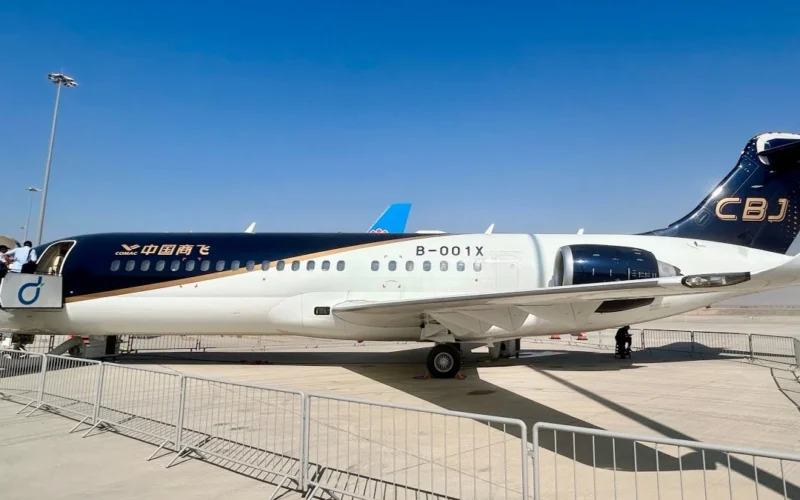
China is getting serious about marketing its homegrown large-cabin private jet after the Comac Business Jet (CBJ) appeared in VIP form at the Dubai Airshow 2025 for the first public display anywhere. A polished cabin walkthrough video posted on YouTube shows the C909-based aircraft positioned squarely against Gulfstream and Bombardier, even as questions remain over who the buyers for Comac’s twinjet might be outside of China.
The CBJ is a new VIP derivative of Comac’s 90-seat ARJ21-700 regional jet, which the manufacturer has rebranded as the C909 as part of a broader marketing push. China’s Civil Aviation Administration (CAAC) validated the type in 2021, but none of Comac’s jets has certification from EASA or the FAA, effectively limiting operations to China and a small group of partner states for now.
In business jet guise, the CBJ targets typical layouts of 12 to 19 passenger seats, with a high-density cabin option for up to 29 seats. The aircraft uses a pair of GE CF34-10A engines and offers about 2,700 nautical miles of range with eight passengers at around 520 knots, with a ceiling of 39,000 feet. Performance figures put it well short of ultra-long-range competitors such as Gulfstream’s G800 or Bombardier’s Global 8000, which advertise ranges close to 8,000 nm, but the CBJ occupies a similar large-cabin size.
Comac has designed five standard VIP layouts that trade off lounge space, meeting areas and seat count. All include a dedicated VIP suite with a double bed and private lavatory, lie-flat first-class seats in a reception zone, and a meeting/dining area around an eight-seat table. The company quotes cabin noise levels as low as 55 dB in the suite, with less than 65 dB elsewhere, and the jet offers high-speed broadband via phased-array satellite equipment, Comac said.
The recent YouTube walkthrough leans heavily into that hardware. Viewers are taken through a sequence of lounge areas, the bedroom suite and galley, with close-ups of materials, lighting, and cabin monuments that echo Western completions more than traditional “airliner-VIP” conversions. The video also highlights practical touches such as fold-out air stairs and integrated connectivity, signaling that Comac wants the CBJ to be seen as a purpose-designed business jet rather than simply a stripped-down regional jet with an upgraded interior.

Price is one of Comac’s strongest talking points. Industry reports and recent ARJ21/C909 sales suggest a basic list price of around $38 million per airframe, depending on interior finish. By comparison, published list or equipped prices for a Gulfstream G800 and Bombardier Global 8000 cluster in the low- to high-$70 million range. On paper, that makes the CBJ roughly half the price of the Western ultra-long-range flagships it mimics visually, albeit with about one-third of the range.
Despite “Made in China” branding, the aircraft carries substantial Western content. The CBJ uses US-produced engines and lists suppliers such as Rockwell Collins (avionics), Liebherr (air systems and landing gear), Parker, Hamilton Sundstrand, Eaton, Kidde and Goodrich for major systems and structures.

Still unclear is the potential size of the market for the CBJ. China’s private jet fleet has actually shrunk in recent years; data show the number of business jets based in mainland China, Hong Kong, and Macau has fallen by about a third from a 2017 peak, as a weaker economy and anti-corruption drives reduced demand for high-profile corporate aircraft. Beijing’s “common prosperity” push and ongoing crackdowns on ostentatious wealth have also cooled enthusiasm for highly visible status symbols such as large private jets.
That suggests the initial market for the CBJ may not be China’s tycoons, but state-linked buyers and corporations that can frame the aircraft as a practical transport tool rather than a luxury toy. Potential customers include large state-owned enterprises, regional governments, and charter/airline operators that already fly the C909 in passenger service and want a VIP variant for senior delegations. Comac has delivered more than 170 ARJ21/C909s to Chinese and Southeast Asian airlines, giving it a base of operators and maintenance providers that could support CBJ deployments.
Outside China, the aircraft may appeal to governments and charter operators in friendly states that face sanctions risk, financing hurdles, or certification delays when sourcing Western business jets. Russia, parts of the Middle East, and some partner countries are likely targets. But without FAA or EASA certification, the CBJ will remain a tough sell for US and European corporate flight departments.