

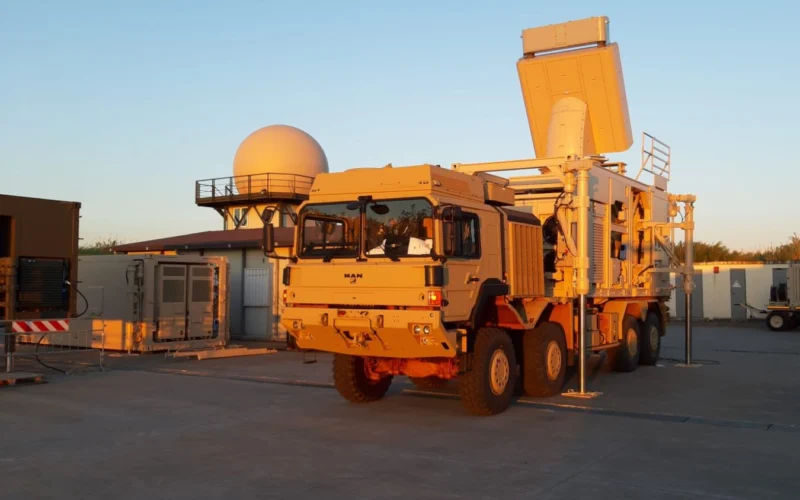
Leonardo, Italy’s state-controlled aerospace and defense group, has been selected to develop and deliver the first four next-generation radars for Italy’s long-range ballistic missile defense, the company announced on December 18, 2025.
The contract was awarded by TELEDIFE, the Directorate of Telecommunications, IT and Advanced Technologies of the Italian Ministry of Defence, and covers the development and delivery of two Ground Based Radars (GBR) and two Mobile Long Range Radars (MLRR).
According to Leonardo, the systems are designed to detect, track and identify ballistic threats at ranges of up to 3,000 kilometers (1,864 miles). The radars will form part of Italy’s future long-range air and missile defense architecture and represent the country’s first national capability dedicated to long-range ballistic missile detection.
AESA GaN radars, fixed and mobile
The GBR and MLRR are both fully digital active electronically scanned array (AESA) radars, using gallium nitride (GaN) technology. Leonardo say that the use of GaN is intended to improve power efficiency, detection range and reliability compared with earlier radar generations.
Leonardo stated that the radars will provide early warning and tracking data and will be able to cue fire-control radars and interceptors within an open-architecture command and control environment. The systems are designed to operate in a multi-domain setting, integrating with other sensors and effectors across air and missile defense networks.
Linked to Michelangelo Dome and SAMP/T NG
The radar contract is positioned by Leonardo as a key element of its Michelangelo Dome concept, an integrated air and missile defense architecture unveiled by the company in November 2025. The company has described Michelangelo Dome as a multi-layered approach intended to protect national territory and critical infrastructure against a range of aerial threats, including ballistic missiles.
Leonardo linked the radar award to recent progress on the SAMP/T Next Generation program, which is being developed by the Franco-Italian Eurosam consortium, bringing together MBDA and Thales. Earlier in December 2025, MBDA confirmed successful qualification firings of the SAMP/T NG system for both the Italian and French variants.
No delivery timeline or contract value has been disclosed as yet.