

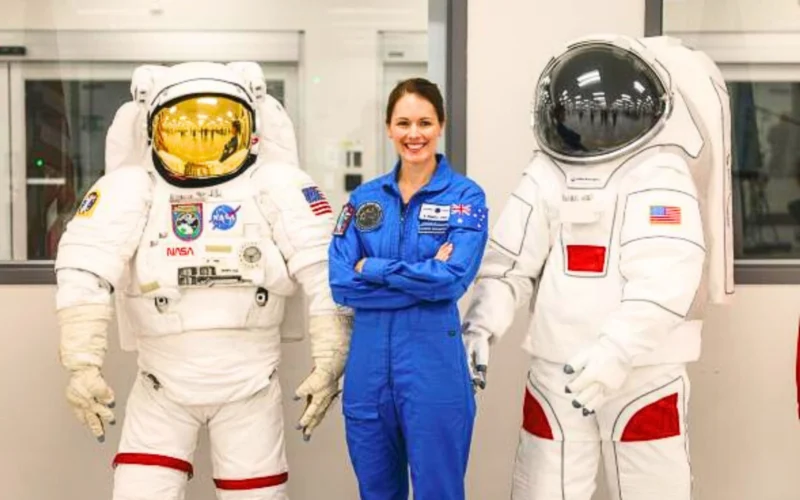
Katherine Bennell-Pegg, Australia’s first qualified astronaut, received the nation’s highest civilian honor on the night of January 25, 2026, when Prime Minister Anthony Albanese presented her with the 2026 Australian of the Year award.
The 41-year-old South Australian aerospace engineer made history in April 2024 when she graduated from Basic Astronaut Training at the European Astronaut Centre in Germany, becoming the first person to train as an astronaut under the Australian flag.
She was also the first international candidate to complete the program alongside a class of five European Space Agency (ESA) astronaut trainees.
Though Bennell-Pegg has yet to travel to space, her journey to the astronaut corps began with a childhood dream that she refused to compromise. When asked in high school to list three career options, she wrote down only one – astronaut – and declined to add alternatives.
“I have always dreamed of being an astronaut,” Bennell-Pegg said in a previous statement. “When I was young, it was for adventure, but after more than a decade working in space, it’s now because I know the role it plays in tackling real-world problems and developing new knowledge that can benefit our society, environment, and science.”
From dream to reality
Bennell-Pegg’s path to becoming an astronaut was methodical and demanding. With her parents’ encouragement, she researched the requirements early and built a resume tailored to space exploration. Her final year of high school included math, physics, chemistry, English, and economics, supplemented by aerobatic flying lessons, amateur astronomy, sports, and debate.
She graduated from the University of Sydney in 2007 with dual degrees: a Bachelor of Engineering with honors in Aeronautical Engineering (space) and a Bachelor of Science in Physics. During her studies, she juggled internships as a mechanical engineer, physics researcher, and computer programmer while serving as an Australian Army Reservist and volunteering with the New South Wales State Emergency Service. She also traveled to India with Engineers Without Borders.
Over the next decade, Bennell-Pegg worked across Europe on human spaceflight missions, International Space Station facilities, debris removal concepts, Earth observation programs, and space exploration missions. She and her husband, spacecraft systems engineer Campbell Pegg, had two daughters during this period before the family returned to Australia in 2019 to join the newly established Australian Space Agency.
Beating 22,500 applicants
Bennell-Pegg was appointed director of space technology at the agency in 2022, but her ambition to become an astronaut persisted. In 2021, leveraging her dual UK citizenship, she responded to the European Space Agency’s call for astronaut recruitment and emerged as one of just 25 candidates selected from more than 22,500 applicants.
She began Basic Astronaut Training in Germany in 2023, balancing the rigorous program with her role advocating for Australia’s space sector. She regularly presents to school groups and industry leaders, using her platform to inspire students to pursue careers in science, technology, engineering, and mathematics (STEM).
“I want to use this experience to open doors for Australian scientists and engineers to utilize space for their discoveries, to inspire the pursuit of STEM careers, and show all Australians that they too can reach for the stars,” she said.
National Australia Day Council CEO Mark Fraser praised Bennell-Pegg as someone “forging new frontiers for Australian space engineering, research and exploration.”
“She leads by example, openly sharing her story to inspire the next generation and reminding us all of the power of a dream, and where determination can lead,” Fraser said.
Bennell-Pegg’s recognition comes at a pivotal moment for Australia’s space ambitions as the nation works to establish itself as a credible player in the global space industry. Her achievement opens pathways for future Australian astronauts and demonstrates the country’s growing commitment to space exploration and research.