

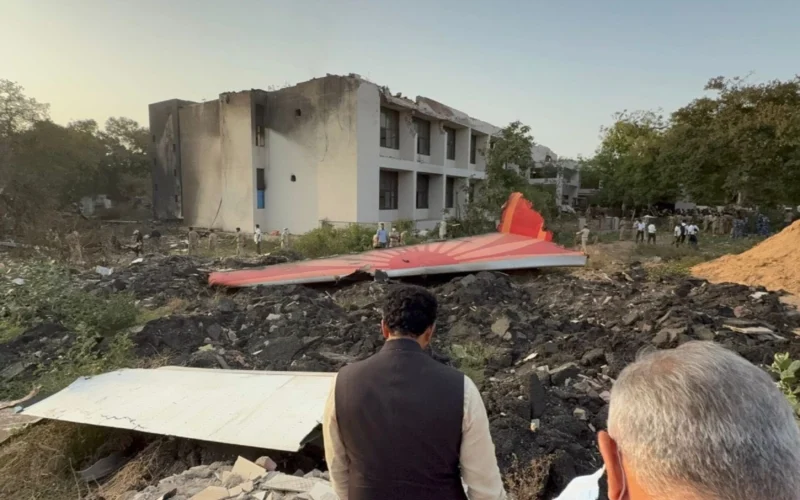
A US-based aviation safety advocacy group says the Boeing 787 Dreamliner involved in last year’s fatal Air India crash had a long and troubling history of technical problems, a claim that will now be examined by a US congressional committee and is adding pressure to an investigation already under intense scrutiny.
The group, the Foundation for Aviation Safety, alleges the aircraft experienced repeated electrical and systems failures over several years before it crashed shortly after takeoff from Ahmedabad on June 12, 2025, killing 260 people. India’s Aircraft Accident Investigation Bureau is leading the inquiry, with US participation because the aircraft and its engines were designed and built in the United States.
The Foundation for Aviation Safety, or FAS, is not a regulator or investigative authority. It is an advocacy group led by Ed Pierson, a former senior manager at Boeing’s Renton factory who has publicly criticized the company’s safety and quality-control practices for several years. The organization says it focuses on identifying systemic risks in commercial aviation and pressing regulators and lawmakers to address them.
In January 2026, FAS submitted a package of materials related to the Air India aircraft to the US Senate Permanent Subcommittee on Investigations. According to the group, the submission was intended to raise concerns about aircraft safety oversight and Boeing’s internal reporting practices, rather than to assert a cause of the crash.
The submission does not represent sworn testimony and is not part of a formal congressional investigation. Lawmakers have not publicly validated the claims or announced new hearings tied specifically to the Air India accident. Congressional submissions of this kind function as briefings or requests for oversight attention, not findings of fact.
FAS says its concerns are based on a review of maintenance records, incident reports, and regulatory filings related to the aircraft, registered VT-ANB. The jet was among the earliest Boeing 787s built, entering service with Air India in early 2014 after its first flight the previous year.
According to the group, those records show a pattern of recurring electrical and systems issues during the aircraft’s service life. FAS alleges the aircraft experienced software faults, repeated circuit breaker trips, wiring damage, short circuits, power losses, and overheating electrical components. The most serious claim involves a January 2022 incident in which a fire allegedly broke out in a P100 power distribution panel during descent into Frankfurt, requiring the panel’s replacement.
FAS has not released the underlying documents publicly, and the claims have not been independently verified by investigators or regulators. Air India has not commented in detail on the group’s assertions, and the AAIB has not said whether the aircraft’s prior maintenance history played any role in the accident.
The group says its review extends beyond the single aircraft involved in the crash. FAS claims it examined roughly 2,000 reports of issues across hundreds of Boeing 787s operating in the United States, Canada, and Australia. Some of those reports, including concerns about water intrusion into electrical bays, have been acknowledged previously by the US Federal Aviation Administration.
The Boeing 787 relies more heavily on electrical systems than earlier airliners, having replaced many mechanical and pneumatic functions with electrically powered systems to reduce weight and improve efficiency. That design approach drew scrutiny early in the aircraft’s life, including a global grounding in 2013 following lithium-ion battery fires. Boeing redesigned several systems afterward, including power distribution components.
Boeing has consistently stated that the 787 has a strong operational record. Prior to the Ahmedabad crash, the model had flown for nearly 15 years without a fatal accident.
Investigators have not determined the cause of the Air India crash. A preliminary AAIB report released one month after the accident described fuel control switches moving to the cut-off position shortly after takeoff, but did not assign responsibility or identify whether the movement resulted from human action or a technical malfunction.